Best UPSC and MPPSC IAS Coaching Classes in Gwalior

Building India’s New Business Framework

Building India’s New Business Framework   1. India recorded an approximate 27 percent increase in active registered companies, rising from 1.55 lakh in 2020–21 to 1.98 lakh in 2025–26 as on 3 February 2026. 2. The Union Budget 2026–27 proposed digital trade facilitation, tax certainty, reduced compliance burden, lower litigation, trust-based customs systems, and an investment-friendly tax regime to strengthen business conditions. 3. Institutional reforms highlighted include Startup India, credit guarantee schemes, and digital credit assessment models, all aimed at creating a transparent, technology-enabled, investor-friendly, and growth-oriented business ecosystem. 4. Regulatory reforms such as the Jan Vishwas Act, Insolvency and Bankruptcy Code, and MAT-related measures were designed to improve regulatory coherence, capacity-building, accountability, and trust-based governance. 5. Ease of Doing Business reforms were launched as part of a long-term government programme focused on making India more attractive for investment, enterprise formation, and sustained economic growth. 6. The Indian business ecosystem was described as stronger and more efficient, supported by reforms that empowered entrepreneurs, reduced procedural barriers, and expanded opportunities within a growth-oriented environment. 7. The RBI’s Business Expectations Index remained above the neutral benchmark of 100 through FY 2024–25 and into July–September quarter of FY 2025–26, indicating continued positive business sentiment. 8. Positive readings in the Business Expectations Index reflected confidence among firms regarding future output, employment generation, investment activity, demand conditions, and broader industrial growth prospects in India. 9. The government identified improvement of the business environment as a strategic priority to attract investment, stimulate enterprise, encourage innovation, and accelerate national economic growth through reform. 10. The reform approach focused on legislative and regulatory restructuring, streamlined procedures, and removal of redundant compliances to build a more transparent, efficient, predictable, and business-friendly ecosystem. 11. Ease of Doing Business now stands as a central pillar of India’s reform agenda, with sustained policy measures reinforcing investor confidence and improving India’s competitiveness as a business destination. 12. India’s reform-driven growth strategy emphasized entrepreneurship promotion, wider access to finance, modernization of regulatory frameworks, and stronger trade facilitation as key pillars of business ecosystem improvement. 13. Under Startup India, eligible companies can obtain DPIIT recognition and access tax incentives, simplified compliance procedures, fast-tracked intellectual property processing, and broader regulatory support mechanisms. 14. As of February 2026, India had over 2.16 lakh DPIIT-recognised startups, placing the country firmly among the world’s largest and most dynamic startup ecosystems globally. 15. Startup-related regulatory reforms initiated since 2016 were aimed at improving ease of doing business, easing capital raising, reducing compliance burden, and strengthening the broader startup ecosystem. Must Know Terms : 1. JanVishwas Jan Vishwas refers to the Jan Vishwas Amendment of Provisions Act 2023. It decriminalised 183 provisions across 42 Central Acts administered by 19 ministries and departments. The law replaced imprisonment for many minor technical or procedural defaults with monetary penalties and administrative action. Its main objective was to strengthen trust based governance and improve ease of living and business conditions in India. 2.DPIIT DPIIT stands for the Department for Promotion of Industry and Internal Trade under the Ministry of Commerce and Industry. It handles Startup India recognition, industrial policy, investment facilitation, and several business reforms. DPIIT recognition allows eligible startups to access tax benefits, simpler compliance processes, and faster intellectual property support. The department also plays a central role in improving India’s investment and enterprise climate. 3.EoDB EoDB means Ease of Doing Business. It refers to reforms that make starting, operating, and expanding businesses simpler, faster, and more predictable. In India, EoDB covers compliance reduction, digital approvals, contract enforcement, trade facilitation, and regulatory simplification. Recent measures linked with it include digital trade systems, tax certainty, reduced litigation, trust based customs administration, and a more investment friendly taxation framework. 4.IBC IBC refers to the Insolvency and Bankruptcy Code 2016. It created a consolidated and time bound framework for insolvency resolution involving companies, partnership firms, and individuals. The Code aims at maximising asset value, improving credit discipline, and balancing stakeholder interests. It introduced a creditor in control model for corporate insolvency and established the Insolvency and Bankruptcy Board of India as the main regulator. 5.MAT MAT means Minimum Alternate Tax under Section 115JB of the Income Tax Act. It applies when a company’s normal tax liability is lower than the prescribed share of its book profits. For domestic companies, MAT is generally charged at 15 percent of book profit, along with applicable surcharge and cess. Certain International Financial Services Centre units receive a concessional MAT rate of 9 percent. 6.ICEGATE ICEGATE stands for Indian Customs Electronic Gateway. It is the national electronic portal of Indian Customs under the Central Board of Indirect Taxes and Customs. The platform provides online filing and transaction services for importers, exporters, customs brokers, shipping lines, airlines, and other trade users. It supports customs documentation, electronic payments, refunds, user registration, and digital exchange of trade related customs messages.   MCQ 1. The approximate increase in active registered companies in India between 2020–21 and 2025–26 was: A) 18 percent B) 22 percent C) 27 percent D) 31 percent 2. The number of active registered companies rose from 1.55 lakh in 2020–21 to: A) 1.78 lakh B) 1.98 lakh C) 2.08 lakh D) 2.16 lakh 3. The data on active registered companies for 2025–26 was stated as on: A) 1 January 2026 B) 31 March 2026 C) 3 February 2026 D) 5 March 2026 4. The Union Budget 2026–27 proposed all of the following except: A) Digital trade facilitation B) Tax certainty C) Reduced compliance burden D) Universal corporate tax exemption 5. Trust-based customs systems were mentioned in the text as part of: A) RBI monetary policy reforms B) Labour code revisions C) Union Budget 2026–27 business measures D) State industrial corridor plans 6. Which set of reforms was highlighted as institutional reforms strengthening the business ecosystem? A) Startup India, credit guarantee schemes, digital credit assessment models B) PMGSY, Jal Jeevan Mission, Smart Cities Mission C) National Education Policy, ULLAS, SWAYAM D) Ayushman Bharat, PMAY, Mission Indradhanush 7. Regulatory reforms mentioned in the passage

More Details

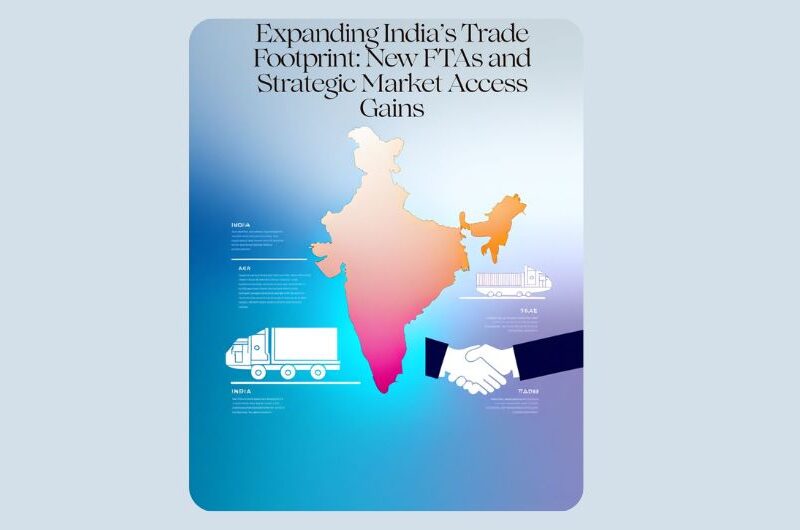
Expanding India’s Trade Footprint: New FTAs and Strategic Market Access Gains

Expanding India’s Trade Footprint: New FTAs and Strategic Market Access Gains     1) India ranks 3rd among Global South economies in trade partnership diversity, as per United Nations Conference on Trade and Development (UNCTAD) Trade and Development Report 2025, and its diversity index score is higher than all Global North countries.   2) India–European Union (EU) Free Trade Agreement (FTA) negotiations were concluded in January 2026 and described as the “Mother of All Deals,” marking a major strategic trade milestone in 2026.   3) India concluded FTAs in Financial Year (FY) 2025-26 with the United Kingdom (UK), Oman, and New Zealand, expanding market access across Europe, the Gulf, and Oceania.   4) India concluded the first round of Israel FTA negotiations and formally launched trade negotiations with the Gulf Cooperation Council (GCC) in February 2026, widening the West Asia trade agenda.   5) India is expanding negotiations with ASEAN, Mexico, and Canada, indicating a push to widen trade architecture beyond traditional partners and deepen global value chain integration.   6) The India–EU FTA provides preferential access across 97% of EU tariff lines, covering 99.5% of trade value, while retaining policy flexibility for sensitive sectors and development priorities.   7) Under the India–EU FTA, 70.4% of tariff lines covering 90.7% of India’s exports get immediate duty elimination, benefiting textiles, leather-footwear, tea, coffee, spices, toys, sports goods, gems-jewellery, and marine products.   8) In the India–EU FTA, 20.3% tariff lines covering 2.9% of exports get zero duty in 3–5 years, and 6.1% tariff lines covering 6% of exports get preferential access via reductions or tariff-rate quotas.   9) Labour-intensive exports gaining from the India–EU FTA exceed INR 2.87 lakh crore (USD 33 billion), covering textiles-apparel, marine, leather-footwear, chemicals, plastics-rubber, sports goods, toys, and gems-jewellery.   10) The EU offered services commitments across 144 subsectors, including Information Technology/Information Technology enabled Services (IT/ITeS), professional, education, and business services, creating a stable platform for Indian services exports.   11) India–Oman Comprehensive Economic Partnership Agreement (CEPA) was signed in December 2025, providing zero-duty access on 98.08% of Oman tariff lines, covering 99.38% of India’s exports by value.   12) The India–Oman CEPA is the first instance of a partner extending commitments on traditional medicine across all modes of supply, strengthening opportunities for India’s AYUSH sector through an institutional framework.   13) India–New Zealand FTA (concluded 2025) eliminates duties on 100% of New Zealand tariff lines from entry into force, giving zero-duty access for all Indian exports and supporting farmers and Micro, Small and Medium Enterprises (MSMEs).   14) India–UK Comprehensive Economic and Trade Agreement (CETA) signed in 2025: bilateral trade is USD 56 billion, the target is doubling by 2030, and agriculture/processed food exports are projected to rise over 50% in three years.   15) India–UK CETA includes a Double Contribution Convention (DCC) removing dual social security contributions, with estimated savings over ₹4,000 crore for Indian companies and professionals working in the UK.     Must Know Terms : 1) Trade Partnership Diversity Index:  Measures how widely a country’s trade is spread across partners; higher implies lower concentration risk. UNCTAD Trade and Development Report 2025 places India 3rd among Global South economies on partnership diversity and notes India’s score exceeds all Global North countries. The metric is used to assess resilience to shocks by limiting overdependence on a few markets.   2) Tariff-rate quotas (TRQs): Allow a fixed quantity of imports at a lower tariff, with higher tariffs above the quota. In the India–EU FTA package described, 6.1% of tariff lines covering about 6% of India’s exports obtain preferential access through reductions or TRQs. TRQs typically apply to sensitive items where full liberalisation is politically difficult yet controlled market access is granted.   3) Double Contribution Convention: Removes dual social security payments when professionals are temporarily posted abroad. Under India–UK CETA (signed 2025), a DCC is included to avoid simultaneous contributions in India and the UK for eligible workers and employers. The stated estimated savings exceed ₹4,000 crore for Indian companies and professionals working in the UK, improving cost competitiveness overall for talent abroad.   4) Modes of supply: Classify how services trade is delivered—cross-border supply, consumption abroad, commercial presence, and presence of natural persons. India–Oman CEPA is described as the first case where a partner extended commitments on traditional medicine across all modes of supply, strengthening market certainty for India’s AYUSH services. In the India–EU context, EU offered commitments across 144 services subsectors.   5) Duty Elimination Schedule: Timeline for cutting tariffs to zero or preferential rates, often split into immediate and phased tranches. In the India–EU FTA description, 70.4% of tariff lines covering 90.7% of India’s exports receive immediate duty elimination; 20.3% tariff lines covering 2.9% exports get zero duty in 3–5 years. Remaining lines may get reductions or TRQs for exporters.   6) Preferential Market Access: Partners apply lower tariffs than they apply to non-partners. India–EU FTA is described as giving preferential access across 97% of EU tariff lines, covering 99.5% of trade value. India–Oman CEPA gives zero-duty access on 98.08% of Oman tariff lines covering 99.38% of India’s exports by value; New Zealand offers 100% zero-duty from entry immediately.   MCQ 1. India ranks among Global South economies in trade partnership diversity at: A) 1st B) 2nd C) 3rd D) 5th 2. The India–EU FTA negotiations were concluded in: A) January 2025 B) January 2026 C) December 2025 D) February 2026 3. FTAs concluded by India in FY 2025-26 include agreements with: A) UK, Oman and New Zealand B) EU, Canada and Mexico C) USA, Oman and Israel D) Japan, UK and GCC 4. India formally launched trade negotiations with which grouping in February 2026? A) ASEAN B) African Union C) Gulf Cooperation Council D) European Free Trade Association 5. India is expanding negotiations beyond traditional partners to deepen: A) Currency union mechanisms B) Global value chain integration C) Agricultural subsidies D) Monetary coordination frameworks 6. The India–EU FTA provides preferential access across what percentage of EU tariff lines? A)

More Details

Modernising India’s GDP Measurement: Base 2022–23 and New Data Framework

Modernising India’s GDP Measurement: Base 2022–23 and New Data Framework     1) Real Gross Domestic Product (GDP) growth for Financial Year (FY) 2025-26 is estimated at 7.6%, above 7.1% in FY 2024-25, showing stronger expansion under new 2022-23 base series. 2) Nominal GDP at current prices is projected to grow 8.6% in FY 2025-26, capturing both real output rise and price changes together for policymaking. 3) October to December quarter GDP at constant prices is estimated at ₹84.54 lakh crore, growing 7.8%, steadily up from 7.1% and 7.4% in prior years. 4) Manufacturing recorded double digit growth in FY 2023-24 and FY 2025-26; secondary and tertiary sectors grew above 9%, while trade related services grew 10.1% showing resilience. 5) Base year for GDP is revised from 2011-12 to 2022-23, so real growth uses newer prices and better reflects today’s economic structure and sector mix. 6) Year 2022-23 was selected as the latest normal year after Coronavirus Disease 2019 (COVID-19) disruptions in 2019-2021, which temporarily skewed consumption, production, and investment behaviour in many sectors. 7) Back series using revised methods is expected by December 2026; estimates will be recalculated up to the earlier base year, then linked to extend data back to 1950-51. 8) National Statistical Office (NSO) estimates GDP using benchmarks and indicators, aligned with System of National Accounts 2008 (SNA 2008) and International Monetary Fund (IMF) manual 2017. 9) Household sector estimates now use actual yearly levels from Annual Survey of Unincorporated Sector Enterprises (ASUSE) and Periodic Labour Force Survey (PLFS), instead of only proxy growth rates. 10) Goods and Services Tax (GST) data is used more systematically to allocate private corporate activity across states, cross check annual accounts, and support quarterly estimation in services sectors. 11) e-Vahan vehicle registration database is used to estimate Private Final Consumption Expenditure (PFCE) for road transport services, giving better demand measurement from real administrative records at national level. 12) Public Financial Management System (PFMS) provides payment and accounting data, helping compile central government accounts and distribute them across states using actual spending at First Revised Estimates stage. 13) Deflation improved: double deflation is applied in manufacturing and agriculture; single extrapolation used elsewhere; deflators are granular, using 260 plus Consumer Price Index (CPI) items to reduce bias. 14) Supply and Use Tables (SUT) are integrated into compilation using product balancing, ensuring total supply equals total use, which reconciles production and expenditure estimates and removes statistical discrepancy. 15) Revised series expands coverage by counting hired domestic workers’ services and capturing digital platforms, self-employed, and informal gig workers more accurately through annual data, not only corporate filings.   Must Know Terms : 1.ASUSE:  ASUSE (Annual Survey of Unincorporated Sector Enterprises) is an NSO annual survey used in the GDP base 2022–23 series to produce “actual level” household-sector estimates. It replaces earlier reliance on proxy growth between benchmarks. It profiles unincorporated enterprises: activity, workers, wages, receipts, expenses, fixed assets, and operating surplus. Outputs feed sector value added and informal-economy measurement nationwide, every year, directly. 2.COICOP:  COICOP (Classification of Individual Consumption According to Purpose) 2018 is adopted in the revised PFCE framework. It standardises household consumption categories for national accounts comparability. India’s mixed PFCE method combines Household Consumer Expenditure Survey, administrative/production data, and commodity-flow approach, then maps totals to COICOP 2018 heads. This improves item-level consistency with Supply and Use Tables and deflators, year after year. 3.SUT:  SUT (Supply and Use Tables) are integrated into the new GDP series to reconcile production and expenditure estimates. For each product, total supply equals total use: domestic output + imports matched with intermediate demand, household/government consumption, NPISH, capital formation, and exports. PIB notes “product-balancing” resolves statistical discrepancies, improving internal consistency and reliability of final GDP figures across sectors and years. 4.Deflator:  Deflators convert current-price values to constant prices. The revised series upgrades deflation: double deflation is applied in manufacturing and agriculture; single extrapolation is used in other sectors; single deflation is discontinued. Deflators are more granular, using 260+ item-level CPI indices. Until WPI rebasing is released, existing WPI continues as a deflator; MoSPI plans Producer Price Index soon, for producers, nationally. 5.PFMS:  PFMS (Public Financial Management System) is a web-based government platform enabling end-to-end digital payments, receipt collection, accounting, reconciliation, and financial reporting. In the new GDP series it compiles central government accounts and distributes them across states. PFMS allows using actual expenditure figures at First Revised Estimates (FRE) stage, instead of relying on budget Revised Estimates (RE), improving accuracy, transparency, measurably. 6.Extrapolation:  Benchmark–Indicator compilation uses annual GDP as the benchmark and high-frequency indicators to extend estimates to quarters. NSO uses this for quarterly GDP aligned with SNA 2008 and IMF Quarterly National Accounts Manual 2017. In the revised framework, indicators include GST, PFMS, e-Vahan and surveys. PIB notes reduced dependence on proxy indicators and fixed ratios, improving timeliness and consistency overall, significantly.     MCQ 1. With reference to India’s revised GDP series, consider the following statements: 1. Real GDP growth for FY 2025-26 is estimated at 7.6%. 2. The estimate is higher than the 7.1% recorded in FY 2024-25. Which of the statements given above is/are correct? A) 1 only B) 2 only C) Both 1 and 2 D) Neither 1 nor 2 2. Nominal GDP at current prices is projected to grow by: A) 7.6% in FY 2025-26 B) 8.6% in FY 2025-26 C) 10.1% in FY 2025-26 D) 9.0% in FY 2025-26 3. The October–December quarter GDP at constant prices is estimated at: A) ₹48.54 lakh crore B) ₹74.58 lakh crore C) ₹84.54 lakh crore D) ₹94.54 lakh crore 4. The October–December quarter GDP growth at constant prices is estimated at: A) 7.1% B) 7.4% C) 7.6% D) 7.8% 5. With reference to the revised GDP base year, consider the following statements: 1. The base year is revised from 2011-12 to 2022-23. 2. Real growth under the series uses newer prices and updated sector mix. Which of the statements given above is/are correct? A) 1 only B) 2 only C) Both 1 and 2

More Details

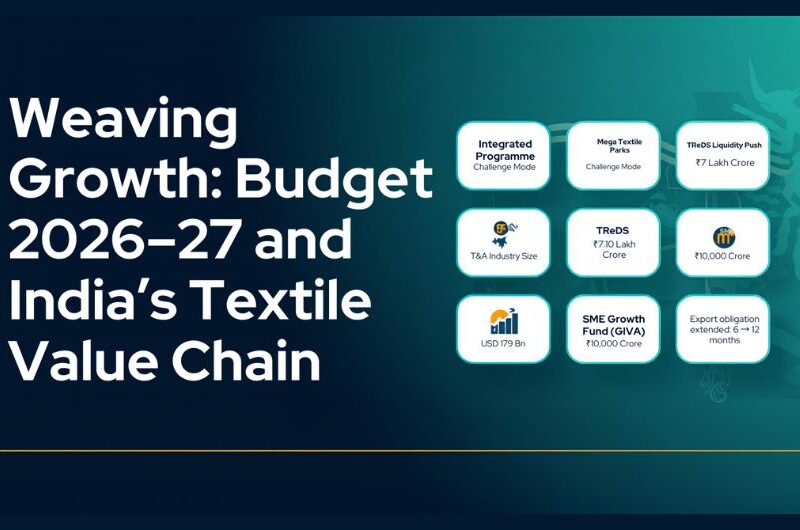
Weaving Growth: Budget 2026–27 and India’s Textile Value Chain

Weaving Growth: Budget 2026–27 and India’s Textile Value Chain   1. Union Budget 2026–27 places textiles at the centre of growth, prioritising jobs, exports, rural livelihoods, and sustainable manufacturing, with integrated policy focus from fibre production to fashion markets. 2. India’s fibre strengths include largest cotton acreage, largest jute output, second-largest silk and cotton production, major MMF hub, and second-largest polyester and viscose fibre production worldwide among nations. 3. An Integrated Programme is proposed to bolster the textile value chain, organised into five components spanning fibre self-reliance, cluster modernisation, artisan support, sustainability compliance, and skilling upgrades nationwide. 4. National Fibre Scheme supports silk, wool, jute, man-made fibres, and new-age fibres, aiming to diversify beyond cotton, spur advanced material innovation, and reduce import dependence for specialised textiles. 5. Textile Expansion and Employment Scheme modernises traditional clusters, providing capital for machinery and technology upgrades, plus common testing and certification centres, to raise productivity, quality compliance, and employment. 6. National Handloom and Handicraft Programme merges existing schemes to improve artisan incomes and market linkages, while supporting natural and vegetable dyes and dye houses via clusters and infrastructure. 7. Tex-Eco Initiative promotes globally competitive, environmentally sustainable textiles and apparel manufacturing, aligning production with international sustainability standards and enabling access to emerging green markets and responsible sourcing requirements. 8. Samarth 2.0 upgrades the skilling framework through deeper collaboration with industry and academic institutions, aiming to supply industry-ready manpower across spinning, weaving, processing, garmenting, and allied services nationwide. 9. Mega Textile Parks will be set up in challenge mode, offering infrastructure and efficiencies, promoting value addition, and supporting technical textiles for industrial, medical, defence, and infrastructure uses. 10. Mahatma Gandhi Gram Swaraj Initiative strengthens khadi, handloom, and handicrafts via branding, market linkages, training, skilling, quality improvement, and process modernisation, benefiting weavers, village industries, youth, and ODOP. 11. Export obligation period is extended from six to twelve months for exporters using duty-free inputs in textile garments and leather goods, improving compliance flexibility and working-capital management overall. 12. TReDS is an electronic platform for financing and discounting MSME trade receivables through multiple financiers, against dues from corporates, government departments, and PSUs, including other buyers across markets. 13. Liquidity push targets textile MSMEs by mandating CPSE procurement invoices on TReDS, providing CGTMSE credit guarantees for invoice discounting, and linking GeM with TReDS for faster, cheaper finance. 14. TReDS receivables will be introduced as asset-backed securities, encouraging secondary-market participation and improving liquidity, which can widen financier interest and smooth credit flow to MSMEs during demand fluctuations. 15. Indian textile and apparel industry is estimated at USD 179 billion, contributes about 2% of GDP, around 11% of manufacturing GVA, and 8.63% of exports in the economy. Must Know terms : 1) Integrated Programme for Textile Sector (Union Budget 2026–27) — Announced as an integrated policy framework for the labour-intensive textile sector, covering value chain “fibre to fashion” and “village industries to global markets”. Built as an umbrella with 5 sub-parts: National Fibre Scheme; Textile Expansion & Employment Scheme; National Handloom & Handicraft Programme; Tex-Eco Initiative; Samarth 2.0. Stated policy objectives: competitiveness + self-reliance + employment generation. Sector context often quoted in govt briefs: textiles & apparel ~2% of GDP; ~11% of manufacturing GVA; direct employment “more than 45 million”. Export context used in official notes: textiles & apparel (incl. handicrafts) 8.63% of India’s merchandise exports in 2024–25; value about USD 37.7 billion. 2) National Fibre Scheme (Budget 2026–27) — Explicit fibre coverage listed: natural fibres (silk, wool, jute) + man-made fibres (MMF) + “new-age fibres”. Core framing: “self-reliance across the fibre spectrum” and strengthening domestic fibre availability. Intended outcomes: reduce import dependence; diversify beyond cotton; support innovation in advanced textile materials. scheme is not cotton-only; it is positioned as diversification + high-performance/specialised textiles capability building. Linkage: it sits inside the 5-part Integrated Programme for Textile Sector (not a standalone unrelated scheme). 3) Textile Expansion and Employment Scheme (Budget 2026–27) — Designed specifically for modernising “traditional clusters” (cluster-focused, not single-factory only). Support types mentioned: capital support for machinery + technology upgradation. Also includes: “common testing and certification centres” (standards/compliance infrastructure). Stated intention: employment-intensive push—modernisation tied with job creation and competitiveness. Lcombines (i) capex support + (ii) shared testing/certification—both appear together in the scheme description. 4) National Handloom and Handicraft Programme (Budget 2026–27) — Announced to “integrate and strengthen existing schemes” (consolidation/umbrella approach). Target group clearly stated: weavers and artisans (handloom + handicraft ecosystem). Design idea: targeted support with better coherence (less fragmentation across multiple schemes). Positioning within Budget: part of the same 5-part textile integrated programme (not separate from it). Question-worthy distinction: this is about integrating schemes + ensuring targeted support; not described as machinery capex or fibre R&D. 5) Tex-Eco Initiative (Budget 2026–27) — Purpose line: promote “globally competitive and sustainable textiles and apparels”. Sustainability is framed as competitiveness enabler (export-market readiness + sustainable manufacturing). Included as the 4th sub-part inside the 5-part Integrated Programme. name suggests ecology; official wording ties it directly to sustainable textiles + global competitiveness (not only pollution control). Differentiator vs other sub-parts: focuses on sustainability + competitiveness, whereas “Expansion & Employment” focuses on clusters/capex/testing. 6) TReDS (Trade Receivables Discounting System) — RBI definition: an electronic platform to facilitate financing/discounting of MSME trade receivables through multiple financiers. Receivables can be due from: corporates and other buyers including Government Departments and PSUs. Key participants (RBI framing): MSME sellers, buyers, and financiers (banks/NBFC-Factors/other RBI-permitted institutions). Legal/regulatory base commonly cited: operated under RBI framework for payment systems (PSS Act, 2007 referenced in RBI-guideline explainers). invoice/bill is uploaded by MSME → buyer acceptance → financiers bid/discount → MSME gets early payment. Platform ecosystem (SIDBI page): TReDS platforms include RXIL; the other two platforms are M1xchange and Invoicemart. Key Takeaways a.The Union Budget 2026-27places Textiles at the centre of growth strategy with focus on employment, exports, rural livelihoods and sustainable manufacturing. b.Push for scale and modern manufacturingthrough mega textile parks and support for MMF and technical textiles. c.MSMEs and artisans supportedthrough liquidity measures, cluster modernisation and skilling initiatives. d.Policy direction emphasises scale, sustainability

More Details

Regulatory and Digital Reforms Driving India’s Business Environment Transformation

Regulatory and Digital Reforms Driving India’s Business Environment Transformation       1. Union Budget 2026–27 reiterates Ease of Doing Business as a growth pillar, prioritising digitisation, tax certainty, investor access and litigation reduction to strengthen confidence across sectors nationwide. 2. An interconnected single digital window for cargo approvals is proposed, enabling streamlined customs clearances, reduced interface duplication, faster releases, and lower compliance friction for trade participants and paperwork. 3. Customs Integrated System will be rolled out within two years as an integrated, scalable platform covering end-to-end customs processes, improving interoperability, traceability, and predictability for trade. 4. Non-intrusive scanning using imaging and AI-enabled risk assessment will expand in phases, targeting scanning of every container across major ports to tighten security and reduce delays. 5. Trusted importers will be recognised in risk systems, cutting physical verification, enabling electronically sealed factory-to-ship export clearance, and facilitating immediate release on arrival for compliant filings. 6. For goods without compliance requirements, customs clearance will occur immediately after online registration by the importer, subject to duty payment, shortening dwell time and improving logistics efficiency overall. 7. Portfolio Investment Scheme access is widened for individuals resident outside India to invest in listed equity instruments, enhancing market liquidity and broadening foreign investor participation pathways significantly overall. 8. Individual PROI investment limit under PIS is proposed to rise from 5% to 10%, while the overall ceiling for individual PROIs rises to 24% from 10% in aggregate. 9. Minimum Alternate Tax is proposed as levy at 14% instead of 15%, aiming to reduce disputes, improve certainty, and simplify settlement of MAT liabilities for firms in India. 10. Non-residents paying presumptive tax are proposed to be exempt from MAT, supporting predictable taxation and lowering friction for global businesses operating under presumptive income frameworks in India. 11. MAT credit set-off in the new regime is proposed up to one-fourth of tax liability, easing costs and improving cash-flow planning for firms shifting regimes. 12. Integrated assessment and penalty proceedings through a common order are proposed, with no interest on penalty during appeal and reduced pre-payment requirement from 20% to 10% thereby. 13. Return updating is proposed even after reassessment initiation, with an additional 10% tax above the applicable rate, enabling voluntary self-correction for taxpayers and reducing prolonged disputes materially. 14. Immunity from penalty and prosecution framework is extended from underreporting to misreporting, requiring payment of 100% additional income tax over tax and interest due in specified eligible cases. 15. Duty deferral period for Tier-2 and Tier-3 Authorised Economic Operators is extended from 15 to 30 days, supporting ‘Clear first, pay later’ for time-sensitive production.   Trust-based systems   Enhanced the duty deferral period for Tier 2 and Tier 3 Authorised Economic Operators (AEO), from 15 days to 30 days. What does it mean?   Deferred duty payment is a mechanism for delinking duty payment and Customs clearance. It is based on the principle ‘Clear first-Pay later’. The aim is to have a seamless wharf to warehouse transit in order to facilitate just-in-time manufacturing.   The enhancement in the duty deferral period means extending the time allowed to pay customs or import duties after goods are imported, instead of paying them immediately.   Other Single Window Digital Platforms     PARIVESH (Pro-Active and Responsive facilitation by Interactive, Virtuous, and Environmental Single Window Hub) 3.0 For environmental clearances and post-approval compliance monitoring.   It integrates baseline data, afforestation land banks, inter-ministerial dashboards, and AI-enabled support to enhance transparency, predictability, and efficiency.         e-Gram SWARAJ portal Provides a single window with the complete Profile of the GP, including details of Sarpanch/Secretary, demography, finances, assets along with activities taken up through the Gram Panchayat Development Plan (GPDP).   Serving as a unified reporting and tracking platform, it strengthens decentralised planning and improves the effectiveness of development fund utilisation. Achievements of States under BRAP     Kerala Streamlined business registration Digitised land and tax processes, Simplified environmental clearances, and advanced renewable energy adoption, carbon-neutral gram panchayats, and waterbody rejuvenation.     Tamil Nadu Introduced single-window Digitised approvals alongside land reforms, while promoting solar parks, decarbonisation plans, Effective monitoring of industrial effluent treatment systems.     Andhra Pradesh Implemented single-window industrial clearances, Online land registration, E-environmental approvals, Expanded its Online Consent Management & Monitoring System allowing firms to apply for consents and track approvals digitally — Must Know Terms :    1.Ease of Doing Business (EoDB) Ease of Doing Business refers to a reform-driven framework aimed at simplifying regulatory procedures, reducing compliance costs, and improving predictability for enterprises. In India, EoDB focuses on digitisation, decriminalisation of minor offences, tax certainty, and trust-based governance to enhance investor confidence, promote entrepreneurship, improve competitiveness, and integrate domestic firms with global value chains effectively. 2.Customs Integrated System (CIS) The Customs Integrated System is a proposed unified digital platform designed to integrate all customs-related processes into a single, scalable architecture. CIS aims to replace fragmented systems, enabling seamless data sharing, end-to-end cargo tracking, faster clearances, improved risk assessment, and enhanced transparency. It supports reduced transaction costs, predictability in trade logistics, and improved ease for importers and exporters. 3.Minimum Alternate Tax (MAT) Minimum Alternate Tax is a tax mechanism introduced to ensure companies with substantial book profits pay a minimum level of tax despite exemptions. Under recent reforms, MAT is proposed as a final tax at a reduced rate of 14 percent, improving tax certainty, lowering litigation, enabling better financial planning, and reducing prolonged disputes between taxpayers and tax authorities. 4.Portfolio Investment Scheme (PIS) The Portfolio Investment Scheme regulates equity investments by persons resident outside India in listed Indian companies. Recent enhancements permit wider access and higher investment limits for individual foreign investors. These reforms aim to deepen capital markets, improve liquidity, diversify investor participation, and align India’s financial markets with global investment practices and standards. 5.Authorised Economic Operator (AEO) Programme The Authorised Economic Operator programme accredits compliant and trusted trade entities, granting them facilitative benefits in customs procedures. Enhanced duty deferral periods and preferential treatment under risk management systems reduce inspections and delays. The programme strengthens supply chain

More Details

Edible Oils and Oilseeds: Production, Import Dependence, and Mission-Based Expansion

Edible Oils and Oilseeds: Production, Import Dependence, and Mission-Based Expansion       Key Takeaways According to a NITI Aayog report (August 2024), India ranks firstglobally in the production of rice bran oil, castor seed, safflower, sesame, and niger. National Mission on Edible Oils (NMEO)aims to strengthen the country’s oilseed ecosystem and achieve Atmanirbharta in edible oil production. The NMEO–OP (Oil Palm) aims to bring 5 lakh hectaresunder oil palm cultivation by 2025–26 and increase crude palm oil production to 28 lakh tonnes by 2029–30. By November 2025, 50 lakh hectareshave been covered, bringing the total coverage of oil palm in the country to 6.20 lakh hectares. Crude Palm Oil (CPO) production has risen from 1.91 lakh tonnes in 2014-15 to 3.80 lakh tonnes in 2024-25. NMEO–OS (Oil Seeds) aims to increase oilseed production from 39 to 7 million tonnesby 2030–31 through cluster-based interventions and improved seed systems.       1. Edible oils are central to food and nutritional security; oilseeds supply dietary fats, energy, vitamins, and support farmer livelihoods as key cash crops nationwide. 2. Domestic edible oil demand has outpaced production; rural consumption rose to 10.58 kg/year and urban to 11.78 kg/year by 2022-23, indicating strong shift overall. 3. Total edible oil output was 12.18 million tonnes in 2023-24, meeting about 44% of demand, leaving substantial reliance on imports for stability nationally today. 4. Import dependence declined from 63.2% in 2015-16 to 56.25% in 2023-24, yet rising consumption still pressures foreign exchange, prices, and supply security for households. 5. India contributes 15-20% of global oilseed area but only 6-7% of vegetable oil output, reflecting yield gaps, limited expansion, and efficiency constraints per hectare. 6. Nine major oilseeds occupy 14.3% of gross cropped area; about 76% oilseed area is rainfed, heightening climate vulnerability, yield instability, and income risk overall. 7. Rajasthan, Madhya Pradesh, Gujarat, and Maharashtra contribute over 77% of national oilseed output, showing regional concentration, crop specialisation, and supply dependence in key years. 8. National Mission on Edible Oils uses two pillars: expand oil palm cultivation and improve traditional oilseeds productivity, seed systems, processing capacity, and market linkages. 9. Oil palm yields far more oil per hectare than traditional oilseeds; Andhra Pradesh and Telangana account for about 98% of current production, leading adoption. 10. Oil palm mission targets 6.5 lakh hectares by 2025-26 and crude palm oil 28 lakh tonnes by 2029-30; coverage reached 6.20 lakh hectares nationally. 11. Price assurance for fresh fruit bunches links farmer returns to a viability price, cushioning international crude palm oil volatility and improving predictable income stability. 12. Input assistance for oil palm rose to Rs. 29,000 per hectare; added support covers maintenance, intercropping, drip irrigation, and old garden rejuvenation support packages. 13. Oilseeds mission targets 33 million hectares, 69.7 million tonnes output, and 2,112 kg/ha yield by 2030-31, raising domestic edible oil availability over seven years. 14. Over 600 value-chain clusters deliver quality seeds, training, and advisory services; post-harvest infrastructure support improves collection, extraction efficiency, recovery, and farmer returns at scale. 15. Seed planning and traceability use a rolling plan portal; SHGs and Krishi Sakhis support data updates, while research notified 432 varieties since 2014 commercially.     MCQ:   1. With reference to edible oils, consider the following statements: I. They are a major source of dietary fats and support nutritional security. II. Oilseeds function as important cash crops for many farming households. Which of the statements given above is/are correct? A. I only B. II only C. Both I and II D. Neither I nor II 2. As per the given data, the level of import dependence for edible oils in 2023–24 was closest to: A. 36% B. 44% C. 56% D. 63% 3. Consider the following pairs: I. Rural per capita edible oil consumption (2022–23) — 10.58 kg/year II. Urban per capita edible oil consumption (2022–23) — 11.78 kg/year Which of the pairs given above is/are correctly matched? A. I only B. II only C. Both I and II D. Neither I nor II 4. Total edible oil production mentioned for 2023–24 was: A. 8.18 million tonnes B. 10.18 million tonnes C. 12.18 million tonnes D. 14.18 million tonnes 5. India’s share in global oilseed area and vegetable oil output is best described as: A. 5–7% area; 15–20% output B. 15–20% area; 6–7% output C. 25–30% area; 10–12% output D. 10–12% area; 25–30% output 6. With reference to oilseeds cultivation, consider the following statements: I. Nine major oilseeds occupy about 14.3% of the gross cropped area. II. Around three-fourths of oilseed area is rainfed. Which of the statements given above is/are correct? A. I only B. II only C. Both I and II D. Neither I nor II 7. Which of the following groups of States together contribute over 77% of national oilseed output, as stated? A. Punjab, Haryana, Uttar Pradesh, Bihar B. Rajasthan, Madhya Pradesh, Gujarat, Maharashtra C. Andhra Pradesh, Telangana, Tamil Nadu, Karnataka D. West Bengal, Odisha, Chhattisgarh, Jharkhand 8. The mission framework described for edible oils is based primarily on: A. Import substitution through tariff bans alone B. Expansion of oil palm and improvement of traditional oilseeds C. Replacement of oilseeds by cereals in rainfed areas D. Exclusive focus on refining capacity without farm interventions 9. Oil palm is emphasised in policy primarily because it: A. Requires no irrigation and thrives only in arid climates B. Has significantly higher oil yield per hectare than traditional oilseeds C. Produces edible oil without any processing requirement D. Has the shortest gestation period among all crops 10. Current oil palm production is described as being concentrated mainly in: A. Andhra Pradesh and Telangana B. Rajasthan and Gujarat C. Punjab and Haryana D. Odisha and West Bengal 11. The oil palm expansion target mentioned for 2025–26 was: A. 2.5 lakh hectares B. 4.5 lakh hectares C. 6.5 lakh hectares D. 8.5 lakh hectares 12. The crude palm oil production target mentioned for 2029–30 was: A. 18 lakh tonnes B. 28 lakh tonnes C. 38 lakh tonnes D. 48 lakh tonnes 13. Price assurance for fresh fruit bunches is designed mainly to: A. Fix prices permanently regardless of market conditions B. Link farmer returns

More Details

Major Governance, Tax, Labour, and Rural Employment Reforms (2025)

Major Governance, Tax, Labour, and Rural Employment Reforms (2025)   Key Takeaways   2025 Economic reforms focused on outcome-driven governance, simplifying systems, and boosting growth, inclusivity, and ease of doing business. Labour reforms unified 29 laws under four Labour Codes, extending social security and workplace safety. Next-Gen GST simplified taxation, expanded the taxpayer base to 1.5 crore. The Export Promotion Mission (₹25,060 crore) strengthens MSME and first-time exporter support with finance, compliance, and market access. Rural employment reforms provide 125 days of guaranteed paid work.   1. 2025 reforms shifted governance from expanding regulations to measurable outcomes, simplifying systems, lowering compliance burdens, and improving predictability for citizens and                      businesses nationwide overall. 2.Union Budget 2025–26 exempted annual income up to ₹12 lakh under the new regime; salaried taxpayers effectively reach ₹12.75 lakh after standard deduction benefit. 3.Income Tax Act, 2025 overhauled the 1961 law, simplifying language, removing obsolete provisions, and restructuring sections, while keeping tax rates unchanged, to cut litigation. 4.A unified Tax Year, the financial year beginning 1 April, replaced Assessment Year and Previous Year concepts, improving clarity and reducing compliance disputes materially. 5.Twenty-nine labour laws were consolidated into four codes covering wages, industrial relations, social security, and occupational safety, health, and working conditions into one framework. 6.The codes expand wage security, social protection, and workplace safety for women, migrant, unorganized, gig, and platform workers, supporting inclusive formalisation for broader coverage. 7.Nearly ten million gig and platform workers receive annual social security support, alongside improved leave provisions, maternity benefits, and strengthened workplace safety each year. 8.Viksit Bharat Guarantee for Rozgar and Ajeevika Mission (Gramin) Act, 2025 replaced MGNREGA, integrating employment with community development and livelihoods with stronger statutory accountability. 9.Rural households receive up to 125 days of guaranteed wage employment yearly, balancing labour availability for peak agricultural seasons with worker security and resilience. 10.Wages must be paid weekly or within fifteen days of completing work, reducing delays and reinforcing income stability for rural workers under legal timelines. 11.All works flow from Viksit Gram Panchayat Plans approved by Gram Sabha, digitally linked with PM Gati Shakti for cross-ministry convergence and district-level coordination. 12.Administrative expenditure ceiling increased from 6% to 9%, strengthening staffing, training, technical capacity, and field support to improve implementation outcomes at the field level. 13.Quality Control Orders were phased with MSME relaxations: extra time for micro and small units, exemptions for certain imports, and legacy stock clearance safely. 14.Next-generation GST aimed for a two-slab structure, expanded the taxpayer base beyond 1.5 crore, and achieved ₹22.08 lakh crore collections in FY2024–25 for stability. 15.Export Promotion Mission, outlay ₹25,060 crore for FY2025–26 to FY2030–31, unifies support with trade finance, compliance, logistics, branding, and market access for MSMEs nationwide.     MCQ:   1. With reference to the Union Budget 2025–26 provisions mentioned, which one is correct regarding the new regime exemption threshold? A. ₹10 lakh, with no standard deduction relevance B. ₹12 lakh, with salaried effective threshold ₹12.75 lakh after standard deduction C. ₹12.75 lakh for all taxpayers regardless of salary status D. ₹15 lakh, with standard deduction removed 2. Consider the following statements about the Income Tax Act, 2025: I. It replaced the 1961 law with simplified language and a restructured layout. II. It changed tax rates to align with the new regime exemption threshold. III. It aimed to reduce litigation by removing obsolete provisions. Which of the statements given above are correct? A. I and II only B. II and III only C. I and III only D. I, II and III 3. The “Tax Year” introduced refers to: A. A calendar year beginning 1 January B. A financial year beginning 1 April, replacing Assessment Year and Previous Year concepts C. A half-yearly tax period for all taxpayers D. A quarterly filing period for GST-linked income tax assessment 4. Twenty-nine labour laws were consolidated into four codes covering: A. Wages; industrial relations; social security; occupational safety, health and working conditions B. Wages; taxation; consumer protection; environmental standards C. Industrial relations; competition law; social security; corporate governance D. Social security; wages; agriculture marketing; workplace harassment 5. Which of the following worker groups are explicitly indicated as beneficiaries of expanded coverage under the labour codes? A. Only government employees and retirees B. Women, migrant, unorganized, gig, and platform workers C. Only organized sector industrial workers D. Only small traders and MSME owners 6. Consider the following statements about annual social security support mentioned: I. It covers nearly ten million gig and platform workers annually. II. It is coupled with improved leave provisions and maternity benefits. Which of the statements given above are correct? A. I only B. II only C. Both I and II D. Neither I nor II 7. The Viksit Bharat Guarantee for Rozgar and Ajeevika Mission (Gramin) Act, 2025 is described as: A. A minor amendment within MGNREGA retaining its original statutory framework B. A replacement of MGNREGA integrating employment with community development and livelihoods C. A scheme limited to urban employment and apprenticeships D. A purely cash-transfer programme without work creation 8. Under the rural wage employment guarantee described, a rural household is entitled to: A. Up to 100 days of guaranteed wage employment yearly B. Up to 125 days of guaranteed wage employment yearly C. Up to 150 days of guaranteed wage employment yearly D. Up to 200 days of guaranteed wage employment yearly 9. Consider the following statements about wage payment timelines under the described rural employment framework: I. Wages must be paid weekly, or within fifteen days of completing work. II. Wages can be deferred up to thirty days if administrative expenditure exceeds the ceiling. Which of the statements given above are correct? A. I only B. II only C. Both I and II D. Neither I nor II 10. All works under the described rural employment framework are to be derived from: A. State secretariat directives only, without local approvals B. Viksit Gram Panchayat Plans approved by Gram Sabha C. District collector’s

More Details

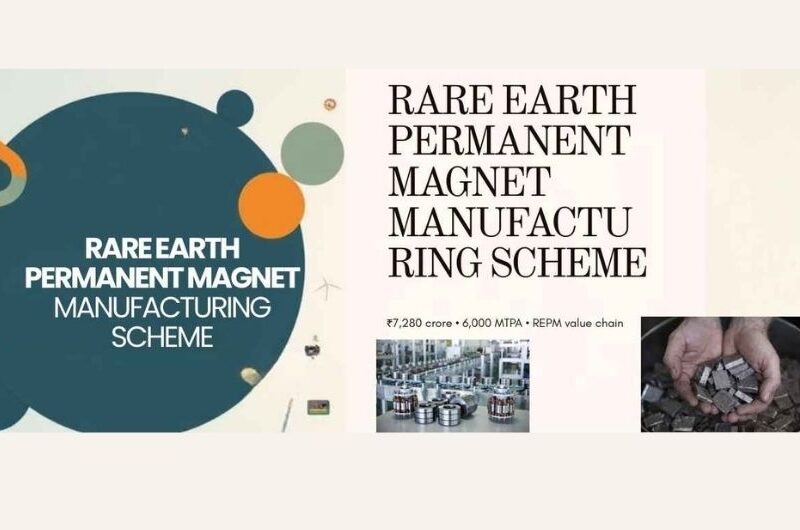
Rare Earth Permanent Magnet Manufacturing Scheme

Rare Earth Permanent Magnet Manufacturing Scheme     Key Takeaways Government approves ₹7,280 crore scheme to establish domestic integrated REPM manufacturing ecosystem. Creates 6,000 MTPA domestic capacity covering the full value chain, from rare-earth oxides to finished magnets. Strengthens self-reliance for critical sectors such as electric mobility, renewable energy, electronics, aerospace and defence. Supported by strong rare-earth resource availability and policy initiatives including NCMM and MMDR Act reforms. Enhances India’s participation in global advanced-materials value chains while reducing import dependence and enabling long-term industrial growth.       1.Government approved a ₹7,280 crore scheme to promote sintered rare earth permanent magnet manufacturing, targeting expansion of national industrial capability and output overall capacity. 2.The scheme will create 6,000 MTPA integrated domestic REPM capacity, covering the full value chain from rare earth oxide to finished magnets in India. 3.REPMs deliver high magnetic strength and stability, enabling efficient use in EV motors, wind turbines, electronics, aerospace platforms, and defence systems globally today widely. 4.A domestic REPM ecosystem can cut import dependence for e-mobility, renewables, electronics, aerospace and defence, strengthening strategic supply-chain resilience at scale for India’s industries. 5.India holds about 13.15 million tonnes of monazite reserves, containing an estimated 7.23 million tonnes of rare earth oxides forming a substantial resource base. 6.Rare earth oxide resources occur in coastal beach sands, teri/red sands and inland alluvium across Andhra Pradesh, Odisha, Tamil Nadu, Kerala, West Bengal, Jharkhand. 7.Hard-rock regions of Gujarat and Rajasthan have identified 1.29 million tonnes of in-situ rare earth oxide resources, supporting longer-term domestic supply security and planning. 8.Geological Survey added 482.6 million tonnes of rare earth ore resources through exploration, indicating strong potential for downstream industry development nationally in coming years. 9.Despite progress in local magnet production, import dependence remained high during 2022–23 to 2024–25, reaching 59.6–81.3% value and 84.8–90.4% volume for these products overall. 10.REPM consumption is projected to double by 2030, driven by e-mobility growth, renewable deployment, electronics manufacturing expansion, and strategic defence applications worldwide by then. 11.Capacity will be allocated through global competitive bidding to up to five beneficiaries; each may receive up to 1,200 MTPA to ensure diversification adequately. 12.The incentive package includes ₹6,450 crore sales-linked incentives over five years and ₹750 crore capital subsidy to support advanced plant establishment nationwide implementation efforts. 13.Implementation spans seven years: two years for facility setup, followed by five years of REPM sales-based incentive payouts, ensuring timely capacity creation and delivery. 14.The initiative supports green technologies by supplying materials for energy-efficient motors and wind power systems, aligning directly with Net Zero 2070 vision targets also. 15.The scheme complements NCMM launched January 2025, MMDR Amendment 2023, MSP, IPEF, iCET partnerships, and KABIL efforts for overseas mineral acquisition and security goals.     MCQ:   1. With reference to the ₹7,280 crore initiative, consider the following statements: I) It targets sintered rare earth permanent magnet manufacturing. II) It aims to expand national industrial capability and output. Which of the statements given above is/are correct? A. I only B. II only C. Both I and II D. Neither I nor II   2. The integrated domestic capacity proposed under the scheme is: A. 1,200 MTPA B. 3,000 MTPA C. 6,000 MTPA D. 7,280 MTPA 3. The scheme’s integration across the value chain is best described as: A. Finished magnets only B. Rare earth oxide to finished magnets C. Mining to rare earth oxide only D. Component assembly to final products only 4. Rare earth permanent magnets are specifically described as having: A. Low magnetic strength and low stability B. High magnetic strength and stability C. High electrical conductivity and ductility D. Low density and high thermal insulation 5. Which of the following sectors are directly cited as key users of REPM? A. EV motors, wind turbines, electronics, aerospace, defence systems B. Cement, textiles, fertilizers, shipping, retail C. Agriculture, fisheries, forestry, hospitality, tourism D. Railways, ports, steel, banking, insurance 6. Consider the following statements about India’s monazite reserves: 1) They are about 13.15 million tonnes. 2) They contain an estimated 7.23 million tonnes of rare earth oxides. Which of the statements given above is/are correct? A. 1 only B. 2 only C. Both 1 and 2 D. Neither 1 nor 2 7. Rare earth oxide resources in coastal and inland settings are cited across several states. Which one of the following is NOT listed? A. Kerala B. Jharkhand C. Andhra Pradesh D. Punjab 8. Hard-rock in-situ rare earth oxide resources of about 1.29 million tonnes are identified in: A. Gujarat and Rajasthan B. Odisha and West Bengal C. Tamil Nadu and Kerala D. Maharashtra and Andhra Pradesh 9. Geological Survey exploration added rare earth ore resources of: A. 48.26 million tonnes B. 482.6 million tonnes C. 4,826 million tonnes D. 728.0 million tonnes 10. During 2022–23 to 2024–25, import dependence for magnets remained high. The stated ranges were: A. Value: 20–40%; Volume: 30–50% B. Value: 59.6–81.3%; Volume: 84.8–90.4% C. Value: 84.8–90.4%; Volume: 59.6–81.3% D. Value: 10–25%; Volume: 70–85% 11. REPM consumption is projected to: A. Halve by 2030 due to substitution B. Remain constant until 2030 C. Double by 2030, driven by e-mobility, renewables, electronics, strategic uses D. Double by 2047, driven only by electronics 12. Consider the following about beneficiary allocation: 1) Allocation is through global competitive bidding. 2) There can be up to five beneficiaries. 3) Each beneficiary can receive up to 1,200 MTPA. Which of the statements given above is/are correct? A. 1 and 2 only B. 2 and 3 only C. 1 and 3 only D. 1, 2 and 3 13. The incentive structure includes which of the following? A. ₹6,450 crore sales-linked incentives and ₹750 crore capital subsidy B. ₹7,280 crore sales-linked incentives and ₹6,450 crore capital subsidy C. ₹750 crore sales-linked incentives and ₹6,450 crore capital subsidy D. Only capital subsidy; no sales-linked incentives 14. The seven-year implementation is structured as: A. 5 years setup + 2 years incentive payouts B. 2 years setup + 5 years sales-based incentive payouts C. 7 years setup; incentives after completion D. 1 year setup + 6 years payouts 15. The scheme is stated to be

More Details

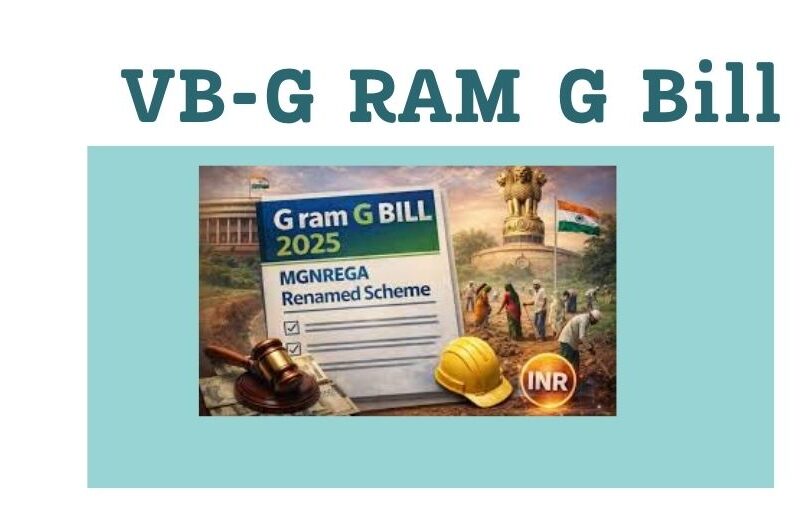
VB-G RAM G Bill, 2025: A Revised Rural Employment Guarantee with Infrastructure Focus

GRAM G Bill, 2025: A Revised Rural Employment Guarantee with Infrastructure Focus 1) Viksit Bharat–G RAM G Bill, 2025 proposes replacing Mahatma Gandhi National Rural Employment Guarantee Act (MGNREGA) with a new statutory rural employment framework linked to the Viksit Bharat 2047 vision.   2) The Bill raises the guaranteed wage employment to 125 days per rural household per financial year, compared to the earlier 100-day entitlement under MGNREGA.   3) It introduces an aggregated 60-day “no-work” pause during sowing and harvesting seasons to avoid disrupting peak farm operations, while still ensuring 125 workdays within the remaining 305 days.   4) Wage payments are tightened: wages must be paid weekly, or at the latest within 15 days (a fortnight) after the work is completed.   5) Works are tied to durable rural assets under four priority verticals: water security works, core rural infrastructure, livelihood-linked infrastructure, and special works for extreme weather risk mitigation.   6) All created assets will be pooled into the Viksit Bharat National Rural Infrastructure Stack to enable unified tracking, coordination, and outcome monitoring at the national level.   7) Planning is decentralised through Viksit Gram Panchayat Plans prepared locally, and these plans are spatially linked with PM Gati Shakti for integrated infrastructure planning.   8) Funding shifts from demand-based releases to a normative allocation model to reduce budget uncertainty, while keeping legal entitlements intact.   9) Estimated annual funds requirement for wages, material, and administration is ₹1,51,282 crore (including State share), with estimated Central share at ₹95,692.31 crore.   10) Cost sharing is set at 60:40 between Centre and States; 90:10 for North Eastern and Himalayan States; and 100% Central funding for Union Territories without legislatures.   11) The administrative expenditure ceiling increases from 6% to 9% to strengthen staffing, pay, training, and technical capacity for planning, execution, and accountability.   12) Women’s participation under MGNREGA increased from 48% to 58.15% between FY 2013-14 and FY 2025-26, alongside near-universal electronic wage payments and wider Aadhaar-based governance.   13) Monitoring findings cited include works not found on ground, spending not matching physical progress, machine use in labour works, bypassing digital attendance, and accumulated misappropriation.   14) Unemployment allowance becomes payable if work is not provided: after 15 days, a daily allowance is due; liability rests on States; and rates and conditions will be set through rules.   15) Governance includes Central and State Gramin Rozgar Guarantee Councils, Steering Committees, Panchayati Raj Institutions, District Programme Coordinators, Programme Officers, and stronger Gram Sabha social audits at least once every six months.     Must Know Terms :     1) Normative Allocation: Funds are fixed in advance using standard norms (households, expected person-days, unit costs, admin limits), so money is sanctioned upfront instead of waiting for demand spikes. This reduces mid-year cash shortage, late wage payments, and sudden supplementary demands. Legal right to work remains, but budget flow becomes more predictable for States and districts.   2) Unemployment Allowance: If work is not given within 15 days of demand, a daily allowance becomes payable. Payment liability is on the State, so States lose money if they fail to provide work. The exact rate, eligibility rules, and payment process are notified through rules. This creates a direct financial penalty for delay in providing employment.   3) Viksit Gram Panchayat Plans: Village-level plans listing works, locations, and season-wise schedule, prepared locally by Gram Panchayat with Gram Sabha role. These plans prioritise practical works like water harvesting, drainage, rural roads, community assets, and livelihood-support works. They are mapped with PM Gati Shakti so village projects align with larger road/utility corridors and avoid duplication.   4) Rural Infrastructure Stack: A single national asset database where every created work is recorded with location and basic details for tracking. It is meant to show what asset was built, where, cost, stage, and expected use. This helps prevent “work not found on ground” cases, supports monitoring of physical progress versus spending, and improves transparency across districts and States.   5) Administrative Expenditure Ceiling: Maximum allowed share for admin costs such as field staff, technical measurements, training, supervision, and system support. Raising the ceiling from 6% to 9% increases money available for staffing and technical capacity. The intent is faster approvals, better worksite checks, stronger monitoring, and fewer payment delays and execution gaps.   6) Social Audit Frequency: Social audits must happen at least once every six months in Gram Sabha. Records like attendance, worksite existence, measurements, and wage payments are publicly checked. Regular audits reduce scope for fake works, machine use in labour works, and record manipulation. Findings are expected to trigger recovery, corrective action, and accountability steps faster. MCQ: 1. Under the GRAM G Bill, 2025, the proposed annual wage-work entitlement per rural household is: (a) 100 days (b) 110 days (c) 125 days (d) 150 days 2. The Bill introduces an aggregated “no-work” window of: (a) 30 days (b) 45 days (c) 60 days (d) 75 days 3. Wage payments are proposed to be made: (a) Monthly only (b) Weekly, or not later than a fortnight after work completion (c) Only after project completion (d) Quarterly through cash disbursement 4. The Bill explicitly links wage employment with durable rural infrastructure through how many priority verticals? (a) Two (b) Three (c) Four (d) Five 5. Which of the following is NOT listed among the priority verticals for infrastructure linkage? (a) Water security works (b) Core rural infrastructure (c) Livelihood-related infrastructure (d) Urban metro connectivity works 6. Planning is proposed to be decentralised through locally prepared: (a) District Vision 2035 Reports (b) Viksit Gram Panchayat Plans (c) State Capital Region Plans (d) Regional Industrial Master Plans 7. Assets created are proposed to be aggregated into a national rural infrastructure: (a) Ledger (b) Stack (c) Portal (d) Census 8. A major funding design shift proposed is moving from: (a) Normative allocation to demand-based funding (b) Demand-based funding to normative allocation (c) State-only funding to private funding (d) Cash funding to barter funding 9. The standard cost-sharing

More Details

India’s Labour Reforms: Simplification, Security, and Sustainable Growth

India’s Labour Reforms: Simplification, Security, and Sustainable Growth     Introduction   India’s labour ecosystem has undergone a significant structural transformation aimed at aligning worker welfare with the needs of a rapidly evolving economy. As employment expands across sectors and work arrangements diversify, the regulatory framework has been redesigned to ensure simplicity, security, and sustainability. The consolidation of multiple legislations into a streamlined structure reflects an effort to modernise labour governance while balancing economic growth with social protection.   Rationale for Labour Law Consolidation   Earlier labour regulations were fragmented across numerous laws, creating compliance complexity and enforcement challenges for both workers and enterprises. Many of these laws were rooted in outdated economic conditions and did not adequately reflect contemporary production systems, technological integration, or new forms of work. Consolidation was undertaken to simplify compliance, reduce administrative burden, improve enforcement efficiency, and align labour regulation with present-day economic realities.   Structure of the Four Labour Codes   The reformed framework groups existing provisions into four functional codes covering wages, industrial relations, social security, and occupational safety. This structure creates clarity by defining rights and obligations within a unified system rather than scattered statutes. The approach improves consistency in definitions, procedures, and standards, enabling smoother implementation and better understanding for stakeholders across the labour market.   Wage Security and Equality   The wage-related framework establishes universal wage protection, ensuring that minimum wage standards apply across sectors and categories of workers. It introduces mechanisms to ensure fairness, timely payment, and gender neutrality in remuneration. By standardising wage definitions and reducing ambiguity, the system strengthens income security and enhances transparency in employer–employee relationships.   Industrial Relations and Workforce Flexibility   The industrial relations framework seeks to balance enterprise continuity with worker protection. It simplifies processes related to trade unions, employment conditions, and dispute resolution. Provisions support structured collective bargaining, quicker resolution of disputes, and flexible employment arrangements, while maintaining safeguards against arbitrary practices. The objective is to create a stable industrial environment conducive to productivity and cooperation.   Expansion of Social Security Coverage   A key reform lies in extending social security beyond traditionally covered workers to include unorganised, gig, and platform workers. The framework integrates multiple welfare provisions under a common structure, covering health, maternity, provident fund, gratuity, and compensation benefits. Digital systems and dedicated funds improve accessibility, portability, and delivery of benefits across regions and occupations.   Occupational Safety and Working Conditions   The safety and working conditions framework consolidates diverse regulations into a single code addressing health standards, working hours, welfare facilities, and workplace safety. It introduces uniform registration and licensing systems, enhances protection for migrant and contract workers, and expands coverage to hazardous activities. Emphasis is placed on preventive safety, formal documentation, and shared responsibility between employers and workers.   Compliance, Governance, and Digitisation   The reforms prioritise ease of compliance through single registration, licensing, and return mechanisms. Technology-enabled processes, risk-based inspections, and facilitator-oriented enforcement improve transparency and reduce discretionary intervention. Decriminalisation of minor offences and emphasis on monetary penalties encourage voluntary compliance while maintaining accountability.   Conclusion   India’s labour reforms represent a shift toward a simplified, inclusive, and future-ready labour framework. By integrating worker protection with economic efficiency, the new structure supports employment generation, enterprise growth, and social security expansion. The emphasis on clarity, digitisation, and balanced governance strengthens the foundation for a resilient labour market capable of supporting long-term, inclusive economic progress.       Multiple Choice Questions   (1)The consolidation of India’s labour laws resulted in how many Labour Codes? (a) Two (b) Three (c) Four (d) Five   Employment in India increased from 47.5 crore in 2017–18 to approximately: 55.2 crore in 2023–24 60.1 crore in 2023–24 62.8 crore in 2023–24 64.33 crore in 2023–24   During the same period, the unemployment rate declined to: 4.8% 4.0% 3.5% 3.2%   The Code on Wages, 2019 consolidated provisions of how many earlier labour laws? Two Three Four Five   The statutory concept introduced to ensure a nationwide minimum standard of wages is known as: Living Wage Fair Wage Floor Wage Basic Wage   Under the Code on Wages, overtime work must be compensated at: 1.25 times the normal wage 1.5 times the normal wage 1.75 times the normal wage At least twice the normal wage   The Industrial Relations Code, 2020 amalgamates provisions of: Two labour laws Three labour laws Four labour laws Five labour laws   Fixed Term Employment under the Industrial Relations Code provides gratuity eligibility after: Six months One year Three years Five years   Approval threshold for lay-off, retrenchment, or closure under the Industrial Relations Code has been raised to: 100 workers 200 workers 250 workers 300 workers   The Code on Social Security, 2020 extends coverage explicitly to: Only organized sector workers Only industrial workers Gig and platform workers Only government employees   Aggregators under the Social Security Code are required to contribute: 0.5–1% of turnover 1–2% of turnover, subject to limits 3–5% of turnover A fixed annual contribution   Fixed-term employees become eligible for gratuity after: Six months of service One year of continuous service Three years of service Five years of service   The Occupational Safety, Health and Working Conditions Code sets a uniform registration threshold of: 5 employees 8 employees 10 employees 20 employees   Women are permitted to work during night hours under the new framework provided: Employer approval alone is obtained State notification is issued Consent and safety measures are ensured Only in manufacturing units   Normal working hours under the Occupational Safety Code are capped at: 7 hours per day and 42 hours per week 8 hours per day and 48 hours per week 9 hours per day and 50 hours per week 10 hours per day and 60 hours per week    

More Details

Free IAS Guidance
Start Your Journey Today 🇮🇳

Fill out the form below, and we will be in touch shortly.