Best UPSC and MPPSC IAS Coaching Classes in Gwalior

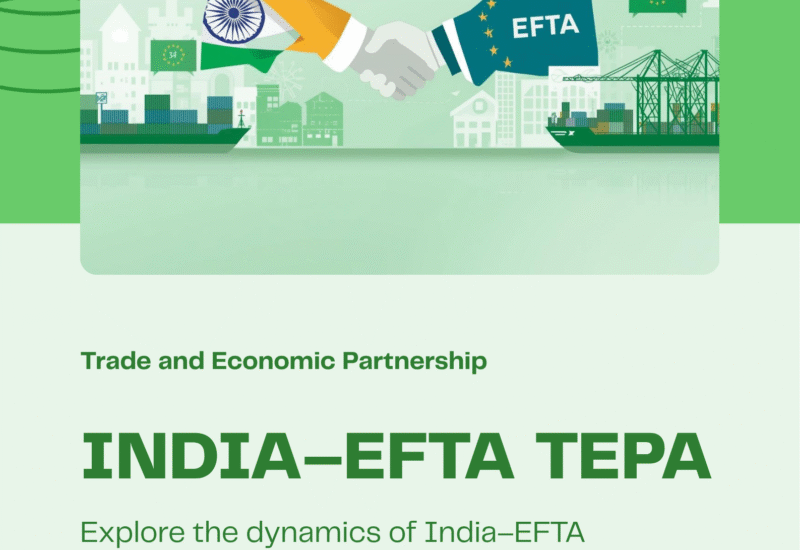
INDIA–EFTA TRADE AND ECONOMIC PARTNERSHIP AGREEMENT (TEPA) 

INDIA–EFTA TRADE AND ECONOMIC PARTNERSHIP AGREEMENT (TEPA)    INTRODUCTION – The India–EFTA TEPA came into effect on 1 October 2025, signed on 10 March 2024 in New Delhi. – It is India’s first Free Trade Agreement with four developed European nations — Switzerland, Norway, Iceland, and Liechtenstein. – First FTA to include binding commitments on investment and job creation: USD 100 billion investment and 1 million direct jobs over 15 years. – Aligns India’s Atmanirbhar Bharat vision with EFTA’s pursuit of diversified, resilient partnerships.   ABOUT EFTA – European Free Trade Association (EFTA) established in 1960. – Members: Iceland, Liechtenstein, Norway, Switzerland. – Promotes free trade and economic integration among non-EU European economies.   KEY FEATURES OF TEPA   (a) Investment and Employment – USD 50 billion FDI in the first 10 years + USD 50 billion in next 5 years (Article 7.1). – One million direct jobs expected. – Focus areas: manufacturing, innovation, renewable energy, life sciences, digital transformation. – India–EFTA Investment Desk operational since February 2025.   (b) Market Access – EFTA: 92.2% of tariff lines (99.6% of India’s exports). – India: 82.7% of tariff lines (95.3% of EFTA exports). – Sensitive sectors excluded: dairy, soya, coal, pharma, medical devices. – Gold imports (80% of total from EFTA) – no duty change. – Tariff reduction phased for Make in India and PLI sectors (5–10 years).   (c) Services and Mobility – India made commitments in 105 sub-sectors; EFTA in 110–128. – Covers IT, business, cultural, education, and professional services. – Includes MRAs in nursing, chartered accountancy, and architecture. – Market access modes: Mode 1 – Digital delivery of services Mode 3 – Commercial presence Mode 4 – Temporary movement of professionals   (d) Intellectual Property Rights (IPR) – Based on TRIPS principles with flexibility for generics and public health. – Protects innovation while preventing patent evergreening. – Enhances mutual trust between India and innovation hubs like Switzerland.   (e) Sustainable Development – Promotes inclusive growth, transparency, simplification, and environmental protection. – Contains a separate chapter on Trade and Sustainable Development (TSD).   SECTORAL AND COUNTRY-WISE GAINS   (a) Agriculture and Allied Goods – Exports: guar gum, basmati rice, pulses, fruits, grapes. – Tariff benefits mainly in Switzerland and Norway (covering 99% of India’s agri-trade with EFTA). Switzerland – Tariff removal on food, grapes, nuts, vegetables. Norway – Duty-free access for rice, condiments, beverages. Iceland – MFN tariffs on processed foods and confectionery cut to zero.   (b) Marine Products – Norway: Up to 13.16% duty removed on fish and shrimp feed. – Iceland: Up to 10% tariff eliminated on frozen seafood. – Switzerland: Zero duty on fish oils.   (c) Industrial and Manufacturing – Engineering exports: USD 315 million in FY 2024–25 (18% growth). – Gains for electric machinery, energy systems, and precision engineering. – Textiles, leather, sports goods, and toys gain from zero-duty access. – Gems and jewellery receive stable duty-free access.   (d) Electronics and Software – Focus: medical electronics, smart sensors, fintech, EV components, energy monitoring systems. – Expands scope for MSMEs and OEMs to integrate with European markets.   (e) Chemicals, Plastics and Allied Products – Zero or reduced tariffs on 95% of exports. – Export growth expected from USD 49 million to USD 65–70 million. – Enables diversification into high-value European markets.   STRATEGIC AND POLICY SIGNIFICANCE – First FTA with a developed European bloc. – Strengthens India’s credibility in global trade negotiations. – Balances domestic protection with export competitiveness. – Advances Make in India, PLI, and Atmanirbhar Bharat objectives. – Encourages technology transfer, innovation partnerships, and green trade.   QUANTITATIVE SNAPSHOT   Parameter Value / Commitment Signed On 10 March 2024 Came into Force 1 October 2025 Investment Commitment $100 billion (15 years) Job Creation Target 1 million direct jobs EFTA Tariff Coverage 92.2% of lines (99.6% of India’s exports) India Tariff Coverage 82.7% of lines (95.3% of EFTA exports) Sensitive Sectors Dairy, coal, soya, select agri goods Key Provisions IPR, MRAs, Sustainable Development, Services Access   SIGNIFICANCE TEPA marks a shift in India’s trade strategy from tariff liberalization to comprehensive economic partnerships driven by investment, employment, and sustainability. It establishes India as a trusted partner in rule-based trade, integrating domestic priorities with global economic opportunities.             MCQ Q1. With reference to the India–EFTA Trade and Economic Partnership Agreement (TEPA), consider the following statements: It is India’s first Free Trade Agreement with four developed European countries. It includes legally binding investment commitments for the first time in any Indian FTA. The agreement came into force in March 2024. Which of the statements given above is/are correct? (a) 1 and 2 only (b) 2 and 3 only (c) 1 and 3 only (d) 1, 2 and 3   Q2. The European Free Trade Association (EFTA) comprises which of the following countries? Iceland Norway Finland Switzerland Liechtenstein Select the correct answer using the code given below: (a) 1, 2, 4 and 5 only (b) 1, 3, 4 and 5 only (c) 2, 3 and 4 only (d) 1, 2, 3, 4 and 5   Q3. Under the TEPA, India has committed to cover approximately what percentage of tariff lines for EFTA exports? (a) 72% (b) 82.7% (c) 89.4% (d) 92.2%   Q4. Which of the following sectors were kept under the ‘sensitive’ category and excluded from tariff liberalisation under TEPA? (a) Dairy and coal (b) Automobiles and petroleum (c) Electronics and software (d) Renewable energy and mining   Q5. Consider the following pairs: Mode of Service Delivery — Description Mode 1 — Commercial presence in foreign country Mode 3 — Digital delivery of services Mode 4 — Temporary movement of professionals Which of the pairs given above is/are correctly matched? (a) 1 and 3 only (b) 2 and 3 only (c) 3 only (d) None   Q6. The TEPA’s Intellectual Property Rights (IPR) chapter is notable because it: (a) Compels India to adopt European patent laws entirely. (b) Protects innovation while allowing flexibility for generics and public health.

More Details

India’s Critical Mineral Mission: Securing the Minerals of Tomorrow

India’s Critical Mineral Mission: Securing the Minerals of Tomorrow   Introduction Launched in January 2025, the National Critical Mineral Mission (NCMM) is India’s 7-year strategic blueprint (2024–25 to 2030–31) to secure supply chains of essential minerals critical for clean energy, electronics, transport, and defense. With ₹16,300 crore in government expenditure and ₹18,000 crore expected from PSUs, it aims to ensure mineral self-reliance and technological independence.   What are Critical Minerals Critical minerals are essential for economic growth, clean energy, and national security, with supply chains vulnerable to disruption. India’s 2023 list identifies 30 critical minerals including lithium, cobalt, nickel, titanium, rare earth elements (REE), copper, tungsten, vanadium, and zirconium.   Importance for India’s Clean Energy Transition a) Solar Energy – Photovoltaic cells depend on silicon, indium, gallium, and tellurium; crucial for India’s 64 GW solar capacity. b) Wind Power – Magnets in turbines use neodymium and dysprosium; vital for the 2030 target of 140 GW wind capacity. c) Electric Vehicles – Batteries require lithium, nickel, and cobalt; with 30% EV penetration target by 2030. d) Energy Storage – Lithium-ion systems rely on lithium, cobalt, and nickel to store renewable power.   Policy and Institutional Framework The Mission is anchored under the amended Mines and Minerals (Development and Regulation) Act (MMDR Act), empowering the Centre to auction 24 of 30 critical minerals. It focuses on exploration, processing, recycling, R&D, and human resource development.   Recycling and Circular Economy A ₹1,500 crore Incentive Scheme supports recycling of critical minerals from e-waste, EV batteries, and vehicle scrap. Targets include: – 270 kilo ton annual recycling capacity – 40 kilo ton of mineral output – ₹8,000 crore investment – 70,000 new jobs   Innovation and Patent Targets NCMM aims for 1,000 patents by FY 2030–31 to advance mineral technologies. Between May–June 2025, 62 patents were filed and 10 granted, covering materials like lithium, tungsten, titanium, vanadium, and tantalum—crucial for defense, batteries, and electronics.   Centres of Excellence (CoEs) Seven premier institutions designated as CoEs: – IIT Bombay – IIT Hyderabad – IIT (ISM) Dhanbad – IIT Roorkee – CSIR–IMMT Bhubaneswar – CSIR–NML Jamshedpur – NFTDC Hyderabad These centres lead R&D, processing innovation, and mineral exploration under NCMM.   Strategic Initiatives – ₹100 crore pilot projects to extract minerals from non-traditional sources (fly ash, red mud, mine tailings) – Development of processing parks and mineral stockpiles – Encouraging global asset acquisitions by Indian PSUs and private firms – Workforce training and strategic reserves creation   Broader Vision India’s mineral strategy under NCMM aligns with its climate goals: – Reduce GDP emission intensity by 45% by 2030 (from 2005) – Achieve 50% non-fossil power capacity by 2030 – Reach net-zero emissions by 2070 NCMM thus positions India as a global hub for clean technology, supply chain security, and innovation in mineral processing.   Conclusion Critical minerals are the foundation of a green, secure, and industrially advanced India. Through the National Critical Mineral Mission, the country is moving toward energy self-sufficiency, technological innovation, and global leadership in the minerals of tomorrow.   MCQ The National Critical Mineral Mission (NCMM) was launched in which year? (a) 2024 (b) 2025 (c) 2023 (d) 2026   The proposed government expenditure for NCMM is approximately: (a) ₹10,000 crore (b) ₹16,300 crore (c) ₹18,000 crore (d) ₹20,000 crore   The expected investment from PSUs and other stakeholders under NCMM is: (a) ₹16,300 crore (b) ₹18,000 crore (c) ₹15,000 crore (d) ₹20,000 crore   NCMM is primarily designed to ensure: (a) Only mining growth (b) Energy security, industrial growth, and technological independence (c) Foreign mineral dependence (d) Only export promotion   Which of the following is NOT included in India’s list of 30 critical minerals? (a) Lithium (b) Titanium (c) Coal (d) Vanadium   Critical minerals are essential for: (a) Agriculture only (b) Economic development and national security (c) Textile industry (d) Tourism   The mineral vital for solar photovoltaic cells include: (a) Lithium and cobalt (b) Silicon, indium, gallium, tellurium (c) Nickel and copper (d) Neodymium and dysprosium   Which minerals are essential for wind turbine magnets? (a) Lithium and cobalt (b) Nickel and titanium (c) Neodymium and dysprosium (d) Silicon and tellurium   Which minerals are key for electric vehicle batteries? (a) Lithium, nickel, cobalt (b) Silicon, indium, tellurium (c) Copper, gallium (d) Zirconium, hafnium   Energy storage using lithium-ion batteries depends on: (a) Lithium, cobalt, nickel (b) Copper, gold, silver (c) Titanium, tungsten, vanadium (d) Graphite, bismuth, antimony   How many years is NCMM planned for? (a) 5 (b) 6 (c) 7 (d) 8   How many critical minerals can the Central Government auction under MMDR Act? (a) 30 (b) 24 (c) 20 (d) 15   The NCMM incentive scheme for recycling is worth: (a) ₹1,000 crore (b) ₹1,500 crore (c) ₹2,000 crore (d) ₹2,500 crore   The annual recycling capacity target under NCMM is: (a) 100 kilo ton (b) 270 kilo ton (c) 500 kilo ton (d) 350 kilo ton   How many kilo ton of critical minerals is NCMM expected to produce via recycling? (a) 20 (b) 30 (c) 40 (d) 50   Approximately how many jobs is NCMM recycling scheme expected to generate? (a) 50,000 (b) 60,000 (c) 70,000 (d) 80,000   NCMM targets how many patents by 2030–31? (a) 500 (b) 750 (c) 1,000 (d) 1,500   How many patents were filed in May 2025 in the critical mineral sector? (a) 21 (b) 31 (c) 41 (d) 51   How many patents were filed in June 2025? (a) 21 (b) 31 (c) 41 (d) 51   Centres of Excellence (CoEs) under NCMM include how many IITs? (a) 3 (b) 4 (c) 5 (d) 6   How many research laboratories are designated as CoEs under NCMM? (a) 2 (b) 3 (c) 4 (d) 5   Which of the following is NOT an NCMM CoE? (a) IIT Bombay (b) IIT Delhi (c) CSIR–NML Jamshedpur (d) NFTDC Hyderabad   Pilot projects under NCMM aim to extract minerals from: (a) Only traditional mines (b) Industrial byproducts like fly ash,

More Details

GSAT-7R Satellite: A New Era in India’s Naval Communication Power

GSAT-7R Satellite: A New Era in India’s Naval Communication Power Introduction GSAT-7R is India’s latest and most advanced communication satellite dedicated to the Indian Navy. Launched by the Indian Space Research Organisation (ISRO), it significantly strengthens maritime communication and operational capabilities across the vast Indian Ocean Region. This satellite marks a major milestone in India’s mission to build a secure, indigenous, and technologically superior defence infrastructure. By enhancing encrypted communication support for ships, submarines, aircraft, and naval bases, GSAT-7R elevates India into a new era of maritime security and strategic readiness.   Development and Launch GSAT-7R is a successor to earlier communication satellites in the GSAT-7 series that serve India’s defence forces. Weighing around 4400 kilograms, it is one of the heaviest military communication satellites ever launched by India. The satellite was placed into Geosynchronous Transfer Orbit using the LVM-3 heavy-lift launcher, ISRO’s most powerful rocket. With an estimated operational life of about 12 to 15 years, GSAT-7R will ensure long-term support to naval operations. The mission highlights India’s growing technological capabilities in space-based defence assets and reflects the progress under the Aatmanirbhar Bharat initiative.   Technical Capabilities GSAT-7R is equipped with advanced multi-band communication systems that support reliable and secure exchange of voice, data, and real-time video. The satellite connects ships to submarines, aircraft to naval headquarters, and different command-and-control centres to each other without disruption. It enhances network-centric warfare capabilities by providing battlefield awareness and faster response chains. A remarkable feature of GSAT-7R is the extensive use of indigenously developed components and improved propulsion and antenna systems. The satellite ensures encrypted, interference-free communication for defence forces even in hostile conditions. By supporting modern maritime operations like anti-submarine warfare, surveillance missions, and maritime reconnaissance, GSAT-7R becomes a core pillar of naval digital transformation.   Strategic Importance The Indian Ocean Region holds immense strategic value for India’s economic security and geopolitical influence. Nearly all energy and trade routes pass through this region. Keeping them secure from foreign aggression, piracy, terrorism, or underwater threats requires fast communication and perfect coordination among naval assets. GSAT-7R meets this exact requirement by ensuring continuous and confidential connectivity over long distances, whether ships are operating close to the coast or deep in the ocean. As global powers increase maritime presence in the Indian Ocean, India’s enhanced space-based communication strengthens its surveillance, deterrence, and power projection capability. Faster decision-making and stronger command structures will directly contribute to national security and stability in the wider Indo-Pacific region.   GSAT-7 Satellite Series for the Armed Forces India is steadily expanding a dedicated defence satellite network. GSAT-7 (Rukmini), launched in 2013, was the first military satellite exclusively for the Indian Navy. GSAT-7A was launched for the Indian Air Force and Army to support UAV and air-ground communication. GSAT-7R, as the newest addition, takes the Indian Navy’s communication power to the next level with upgraded payloads and enhanced coverage.   Strengthening Defence and Self-Reliance GSAT-7R showcases India’s emergence as a modern defence power capable of independently developing space-based strategic systems. It reduces reliance on external technologies and supports the vision of a secure, resilient, and technologically advanced naval force. The satellite also empowers the Defence Space Agency and future missions that may integrate space, cyber, and artificial intelligence-driven warfare systems.   Conclusion GSAT-7R is not just a satellite launch; it is a strategic investment that reinforces India’s maritime superiority for the next decade and beyond. With secure communication and real-time monitoring across the Indian Ocean, the Indian Navy will operate with greater efficiency, intelligence, and authority. GSAT-7R symbolizes India’s confidence, capability, and commitment to protecting national interests in an increasingly contested maritime environment. MCQ 1. GSAT-7R is primarily designed to enhance communication capabilities of: (a) Indian Air Force (b) Indian Navy (c) Indian Army (d) DRDO 2. GSAT-7R was launched using which ISRO launch vehicle? (a) PSLV (b) GSLV Mk-II (c) LVM-3 (d) SSLV 3. The approximate weight of GSAT-7R is: (a) 1200 kg (b) 2200 kg (c) 3400 kg (d) 4400 kg 4. The operational life of GSAT-7R is estimated to be: (a) 5–7 years (b) 8–10 years (c) 12–15 years (d) 20 years 5. GSAT-7R strengthens India’s position in which region? (a) Arctic region (b) Pacific region (c) Indian Ocean Region (d) Atlantic region 6. Which earlier satellite series does GSAT-7R succeed? (a) INSAT-3D (b) GSAT-6 (c) GSAT-7 series (d) Cartosat series 7. GSAT-7R supports which type of defence communication? (a) Only voice communication (b) Only video communication (c) Multi-band encrypted communication (d) Only radar-based communication 8. One of the major strategic benefits of GSAT-7R is: (a) Enhancing agricultural productivity (b) Facilitating underwater and naval operations (c) Weather forecasting (d) Railway signalling 9. The first exclusive military satellite for the Indian Navy was: (a) GSAT-7A (b) GSAT-7R (c) GSAT-7 (Rukmini) (d) RISAT-2 10. GSAT-7A was launched primarily for: (a) Navy operations (b) Space research (c) Indian Air Force and Army (d) ISRO internal testing 11. GSAT-7R contributes to which national initiative? (a) Digital India (b) Make in India (c) Aatmanirbhar Bharat (d) Skill India 12. Which of the following is a key technical feature of GSAT-7R? (a) Solar imaging capability (b) Encrypted, interference-free communication (c) Weather radar systems (d) Civilian broadcast channels 13. GSAT-7R helps improve which warfare capability? (a) Desert warfare (b) Biological warfare (c) Network-centric maritime warfare (d) Space tourism 14. Which organisation launched GSAT-7R? (a) DRDO (b) HAL (c) ISRO (d) BEL 15. GSAT-7R enhances the Navy’s: (a) Fishing capacity (b) Maritime surveillance and coordination (c) Tourism activities (d) Civil aviation monitoring  

More Details

August 2025 Current Affairs Part-2

Promotion and Regulation of Online Gaming Act, 2025 – Passed August 2025 Passed in August 2025, this Act establishes a national framework for online gaming regulation in India. It distinguishes between games of skill and chance, prohibits real-money gambling platforms, promotes e-sports, and sets up a central regulatory body—making India one of the few countries with a dedicated gaming law. Key Points: Bans all real-money gaming involving chance, including betting and wagering. Allows certified e-sports and skill-based platforms to operate under regulation. Establishes the National Online Gaming Commission (NOGC) to license and monitor platforms. Mandates platforms to verify age, comply with data security, and ensure no addictive mechanics. Penal provisions include heavy fines and platform shutdowns for non-compliance. The Act strikes a careful balance—protecting users from digital gambling addiction while nurturing the potential of e-sports and gaming startups. By creating a defined legal ecosystem, it brings legitimacy and order to a rapidly expanding but previously grey regulatory area. UPSC Prelims‑style MCQs: The Promotion and Regulation of Online Gaming Act, 2025 prohibits: A) E-sports events B) Real-money betting platforms C) Skill-based puzzles D) Fantasy leagues with entry limits The Act empowers which regulatory body? A) TRAI B) National Gaming Commission of India C) National Online Gaming Commission D) Digital India Games Authority Which of the following is permitted under the Act? A) Online poker tournaments B) Educational quiz games C) Lottery apps D) Roulette and slot machine apps The Act was primarily passed to: A) Boost state tax revenue B) Promote fantasy cricket C) Curb gambling and support skill-based gaming D) Expand casinos across Indian states UN Regional SDG Centre for Central Asia and Afghanistan – Launched 3 August 2025   In a landmark development, the United Nations inaugurated a Regional Centre for Sustainable Development Goals in Almaty, Kazakhstan, on 3 August 2025. The centre aims to enhance regional cooperation, especially for fragile states like Afghanistan, in achieving Agenda 2030 targets. Key Points: Functions as a multilateral platform for SDG planning, monitoring, and coordination across Central Asia. Focuses on education, gender equity, water security, and post-conflict resilience in Afghanistan. Operates under the UN Sustainable Development Division in collaboration with local governments. Expected to strengthen climate adaptation, urban resilience, and digital governance. Serves as a neutral bridge between Central Asian republics and global partners. This centre enhances institutional capacity in a geopolitically volatile region. For India, it offers strategic convergence—supporting Afghanistan’s development while countering influence from other regional powers through multilateral frameworks and soft power diplomacy. UPSC Prelims‑style MCQs: The UN SDG Regional Centre launched in August 2025 is located in: A) Kabul B) Dushanbe C) Almaty D) Tashkent One of the core goals of the centre is to: A) Build railways in Central Asia B) Provide military training C) Coordinate SDG efforts in fragile states D) Promote e-sports across Afghanistan Which of the following is NOT a focus area of the Centre? A) Water security B) Digital governance C) Arms trade regulation D) Post-conflict resilience The Centre works under: A) UN Security Council B) UN Development Programme C) UN Sustainable Development Division D) UNESCO Pradhan Mantri Kisan Samman Nidhi – 20th Installment (2 August 2025) On 2 August 2025, Prime Minister Modi released the 20th installment of the PM-KISAN scheme in Varanasi. A total of ₹20,500 crore was disbursed via Direct Benefit Transfer to 9.7 crore farmers, reinforcing the government’s commitment to agricultural welfare and digital transparency. Key Points: Mass Disbursement: ₹20,500 crore transferred to 9.7 crore beneficiaries—each received ₹2,000. Transparent Delivery: Funds credited instantaneously via DBT, minimizing leakages. Community Engagement: Event emphasized as both mission and festival, mobilizing KVKs, Drone Didis, Krishi Sakhis, and others. Agricultural Messaging: PM, amidst tariff tensions, reaffirmed support for farmers, promoted ‘Vocal for Local’, and inaugurated development projects alongside the disbursement. Potential Delays: Some farmers faced delays due to e‑KYC incomplete or land record linkage issues; advised to check status via portal or helplines. The 20th installment exemplifies how digital infrastructure and community outreach can elevate welfare schemes. By linking monetary relief with developmental messaging and addressing procedural hurdles, it reinforces both pedagogical outreach and grassroots-centric governance. UPSC Prelims‑style MCQs: The 20th installment of PM‑KISAN, released on 2 August 2025, involved disbursement of approximately: A) ₹6,000 crore B) ₹20,500 crore C) ₹50,000 crore D) ₹3.6 lakh crore How much did each eligible farmer receive under the 20th installment? A) ₹500 B) ₹2,000 C) ₹6,000 D) ₹10,000 Which method was used to transfer the funds? A) Postal cheques B) Direct Benefit Transfer (DBT) C) Cash distribution at KVKs D) Through agricultural cooperatives Which of the following was not a reason for payment delay mentioned in media reports? A) Incomplete e-KYC B) Incorrect bank details C) Pending land record linkage D) Faulty biometric screening at village level Raksha Bandhan Event under Nasha Mukt Bharat Abhiyaan (8 August 2025) On 8 August 2025, as part of the fifth anniversary of the Nasha Mukt Bharat Abhiyaan (NMBA), Brahma Kumaris sisters tied rakhis to nearly 400 CRPF personnel at the Dr. Ambedkar International Centre in New Delhi. The event included a mass pledge against drug abuse, symbolizing the nation’s commitment to a drug-free society. Key Points: Organized by the Department of Social Justice & Empowerment to honor Raksha Bandhan and reinforce NMBA goals. Brahma Kumaris tied rakhis to approximately 400 CRPF jawans, viewing them as defenders of society against drugs. Participants—including ministers, officers, and civil society—took a mass pledge committing to remain drug-free. NMBA, operational across all districts, focuses on raising awareness among youth, women, and educational institutions. The campaign includes tech-enabled initiatives such as NMBA mobile app, online pledges, Master Volunteers, and institutional collaborations. Merging cultural symbolism with social messaging, this unique Raksha Bandhan initiative strengthened public outreach and emotional resonance of NMBA. By involving uniformed personnel and spiritual entities, it blended moral appeal with institutional partnership—enhancing public engagement with the anti-drug mission. UPSC Prelims‑style MCQs: The special Raksha Bandhan event under Nasha Mukt Bharat Abhiyaan in August 2025 involved: A) Tying rakhis to BSF jawans B) A

More Details

August 2025 Current Affairs Part-1

Pradhan Mantri Viksit Bharat Rozgar Yojana (PM-VBRY) – Launched 15 August 2025 On 15 August 2025, PM Modi announced the Pradhan Mantri Viksit Bharat Rozgar Yojana, a ₹1 lakh crore Employment Linked Incentives scheme under the “Viksit Bharat 2047” vision. It targets creation of 3.5 crore jobs in two years, offering wage support to youth and hiring incentives to employers. Key Points: Scheme Outlay & Timeline: ₹99,446 crore approved; job generation valid from 1 August 2025 to 31 July 2027. Beneficiaries: Aims to create 3.5 crore jobs, with nearly 1.92 crore first-time workers supported. Dual Incentives: Part A supports employees (e.g., partial wage support); Part B incentivizes employers for job creation. Implementation Mode: Benefits transferred directly to beneficiaries for transparency and efficiency. Link with Vision: Aligns with “Viksit Bharat 2047”, turning demographic potential into formal employment-led growth. The PM-VBRY is a critical instrument to translate India’s demographic dividend into sustainable growth. By blending employee-driven wage support with employer incentives, it fosters immediate job creation while embedding long-term structural reform.  MCQs: The Pradhan Mantri Viksit Bharat Rozgar Yojana (PM-VBRY), launched on 15 August 2025, aims to create how many jobs? A) 1 crore B) 2 crore C) 3.5 crore D) 5 crore Under PM-VBRY, scheme benefits are designed to be transferred: A) Through state governments B) Via banks only C) Directly to beneficiaries D) Through NGOs Which aspect of PM-VBRY refers to financial support to employers for job generation? A) Part A B) Part B C) Part C D) Part D The PM-VBRY scheme is intended to operate within which timeline? A) Aug 2025 – Jul 2027 B) Jan 2025 – Dec 2026 C) Aug 2025 – Aug 2028 D) Jan 2026 – Dec 2027 Next‑Generation GST Reforms – Effective from 22 September 2025 As announced under India’s “Next‑Generation GST Reforms,” the GST Council on 3 September streamlined the tax system into two rate slabs—5% (merit) and 18% (standard)—plus a 40% demerit rate for sin and luxury goods. Additionally, essential items and insurance received tax relief; reforms aim to simplify compliance and boost affordability. Key Points: Simplified Slab Structure: GST reduced from four slabs (5%, 12%, 18%, 28%) to two—5% and 18%—with 40% applied only to sin and luxury goods. Tax Relief for Common Goods: Everyday essentials—from toiletries and packaged foods to soap, hair oil, butter, and paneer—now attract reduced or zero GST. Insurance Exemption: All individual life and health insurance policies (including ULIPs and senior citizen plans) are now fully exempt from GST. Rationalization & Structural Reforms: The reform corrects inverted duty structures, resolves classification disputes, and improves compliance through facilitation measures. Effective Date & Impact: Implemented from 22 September 2025. Expected to lower consumer prices, boost demand, and reinforce ease of doing business. This overhaul marks a bold policy reset—from complexity to citizen-centricity. By aligning taxation with consumption patterns and prioritizing transparency, the reforms simultaneously ease household burdens and modernize the compliance architecture, signaling India’s taxation maturity and fiscal sensitivity.  (choose correct answer): Under the “Next‑Generation GST Reforms” of 2025, what are the standard and merit slabs? A) 5% and 12% B) 5% and 18% C) 12% and 18% D) 18% and 28% Which category is entirely exempt from GST under the 2025 reforms? A) Motorcycles under 350cc B) Small cars C) Individual life and health insurance policies D) Beauty and wellness services The demerit GST rate of 40% applies to: A) Essential food items B) Indian breads and paneer C) Sin and super luxury goods D) Agricultural inputs From what date did the 2025 Next‑Generation GST Reforms become effective? A) Diwali 2025 B) 15 August 2025 C) 22 September 2025 D) 1 January 2026 Environment Audit Rules, 2025 – Notified on 29 August 2025 The Environment Audit Rules, 2025 were notified to formalize and institutionalize environmental auditing in India. They aim to transition from punitive enforcement to a proactive compliance regime by introducing certified auditors, audit frameworks, and oversight mechanisms—marking a major step toward accountable ecological governance. Key Points: Introduces a two-tier environmental audit system for industries, replacing inconsistent monitoring norms. Requires mandatory registration and certification of Environmental Auditors to ensure professionalism. Designates a national agency to accredit auditors, manage quality control, and ensure oversight. Ensures audit reports are submitted annually, including emission records, mitigation plans, and compliance status. Designed to complement—rather than replace—existing pollution control board functions and environmental laws. This reform signals a shift from reactive policing to structured environmental accountability. By embedding third-party audit systems into regulatory architecture, the state builds capacity for both enforcement and self-regulation—paving the way for transparent and investor-friendly environmental governance. UPSC Prelims‑style MCQs: The Environment Audit Rules, 2025 aim primarily to: A) Regulate construction near protected forests B) Institutionalize certified environmental audits C) Promote solar manufacturing industries D) Replace the Environment Protection Act, 1986 Which of the following is a key feature of the 2025 audit rules? A) Carbon pricing mechanism B) Compulsory annual environmental audits C) Disbanding of State Pollution Control Boards D) Creation of an Environment Tribunal The Environment Audit Rules are administered under which Ministry? A) Ministry of Power B) Ministry of Finance C) Ministry of Environment, Forest and Climate Change D) Ministry of Law and Justice Which of these is true under the new rules? A) All pollution control boards are abolished B) Only multinationals require audits C) Audit reports must include compliance and mitigation data D) Forests are now fully privatized

More Details

Free IAS Guidance
Start Your Journey Today 🇮🇳

Fill out the form below, and we will be in touch shortly.