Best UPSC and MPPSC IAS Coaching Classes in Gwalior

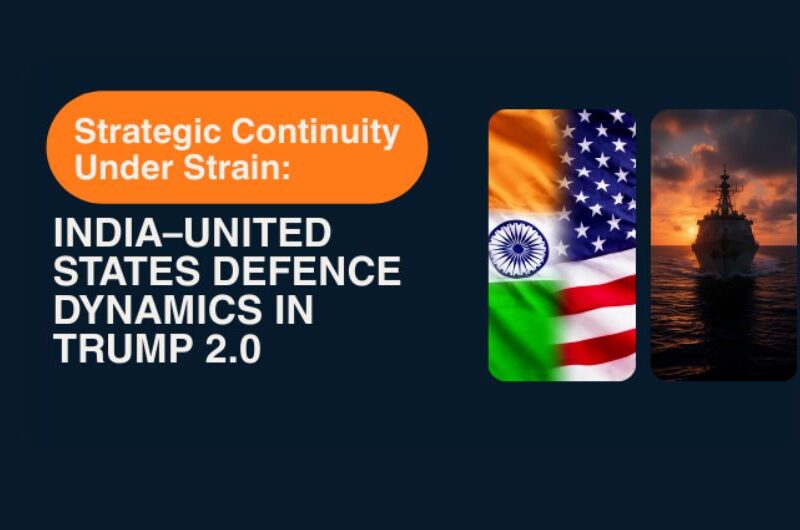
Strategic Continuity Under Strain: India–United States Defence Dynamics in Trump 2.0

Strategic Continuity Under Strain: India–United States Defence Dynamics in Trump 2.0   1. India–United States ties during Trump 2.0’s first year remained fragile and were sustained more by institutional resilience built over three decades than by fresh political momentum after the Modi–Trump meeting on 13 February 2025. 2. A key source of friction was the imposition of United States tariffs, reportedly reaching up to 50% on several Indian exports, linked to India’s continued import of Russian oil along with wider bilateral trade disputes. 3. Repeated United States claims of mediation on India–Pakistan issues, along with sensitivities over immigration, agriculture, and reduced leader-level engagement, adversely affected Indian public sentiment and mutual trust. 4. Defence cooperation remained the most resilient pillar of the India–US Comprehensive Global Strategic Partnership and functioned as an island of continuity despite turbulence across other sectors. 5. Major defence cooperation expanded sharply during 2015–2020, continued despite CAATSA-related sanction risks, and later evolved toward advanced technology collaboration and defence-industrial cooperation. 6. The broader context included the postponed QUAD summit planned in India in 2025, growing Trump–Pakistan military proximity, 2025 United States National Security Strategy priorities, and renewal of the 10-year defence framework. 7. Major military exercises during 2025 included Tiger Triumph from 01–13 April, Yudh Abhyas from 01–14 September, and Malabar from 08–18 November, reflecting continued operational coordination. 8. Delivery of the final three Apache attack helicopters for the Indian Army was completed on 16 December 2025, in addition to the larger fleet already contracted for the Indian Air Force and Army. 9. Deliveries of GE F404 IN20 engines for the Light Combat Aircraft Tejas Mk1A resumed in 2025, and five out of the 99 contracted engines had been delivered by December 2025 after earlier delays. 10. In November 2025, Hindustan Aeronautics Limited signed an agreement with General Electric for 113 additional F404 engines, with deliveries scheduled for 2027–2032 to support 97 aircraft ordered by the Indian Air Force. 11. In mid-November 2025, the United States Defence Security Cooperation Agency notified Congress of a proposed 93 million United States dollar sale including Javelin anti-tank guided missiles and Excalibur precision artillery munitions for India. 12. Around 15 of the 24 MH-60R Seahawk helicopters contracted in 2020 had been delivered, full induction was expected by end-2026, and India signed a 946 million United States dollar five-year sustainment package in December 2025. 13. QUAD engagement continued in functional terms, with Foreign Ministers meeting in Washington DC in January and July 2025, while workshops and working groups advanced areas such as counterterrorism and critical minerals cooperation. 14. The framework for the US–India Major Defence Partnership was renewed in late October 2025 for another 10 years, with priority areas including maritime security, intelligence sharing, counterterrorism, and missile defence. 15. A major strategic risk remained the proposed Sanctioning Russia Act, under which tariffs could rise up to 500% on India, even as Russia-origin defence imports had already fallen below 50% during 2019–23.   Must Know Terms : 1) PVSM (Param Vishisht Seva Medal): This is one of India’s highest peacetime military decorations. It is awarded for “distinguished service of the most exceptional order.” It can be given to officers of the Army, Navy, Air Force, and other uniformed services. It ranks above AVSM and VSM in the peacetime distinguished service category. 2) UYSM (Uttam Yudh Seva Medal): This is a wartime distinguished service medal. It is awarded for exceptional service in an operational context during war or conflict. It ranks below Sarvottam Yudh Seva Medal (SYSM) but above Yudh Seva Medal (YSM). It recognises high-level operational leadership and planning in combat situations. 3) AVSM (Ati Vishisht Seva Medal): This is a peacetime military award for “distinguished service of an exceptional order.” It is lower in precedence than PVSM but higher than VSM. It is awarded to senior officers for outstanding service in command, staff, or leadership roles during peacetime. 4) SM (Sena Medal): Sena Medal is awarded for individual acts of exceptional devotion to duty or courage. It can be given in both peacetime and operational situations. When awarded for gallantry, it is specifically recognised as Sena Medal (Gallantry). It is primarily an Indian Army decoration. 5) VSM (Vishisht Seva Medal): This is a peacetime award for “distinguished service of a high order.” It ranks below AVSM. It is awarded to officers and personnel for meritorious service in command, administration, or technical roles contributing to military effectiveness. 6) BAR: A Bar is not a separate medal but an additional award of the same decoration. If an officer receives the same medal again, a Bar is added to the ribbon. It indicates repeat recognition for distinguished or gallant service under the same award category.   MCQ: 1. India–US defence cooperation is best described as: A) A partnership limited to trade and tariffs B) An “island of continuity” insulated from turbulence C) A stalled domain due to immigration disputes D) A QUAD-only arrangement without bilateral depth 2. The primary driver of the downturn in India–US sentiment in the first year of Trump 2.0, as described, was: A) Cancellation of Malabar exercise B) US tariffs linked to India’s Russian oil imports C) India’s withdrawal from QUAD D) India’s refusal to renew defence frameworks 3. The Modi–Trump meeting cited as the early high-optics moment occurred on: A) 13 February 2024 B) 13 February 2025 C) 20 January 2025 D) 16 December 2025 4. Which additional irritant harmed trust and public sentiment? A) US claim of mediation on India–Pakistan issues B) India’s rejection of missile defence cooperation C) India’s suspension of intelligence sharing D) US refusal to supply naval helicopters 5. The surge phase of major India–US defence cooperation is placed mainly in: A) 2005–2010 B) 2010–2015 C) 2015–2020 D) 2021–2025 6. CAATSA is relevant in this context primarily because it: A) Mandates QUAD naval exercises annually B) Enables sanctions linked to major Russian defence purchases C) Funds US exports of agricultural produce to India D) Regulates immigration quotas for skilled workers 7. Which set correctly matches the cited

More Details
India’s AI Governance Framework 2026: Seven Sutras, Safety Institutions and Compute Expansion

India’s AI Governance Framework 2026: Seven Sutras, Safety Institutions and Compute Expansion   1) India AI Governance Guidelines were released at AI Impact Summit 2026 and adopt a principle-based “techno-legal” framework built around seven Sutras for safe, trusted and inclusive AI innovation.   2) Ministry of Electronics and Information Technology (MeitY) formed the drafting committee in July 2025 to review laws, global developments, research, and public feedback.   3) The framework is presented in four parts: (1) seven Sutras, (2) key issues and recommendations, (3) action plan, and (4) practical guidelines for industry and regulators.   4) Guidelines recommend new national institutions: AI Governance Group (AIGG), Technology & Policy Expert Committee (TPEC), and IndiaAI Safety Institute for standards, testing, and guidance.   5) IndiaAI Mission has onboarded 38,000+ Graphics Processing Units (GPUs) via a subsidised national compute facility, with a stated target of 100,000 GPUs through the IndiaAI Compute Portal.   6) AIKosh hosts 9,500+ datasets and 273 sectoral models, supporting indigenous model development and providing ready resources for sector-specific AI deployment.   7) National Supercomputing Mission has operationalised 40+ petaflop systems, including AIRAWAT and PARAM Siddhi-AI, strengthening high-end compute capacity for AI.   8) Capacity initiatives support 500 PhDs, 5,000 postgraduates, and 8,000 undergraduates; 570 AI Data Labs and 27 IndiaAI labs across states expand grassroots innovation.   9) National Education Policy 2020 integrates AI-linked curriculum; additionally, 174 Industrial Training Institutes (ITIs) are approved across 27 States/Union Territories for skilling.   10) YUVA AI for ALL is a free foundational course launched for mass AI literacy, aiming to spread basic AI understanding beyond specialists to citizens and small businesses.   11) Seven Sutras include: Trust is the Foundation, People First, Innovation over Restraint, Fairness and Equity, Accountability, Understandable by Design, Safety–Resilience–Sustainability.   12) The guidelines position “innovation over restraint” as a core approach, prioritising AI adoption as a driver of inclusive growth, competitiveness, and Viksit Bharat 2047.   13) The risk-mitigation pillar references existing agencies: Indian Computer Emergency Response Team (CERT-In), Indian Cyber Crime Coordination Centre (I4C), and National Critical Information Infrastructure Protection Centre (NCIIPC).   14) Policy foundations referenced include Information Technology Act 2000, Information Technology Rules 2021 and Information Technology Amendment Rules 2026, Digital Personal Data Protection Act 2023, and 2026 IT rules addressing AI-generated and deepfake harms.   15) Action plan timelines: short-term sets up AIGG/TPEC, master circular, risk frameworks and incident database groundwork; medium-term publishes standards and sandboxes; long-term updates laws and expands global standards engagement.     Must Know Terms :   1) AI Governance Group: A proposed national body to steer AI governance in India. It is meant to coordinate policy direction, oversee implementation of the guidelines, and ensure agencies follow common risk and compliance expectations. It can act as a single window for government-wide alignment on AI safety, standards, accountability, and regulatory coordination across sectors. 2) IndiaAI Safety Institute: A proposed institution focused on practical AI safety work. It is meant to support standards, model testing, evaluation methods, and safety guidance for developers and users. The idea is to create a national capability for red-teaming, benchmarking, and risk assessment so that AI systems used at scale can be checked for reliability, bias, and security risks. 3) AIKosh: A national AI resource platform hosting 9,500+ datasets and 273 sectoral models. It supports Indian model development by providing ready data and model assets for domains like health, agriculture, education, and governance. It reduces duplication, speeds up prototyping, and helps teams build sector-focused AI solutions with local datasets and context. 4) IndiaAI Compute Portal: A national platform to provide subsidised compute access for AI development. The IndiaAI Mission has onboarded 38,000+ GPUs through a national compute facility, with a stated target of 100,000 GPUs via this portal. It aims to make high-performance compute affordable for startups, researchers, and public projects needing large-scale training and inference. 5) Seven Sutras Framework: A principle set used to guide safe and trusted AI. The seven sutras listed are: Trust is the Foundation, People First, Innovation over Restraint, Fairness and Equity, Accountability, Understandable by Design, and Safety–Resilience–Sustainability. These act as decision rules for design, deployment, monitoring, and governance across sectors. 6) Incident Database Framework: A proposed system to record, classify, and analyse AI-related incidents such as misuse, harmful outputs, security failures, deepfake harms, or operational breakdowns. It is planned as groundwork in the short-term action plan, so patterns can be tracked and risk controls updated. It supports faster response, learning loops, and evidence-based regulation over time.     MCQ :   1. India AI Governance Guidelines were released at: A) Digital India Week 2026 B) AI Impact Summit 2026 C) Global Tech Forum 2026 D) IndiaAI Conclave 2026 2. The drafting committee for the guidelines was formed in: A) July 2024 B) July 2025 C) January 2026 D) March 2026 3. The framework is presented in how many parts? A) 3 B) 4 C) 5 D) 6 4. Which of the following is NOT listed as a proposed new national institution? A) AI Governance Group (AIGG) B) Technology & Policy Expert Committee (TPEC) C) IndiaAI Safety Institute D) National AI Ethics Tribunal 5. IndiaAI Mission has onboarded how many GPUs through a subsidised national compute facility? A) 18,000+ B) 28,000+ C) 38,000+ D) 48,000+ 6. The stated target through the IndiaAI Compute Portal is: A) 50,000 GPUs B) 75,000 GPUs C) 90,000 GPUs D) 100,000 GPUs 7. AIKosh hosts more than: A) 5,500 datasets and 173 models B) 7,500 datasets and 200 models C) 9,500 datasets and 273 models D) 12,500 datasets and 300 models 8. National Supercomputing Mission has operationalised: A) 20+ petaflop systems B) 30+ petaflop systems C) 40+ petaflop systems D) 60+ petaflop systems 9. Which pair is specifically mentioned under National Supercomputing Mission capability for AI? A) PARAM 8000 and PARAM Yuva B) AIRAWAT and PARAM Siddhi-AI C) Pratyush and Mihir D) EKA and TeraFlop-1 10. Capacity initiatives support how many PhDs? A) 250 B) 400 C) 500 D) 700 11. The number of AI

More Details

Tourism Push in Budget 2026–27: Pilgrimage Circuits, Eco-Trails, Skills and Heritage Sites

Tourism Push in Budget 2026–27: Pilgrimage Circuits, Eco-Trails, Skills and Heritage Sites     1) Union Budget 2026–27 treats tourism as a strategic growth driver; India Tourism Data Compendium 2025 shows total GDP impact 5.22% and direct share 2.72% from the tourism sector.   2) Tourism supports 13.34% of total employment in India, with direct tourism employment share at 5.82%, reflecting strong livelihood creation across hospitality, transport, handicrafts and services.   3) Budget proposes preserving temples and monasteries, creating pilgrimage centres, and improving connectivity and amenities in Arunachal Pradesh, Sikkim, Assam, Manipur, Mizoram, and Tripura.   4) A new Scheme for Development of Buddhist Circuits in the North-Eastern Region will develop and conserve monasteries, build interpretation centres, improve site connectivity, and create pilgrim amenities.   5) The scheme builds on Swadesh Darshan launched 2014–15, which developed theme-based circuits and tourism infrastructure to improve accessibility, amenities, and visitor experience.   6) Swadesh Darshan was revamped as Swadesh Darshan 2.0, focusing on responsible tourism, conservation of cultural and natural heritage, community participation, and improvement of local livelihoods.   7) As of date, 76 Swadesh Darshan projects are sanctioned with approved cost ₹5,290.33 crore; 75 projects are physically completed, showing near-full execution.   8) Budget proposes ecologically sustainable mountain and nature trails in Himachal Pradesh, Uttarakhand, Jammu & Kashmir, Araku Valley (Eastern Ghats) and Podhigai Malai (Western Ghats).   9) Eco-trails include turtle trails at nesting sites along Odisha, Karnataka and Kerala coasts, and bird-watching trails along Pulicat Lake in Andhra Pradesh, linking biodiversity with tourism.   10) India will host the first Global Big Cat Summit in 2026, inviting heads of governments and ministers from 95 big cat range countries for conservation and wildlife tourism strategy.   11) India is home to five of the world’s seven big cat species: tiger, lion, leopard, snow leopard and cheetah, strengthening its credibility in global big cat conservation leadership.   12) International Big Cat Alliance (IBCA) is a treaty-based intergovernmental organisation; its framework agreement was approved and ratified by multiple countries, with headquarters and secretariat hosted by India.   13) Budget upgrades National Council for Hotel Management and Catering Technology into a National Institute of Hospitality to improve curriculum, research, and international collaboration for tourism skills.   14) Pilot scheme will upskill 10,000 tourist guides across 20 iconic destinations using a 12-week hybrid model with classroom, field training and digital modules, in collaboration with an Indian Institute of Management (IIM).   15) Budget proposes developing 15 archaeological sites into experiential cultural destinations, including Lothal, Dholavira, Rakhigarhi, Adichanallur, Sarnath, Hastinapur and Leh Palace. Must Know Terms : 1) Tourism GDP Impact: Tourism contributes 5.22% to India’s total GDP (overall impact), while its direct share is 2.72%, as per India Tourism Data Compendium 2025. It also supports 13.34% of total employment, with 5.82% direct tourism jobs. This shows tourism has strong multiplier effects across transport, hotels, handicrafts, food services and local markets.   2) Swadesh Darshan 2.0: Revamped version of Swadesh Darshan launched earlier in 2014–15. It focuses on responsible and sustainable tourism, conservation of cultural and natural heritage, community participation, and livelihood improvement. So far, 76 projects worth ₹5,290.33 crore are sanctioned and 75 are completed, indicating near-full implementation of tourism infrastructure projects.   3) Buddhist Circuits Scheme: A new scheme for the North-Eastern Region to develop and conserve monasteries, create interpretation centres, improve connectivity, and build pilgrim facilities. It aims to promote religious tourism while preserving heritage. The scheme supports states like Arunachal Pradesh, Sikkim, Assam, Manipur, Mizoram and Tripura, strengthening regional tourism economy.   4) Eco-Tourism Trails: Budget proposes sustainable mountain and nature trails in Himachal Pradesh, Uttarakhand, Jammu & Kashmir, Araku Valley and Podhigai Malai. It also includes turtle nesting trails in Odisha, Karnataka, Kerala and bird-watching trails at Pulicat Lake. The focus is biodiversity-linked tourism with minimal ecological damage and local income generation.   5) International Big Cat Alliance: A treaty-based intergovernmental organisation focused on conservation of big cats. India hosts its headquarters and secretariat. India will also host the first Global Big Cat Summit in 2026, with participation from 95 big cat range countries. India has five of seven global big cat species, strengthening its leadership role.   6) Heritage Destination Development: Budget proposes developing 15 archaeological sites into experiential destinations. Sites include Lothal, Dholavira, Rakhigarhi, Adichanallur, Sarnath, Hastinapur and Leh Palace. The aim is to improve visitor facilities, interpretation, and connectivity so that heritage tourism generates higher cultural value and economic benefits locally.   MCQ : 1. Tourism’s total GDP impact is reported at: A) 2.72% B) 3.82% C) 5.22% D) 6.22% 2. Tourism’s direct GDP share is reported at: A) 1.72% B) 2.72% C) 3.72% D) 5.22% 3. Tourism supports what share of total employment in India? A) 5.82% B) 9.34% C) 13.34% D) 18.34% 4. Direct tourism employment share is: A) 2.72% B) 4.82% C) 5.82% D) 13.34% 5. Budget focus for preserving temples and monasteries and improving amenities is specifically highlighted for: A) Rajasthan, Gujarat, Maharashtra, Goa, Kerala, Tamil Nadu B) Arunachal Pradesh, Sikkim, Assam, Manipur, Mizoram, Tripura C) Punjab, Haryana, Uttar Pradesh, Bihar, Jharkhand, Chhattisgarh D) Himachal Pradesh, Uttarakhand, Jammu & Kashmir, Ladakh, Delhi, Chandigarh 6. The new Buddhist circuits scheme is designed for: A) Western India coastal belt B) North-Eastern Region C) Central India plateau region D) Indo-Gangetic plains 7. Swadesh Darshan was launched in: A) 2012–13 B) 2013–14 C) 2014–15 D) 2016–17 8. Swadesh Darshan 2.0 focuses on: A) Only luxury tourism and metropolitan branding B) Responsible tourism, heritage conservation, community participation, local livelihoods C) Only adventure sports and extreme tourism D) Only international inbound tourism campaigns 9. Number of Swadesh Darshan projects sanctioned is: A) 75 B) 76 C) 86 D) 90 10. Approved cost of sanctioned Swadesh Darshan projects is: A) ₹4,290.33 crore B) ₹5,290.33 crore C) ₹6,290.33 crore D) ₹7,290.33 crore 11. Number of Swadesh Darshan projects physically completed is: A) 70 B) 72 C) 75 D) 76 12. Budget proposes sustainable mountain and nature trails in Himachal Pradesh, Uttarakhand,

More Details

India’s Power Transition: Rising Electricity Supply, Rapid Renewables, and Green Hydrogen Push

India’s Power Transition: Rising Electricity Supply, Rapid Renewables, and Green Hydrogen Push     1) Average rural electricity supply improved from 12.5 hours in 2014 to 22.6 hours now, while urban supply improved from 22.1 hours in 2014 to 23.4 hours now.   2) India is among the world’s top three energy consumers, and electricity demand keeps rising with more households, growing industry, and expanding services.   3) Total electricity generation rose from 1,739.09 Billion Units (BU) in 2023–24 to 1,829.69 BU in 2024–25, showing 5.21% growth in one year.   4) For 2025–26, the electricity generation target is 2,000.4 BU, showing continued scaling of supply capacity.   5) As per International Renewable Energy Agency (IRENA) Renewable Energy Statistics 2025, India ranks 4th globally in total installed renewable energy capacity.   6) Installed solar capacity increased from 3 Gigawatt (GW) in 2014 to 140 GW in January 2026, showing rapid expansion of solar power capacity.   7) Non-fossil fuel capacity has crossed 50% of India’s total installed electricity capacity, mainly due to solar growth and other clean sources.   8) India’s total installed wind capacity reached about 54.65 GW by January 2026, making wind a major pillar alongside solar in the renewable mix.   9) PM Surya Ghar enabled 23.9 lakh households to install rooftop solar, adding 7 GW of decentralised clean capacity and increasing consumer-level power generation.   10) Pradhan Mantri Kisan Urja Suraksha evam Utthaan Mahabhiyan (PM-KUSUM) aims to install 14 lakh standalone solar pumps by 31.03.2026, supporting solar use in farming and reducing diesel use for irrigation.   11) 55 solar parks across 13 states have been approved with a sanctioned capacity of nearly 40 GW, helping faster large-scale renewable deployment.   12) Solar manufacturing is being strengthened through Production Linked Incentive (PLI) Scheme with ₹24,000 crore outlay, aimed at reducing import dependence in solar supply chains.   13) National Green Hydrogen Mission targets 5 million metric tonnes (MMT) green hydrogen per year by 2030, with a standard allowing up to 2 kg CO₂e per 1 kg hydrogen output.   14) The Mission expects over ₹8 lakh crore investment, fossil fuel import reduction of over ₹1 lakh crore, and avoidance of nearly 50 MMT greenhouse gas emissions annually by 2030.   15) Government approved ₹19,744 crore outlay till FY 2029–30, including ₹17,490 crore under Strategic Interventions for Green Hydrogen Transition (SIGHT), and progress includes a first port-based pilot, mobility pilots on 10 routes, and Green Hydrogen Certification Scheme 2025.     Must Know Terms : 1) Renewable Energy Capacity: This means total installed power capacity from renewables like solar, wind, small hydro and bioenergy. India is ranked 4th globally in total installed renewable capacity as per IRENA Renewable Energy Statistics 2025. Rising renewable capacity directly increases clean electricity supply and reduces dependence on coal and imported fuels over time. 2) Non-Fossil Fuel Share: This is the share of total installed electricity capacity coming from non-fossil sources such as solar, wind, hydro and nuclear. India’s non-fossil capacity has crossed 50% of total installed capacity. It signals a cleaner capacity mix, though actual electricity generation share can differ because solar and wind depend on weather and time. 3) Solar Capacity Expansion: Installed solar capacity rose from 3 GW in 2014 to 140 GW by January 2026. This includes large solar parks and rooftop systems. PM Surya Ghar helped 23.9 lakh households add rooftop solar, contributing about 7 GW. Fast solar growth is a key reason non-fossil capacity crossed the 50% mark. 4) Wind Power Capacity: India’s installed wind capacity reached about 54.65 GW by January 2026. Wind is a major renewable pillar along with solar, especially in coastal and high-wind states. Wind helps balance solar because wind generation can be stronger in different seasons and at different times than solar, improving renewable reliability. 5) Green Hydrogen Mission: It targets 5 million metric tonnes of green hydrogen per year by 2030. The standard mentioned allows up to 2 kg CO₂e emissions per 1 kg hydrogen produced. Expected outcomes include over ₹8 lakh crore investment, over ₹1 lakh crore reduction in fossil fuel imports, and avoidance of nearly 50 MMT greenhouse gas emissions annually by 2030. 6) Production Linked Incentive Scheme: PLI is a manufacturing support scheme where incentives are linked to actual production. For solar manufacturing, the outlay mentioned is ₹24,000 crore to strengthen domestic supply chains and reduce import dependence. Stronger domestic manufacturing supports faster solar installation, better availability of modules, and more stable pricing for projects.     MCQ : 1. Average rural electricity supply improved from 12.5 hours in 2014 to: A) 18.6 hours B) 20.6 hours C) 22.6 hours D) 23.6 hours 2. Average urban electricity supply improved from 22.1 hours in 2014 to: A) 22.6 hours B) 23.4 hours C) 23.9 hours D) 24.0 hours 3. India is among the world’s top three: A) Oil exporters B) Coal producers C) Energy consumers D) LNG importers 4. Total electricity generation in 2023–24 was: A) 1,629.69 BU B) 1,739.09 BU C) 1,829.69 BU D) 2,000.4 BU 5. Total electricity generation in 2024–25 was: A) 1,739.09 BU B) 1,829.69 BU C) 1,929.69 BU D) 2,000.4 BU 6. The one-year generation growth from 2023–24 to 2024–25 was: A) 3.21% B) 4.21% C) 5.21% D) 6.21% 7. The electricity generation target for 2025–26 is: A) 1,900.4 BU B) 2,000.4 BU C) 2,040.0 BU D) 2,100.4 BU 8. India ranks globally in total installed renewable energy capacity at: A) 2nd B) 3rd C) 4th D) 5th 9. Installed solar capacity increased from 3 GW in 2014 to 140 GW by: A) January 2024 B) January 2025 C) January 2026 D) January 2027 10. Non-fossil fuel capacity has crossed: A) 40% of total installed capacity B) 45% of total installed capacity C) 50% of total installed capacity D) 60% of total installed capacity 11. India’s total installed wind capacity reached about 54.65 GW by: A) January 2024 B) January 2025 C) January 2026 D) January 2027 12. PM Surya Ghar enabled

More Details

Expanding India’s Trade Footprint: New FTAs and Strategic Market Access Gains

Expanding India’s Trade Footprint: New FTAs and Strategic Market Access Gains     1) India ranks 3rd among Global South economies in trade partnership diversity, as per United Nations Conference on Trade and Development (UNCTAD) Trade and Development Report 2025, and its diversity index score is higher than all Global North countries.   2) India–European Union (EU) Free Trade Agreement (FTA) negotiations were concluded in January 2026 and described as the “Mother of All Deals,” marking a major strategic trade milestone in 2026.   3) India concluded FTAs in Financial Year (FY) 2025-26 with the United Kingdom (UK), Oman, and New Zealand, expanding market access across Europe, the Gulf, and Oceania.   4) India concluded the first round of Israel FTA negotiations and formally launched trade negotiations with the Gulf Cooperation Council (GCC) in February 2026, widening the West Asia trade agenda.   5) India is expanding negotiations with ASEAN, Mexico, and Canada, indicating a push to widen trade architecture beyond traditional partners and deepen global value chain integration.   6) The India–EU FTA provides preferential access across 97% of EU tariff lines, covering 99.5% of trade value, while retaining policy flexibility for sensitive sectors and development priorities.   7) Under the India–EU FTA, 70.4% of tariff lines covering 90.7% of India’s exports get immediate duty elimination, benefiting textiles, leather-footwear, tea, coffee, spices, toys, sports goods, gems-jewellery, and marine products.   8) In the India–EU FTA, 20.3% tariff lines covering 2.9% of exports get zero duty in 3–5 years, and 6.1% tariff lines covering 6% of exports get preferential access via reductions or tariff-rate quotas.   9) Labour-intensive exports gaining from the India–EU FTA exceed INR 2.87 lakh crore (USD 33 billion), covering textiles-apparel, marine, leather-footwear, chemicals, plastics-rubber, sports goods, toys, and gems-jewellery.   10) The EU offered services commitments across 144 subsectors, including Information Technology/Information Technology enabled Services (IT/ITeS), professional, education, and business services, creating a stable platform for Indian services exports.   11) India–Oman Comprehensive Economic Partnership Agreement (CEPA) was signed in December 2025, providing zero-duty access on 98.08% of Oman tariff lines, covering 99.38% of India’s exports by value.   12) The India–Oman CEPA is the first instance of a partner extending commitments on traditional medicine across all modes of supply, strengthening opportunities for India’s AYUSH sector through an institutional framework.   13) India–New Zealand FTA (concluded 2025) eliminates duties on 100% of New Zealand tariff lines from entry into force, giving zero-duty access for all Indian exports and supporting farmers and Micro, Small and Medium Enterprises (MSMEs).   14) India–UK Comprehensive Economic and Trade Agreement (CETA) signed in 2025: bilateral trade is USD 56 billion, the target is doubling by 2030, and agriculture/processed food exports are projected to rise over 50% in three years.   15) India–UK CETA includes a Double Contribution Convention (DCC) removing dual social security contributions, with estimated savings over ₹4,000 crore for Indian companies and professionals working in the UK.     Must Know Terms : 1) Trade Partnership Diversity Index:  Measures how widely a country’s trade is spread across partners; higher implies lower concentration risk. UNCTAD Trade and Development Report 2025 places India 3rd among Global South economies on partnership diversity and notes India’s score exceeds all Global North countries. The metric is used to assess resilience to shocks by limiting overdependence on a few markets.   2) Tariff-rate quotas (TRQs): Allow a fixed quantity of imports at a lower tariff, with higher tariffs above the quota. In the India–EU FTA package described, 6.1% of tariff lines covering about 6% of India’s exports obtain preferential access through reductions or TRQs. TRQs typically apply to sensitive items where full liberalisation is politically difficult yet controlled market access is granted.   3) Double Contribution Convention: Removes dual social security payments when professionals are temporarily posted abroad. Under India–UK CETA (signed 2025), a DCC is included to avoid simultaneous contributions in India and the UK for eligible workers and employers. The stated estimated savings exceed ₹4,000 crore for Indian companies and professionals working in the UK, improving cost competitiveness overall for talent abroad.   4) Modes of supply: Classify how services trade is delivered—cross-border supply, consumption abroad, commercial presence, and presence of natural persons. India–Oman CEPA is described as the first case where a partner extended commitments on traditional medicine across all modes of supply, strengthening market certainty for India’s AYUSH services. In the India–EU context, EU offered commitments across 144 services subsectors.   5) Duty Elimination Schedule: Timeline for cutting tariffs to zero or preferential rates, often split into immediate and phased tranches. In the India–EU FTA description, 70.4% of tariff lines covering 90.7% of India’s exports receive immediate duty elimination; 20.3% tariff lines covering 2.9% exports get zero duty in 3–5 years. Remaining lines may get reductions or TRQs for exporters.   6) Preferential Market Access: Partners apply lower tariffs than they apply to non-partners. India–EU FTA is described as giving preferential access across 97% of EU tariff lines, covering 99.5% of trade value. India–Oman CEPA gives zero-duty access on 98.08% of Oman tariff lines covering 99.38% of India’s exports by value; New Zealand offers 100% zero-duty from entry immediately.   MCQ 1. India ranks among Global South economies in trade partnership diversity at: A) 1st B) 2nd C) 3rd D) 5th 2. The India–EU FTA negotiations were concluded in: A) January 2025 B) January 2026 C) December 2025 D) February 2026 3. FTAs concluded by India in FY 2025-26 include agreements with: A) UK, Oman and New Zealand B) EU, Canada and Mexico C) USA, Oman and Israel D) Japan, UK and GCC 4. India formally launched trade negotiations with which grouping in February 2026? A) ASEAN B) African Union C) Gulf Cooperation Council D) European Free Trade Association 5. India is expanding negotiations beyond traditional partners to deepen: A) Currency union mechanisms B) Global value chain integration C) Agricultural subsidies D) Monetary coordination frameworks 6. The India–EU FTA provides preferential access across what percentage of EU tariff lines? A)

More Details

Modernising India’s GDP Measurement: Base 2022–23 and New Data Framework

Modernising India’s GDP Measurement: Base 2022–23 and New Data Framework     1) Real Gross Domestic Product (GDP) growth for Financial Year (FY) 2025-26 is estimated at 7.6%, above 7.1% in FY 2024-25, showing stronger expansion under new 2022-23 base series. 2) Nominal GDP at current prices is projected to grow 8.6% in FY 2025-26, capturing both real output rise and price changes together for policymaking. 3) October to December quarter GDP at constant prices is estimated at ₹84.54 lakh crore, growing 7.8%, steadily up from 7.1% and 7.4% in prior years. 4) Manufacturing recorded double digit growth in FY 2023-24 and FY 2025-26; secondary and tertiary sectors grew above 9%, while trade related services grew 10.1% showing resilience. 5) Base year for GDP is revised from 2011-12 to 2022-23, so real growth uses newer prices and better reflects today’s economic structure and sector mix. 6) Year 2022-23 was selected as the latest normal year after Coronavirus Disease 2019 (COVID-19) disruptions in 2019-2021, which temporarily skewed consumption, production, and investment behaviour in many sectors. 7) Back series using revised methods is expected by December 2026; estimates will be recalculated up to the earlier base year, then linked to extend data back to 1950-51. 8) National Statistical Office (NSO) estimates GDP using benchmarks and indicators, aligned with System of National Accounts 2008 (SNA 2008) and International Monetary Fund (IMF) manual 2017. 9) Household sector estimates now use actual yearly levels from Annual Survey of Unincorporated Sector Enterprises (ASUSE) and Periodic Labour Force Survey (PLFS), instead of only proxy growth rates. 10) Goods and Services Tax (GST) data is used more systematically to allocate private corporate activity across states, cross check annual accounts, and support quarterly estimation in services sectors. 11) e-Vahan vehicle registration database is used to estimate Private Final Consumption Expenditure (PFCE) for road transport services, giving better demand measurement from real administrative records at national level. 12) Public Financial Management System (PFMS) provides payment and accounting data, helping compile central government accounts and distribute them across states using actual spending at First Revised Estimates stage. 13) Deflation improved: double deflation is applied in manufacturing and agriculture; single extrapolation used elsewhere; deflators are granular, using 260 plus Consumer Price Index (CPI) items to reduce bias. 14) Supply and Use Tables (SUT) are integrated into compilation using product balancing, ensuring total supply equals total use, which reconciles production and expenditure estimates and removes statistical discrepancy. 15) Revised series expands coverage by counting hired domestic workers’ services and capturing digital platforms, self-employed, and informal gig workers more accurately through annual data, not only corporate filings.   Must Know Terms : 1.ASUSE:  ASUSE (Annual Survey of Unincorporated Sector Enterprises) is an NSO annual survey used in the GDP base 2022–23 series to produce “actual level” household-sector estimates. It replaces earlier reliance on proxy growth between benchmarks. It profiles unincorporated enterprises: activity, workers, wages, receipts, expenses, fixed assets, and operating surplus. Outputs feed sector value added and informal-economy measurement nationwide, every year, directly. 2.COICOP:  COICOP (Classification of Individual Consumption According to Purpose) 2018 is adopted in the revised PFCE framework. It standardises household consumption categories for national accounts comparability. India’s mixed PFCE method combines Household Consumer Expenditure Survey, administrative/production data, and commodity-flow approach, then maps totals to COICOP 2018 heads. This improves item-level consistency with Supply and Use Tables and deflators, year after year. 3.SUT:  SUT (Supply and Use Tables) are integrated into the new GDP series to reconcile production and expenditure estimates. For each product, total supply equals total use: domestic output + imports matched with intermediate demand, household/government consumption, NPISH, capital formation, and exports. PIB notes “product-balancing” resolves statistical discrepancies, improving internal consistency and reliability of final GDP figures across sectors and years. 4.Deflator:  Deflators convert current-price values to constant prices. The revised series upgrades deflation: double deflation is applied in manufacturing and agriculture; single extrapolation is used in other sectors; single deflation is discontinued. Deflators are more granular, using 260+ item-level CPI indices. Until WPI rebasing is released, existing WPI continues as a deflator; MoSPI plans Producer Price Index soon, for producers, nationally. 5.PFMS:  PFMS (Public Financial Management System) is a web-based government platform enabling end-to-end digital payments, receipt collection, accounting, reconciliation, and financial reporting. In the new GDP series it compiles central government accounts and distributes them across states. PFMS allows using actual expenditure figures at First Revised Estimates (FRE) stage, instead of relying on budget Revised Estimates (RE), improving accuracy, transparency, measurably. 6.Extrapolation:  Benchmark–Indicator compilation uses annual GDP as the benchmark and high-frequency indicators to extend estimates to quarters. NSO uses this for quarterly GDP aligned with SNA 2008 and IMF Quarterly National Accounts Manual 2017. In the revised framework, indicators include GST, PFMS, e-Vahan and surveys. PIB notes reduced dependence on proxy indicators and fixed ratios, improving timeliness and consistency overall, significantly.     MCQ 1. With reference to India’s revised GDP series, consider the following statements: 1. Real GDP growth for FY 2025-26 is estimated at 7.6%. 2. The estimate is higher than the 7.1% recorded in FY 2024-25. Which of the statements given above is/are correct? A) 1 only B) 2 only C) Both 1 and 2 D) Neither 1 nor 2 2. Nominal GDP at current prices is projected to grow by: A) 7.6% in FY 2025-26 B) 8.6% in FY 2025-26 C) 10.1% in FY 2025-26 D) 9.0% in FY 2025-26 3. The October–December quarter GDP at constant prices is estimated at: A) ₹48.54 lakh crore B) ₹74.58 lakh crore C) ₹84.54 lakh crore D) ₹94.54 lakh crore 4. The October–December quarter GDP growth at constant prices is estimated at: A) 7.1% B) 7.4% C) 7.6% D) 7.8% 5. With reference to the revised GDP base year, consider the following statements: 1. The base year is revised from 2011-12 to 2022-23. 2. Real growth under the series uses newer prices and updated sector mix. Which of the statements given above is/are correct? A) 1 only B) 2 only C) Both 1 and 2

More Details

Sarvam-Led Sovereign AI: Multilingual Models, Enterprise Stack, and Public Service Scale

Sarvam-Led Sovereign AI: Multilingual Models, Enterprise Stack, and Public Service Scale   1. India’s AI push is linked to building indigenous systems trained on Indian languages, local datasets, and governance contexts, so public services and citizen engagement remain relevant and reliable. 2. Sarvam AI (Artificial Intelligence) is positioned as an India-built, end-to-end platform where development, deployment, and governance occur domestically, aiming to reduce dependence on foreign AI infrastructure. 3. A major policy emphasis is “sovereign” foundational models—LLMs (Large Language Models) and speech models aligned with national priorities, accessibility needs, and multilingual communication across India’s linguistic diversity. 4. Sarvam AI (Artificial Intelligence) is one of 12 organisations selected under the Innovation Centre pillar of the IndiaAI Mission, receiving financial and compute support totaling ₹246.72 crore for foundational model development. 5. Its focus includes voice-based interfaces and document processing, targeting citizen-centric applications that can improve access, ease-of-use, and service delivery in multilingual settings. 6. Bulbul, a text-to-speech model, provides output in 11 Indian languages and offers 39 distinct speaker voices, expanding usable voice options for large-scale deployments. 7. Saaras, a speech-to-text model, supports all 22 scheduled languages and handles 8 kHz (kilohertz) telephony audio, improving transcription for calls and mixed-quality speech channels. 8. Saaras also processes code-mixed speech, a common Indian communication pattern, helping recognition when speakers blend languages within a single sentence during conversations. 9. Vision, the document-understanding component, is built for 22+ Indian languages, mixed scripts, and handwritten text, supporting extraction and interpretation of forms and records. 10. The conversational platform claims 100 million+ interactions handled with under 500 ms (milliseconds) latency, enabling fast responses for high-volume customer or citizen service environments. 11. The same conversational system is described as deployable within 24 hours and reporting up to 10x (ten times) ROI (Return on Investment), indicating an enterprise-focused, rapid implementation design. 12. Sarvam for Work is presented as a unified enterprise AI (Artificial Intelligence) platform supporting build–debug–optimize workflows, and designed to integrate with any model, data source, or infrastructure. 13. Content tools include multilingual video dubbing with voice cloning and audio-visual synchronisation, plus document translation that preserves layout and tone with built-in review and editing. 14. UIDAI (Unique Identification Authority of India) collaboration includes AI (Artificial Intelligence) voice interaction for Aadhaar services, real-time fraud detection, and multilingual support; a custom GenAI (Generative Artificial Intelligence) stack is planned on secure on-premise infrastructure for 10 languages. 15. Public-sector compute and research infrastructure includes Odisha’s 50 MW (megawatt) AI (Artificial Intelligence) capacity hub and Tamil Nadu–IIT (Indian Institute of Technology) Madras Digital Sangam, anchored by a 20 MW (megawatt) AI (Artificial Intelligence) data centre.   Must Know Terms :     1.Bulbul: Bulbul v3 is a text-to-speech model/API (Application Programming Interface) that supports 11 languages: Hindi, Bengali, Tamil, Telugu, Gujarati, Kannada, Malayalam, Marathi, Punjabi, Odia, and English (Indian accent). It supports output formats MP3, WAV, AAC, OPUS, FLAC, PCM (Pulse Code Modulation; LINEAR16), μ-law (Mu-law) (MULAW) and A-law (ALAW). Output sample rates supported include 8 kHz (kilohertz), 16 kHz (kilohertz), 22.05 kHz (kilohertz), and 24 kHz (kilohertz). 2.Saaras: Saaras v3 is a speech-to-text model/API (Application Programming Interface) that supports 22 Indian languages with automatic language detection. It is described as handling code-mixed audio within the same recording. It supports multiple operating modes including synchronous transcription for short inputs, batch transcription for longer files, and streaming transcription for real-time use cases. 3.Code-mixing: Code-mixing is the mixing of linguistic units such as words, phrases, or clauses from two languages within a single sentence or utterance. A commonly cited typology describes three code-mixing patterns: insertion, alternation, and congruent lexicalization. A practical distinction is that code-mixing occurs within the same syntactic unit, while switching between sentences is usually classified as inter-sentential code-switching. 4.Telephony: Narrowband telephony audio commonly uses 8 kHz (kilohertz) sampling. Classic voice systems use μ-law (Mu-law) (MULAW) and A-law (ALAW) companding encodings at 64 kbps (kilobits per second), and many IVR (Interactive Voice Response) or call-centre pipelines still accept 8 kHz PCM (Pulse Code Modulation)/μ-law (Mu-law)/A-law streams for compatibility with legacy voice infrastructure. 5.Zonation: Zonation means division into distinct zones based on a controlling factor, and it is used in ecology as well as land-use planning. In intertidal ecology, vertical zonation forms visible bands of organisms between low and high tide lines. In land-use regulation, zoning divides land into districts with legally defined permitted uses and density rules. 6.On-premise: On-premises deployment means software, hardware, and data are hosted and operated on customer-controlled servers within an organization’s own facilities rather than on a public cloud. It is typically chosen for data sovereignty, regulatory compliance, lower-latency control, and internal security policy requirements, as compared to cloud/SaaS (Software as a Service) models where the provider hosts and runs the infrastructure.     MCQ 1. The initiative described emphasizes “sovereign” AI mainly to: A) Shift all AI training overseas for scale B) Prioritize models rooted in Indian languages, data, and governance needs C) Replace multilingual systems with English-only services D) Stop using speech technologies entirely 2. The platform approach highlighted is best described as: A) Hardware-only, without deployment tools B) End-to-end development and governance within India C) Only third-party cloud dependence D) Limited to entertainment applications 3. The number of organisations selected under the Innovation Centre pillar mentioned is: A) 8 B) 10 C) 12 D) 20 4. The financial and compute support amount referenced is: A) ₹46.72 crore B) ₹146.72 crore C) ₹246.72 crore D) ₹346.72 crore 5. The text-to-speech model named Bulbul is described as supporting: A) 6 languages and 10 voices B) 11 languages and 39 speaker voices C) 22 languages and 11 voices D) 39 languages and 22 voices 6. The speech-to-text model Saaras is described as supporting: A) 11 Indian languages only B) 15 Indian languages with manual detection C) 22 scheduled languages with telephony focus D) 22 scheduled languages with code-mixed handling 7. Telephony audio sampling frequently referenced for narrowband speech is: A) 4 kHz B) 8 kHz C) 16 kHz D) 24 kHz 8. “Code-mixed speech” refers to: A) Mixing two

More Details

Waste-to-Wealth in Agriculture: Circular Solutions and Key Numbers

Waste-to-Wealth in Agriculture: Circular Solutions and Key Numbers 1. India generates about 350 million tonnes of agricultural waste annually, including crop residues, husk, straw, and food-processing by-products, creating serious air, soil, and water contamination risks when mismanaged. 2. MNRE estimates agricultural residues could generate over 18,000 MW of power annually, alongside producing nutrient-rich organic fertilisers that improve soil health and significantly reduce dependence on chemical inputs. 3. Under Crop Residue Management initiatives, ₹3,926.16 crore was released from 2018-19 to 2025-26 to Punjab, Haryana, Uttar Pradesh, NCT Delhi, and ICAR for targeted residue-management support measures additional. 4. Over 42,000 Custom Hiring Centres were set up for crop-residue machines, and more than 3.24 lakh machines were supplied to CHCs and individual farmers during 2018-19 to 2025-26. 5. Under GOBARdhan, 979 biogas plants were operational by 14 January 2026, covering 51.4% of India’s districts and converting dung, crop residues, and food waste into energy and manure. 6. Globally, food waste reached 1.05 billion tonnes in 2022; about 60% came from households, indicating major consumer-stage losses with significant climate, fiscal, and resource costs worldwide every year. 7. Organic waste decomposing in landfills releases methane and other greenhouse gases, generates odours, and can pollute air and groundwater; segregation, composting, and biomethanation at scale reduce landfill pressure. 8. Circularity is framed around six Rs Reduce, Reuse, Recycle, Refurbish, Recover, Repair, aiming to minimise raw-material, water, and energy extraction while keeping materials in productive use longer, profitably. 9. India’s circular economy is projected to reach about $2 trillion market value by 2050 and create roughly 10 million jobs, linking waste-to-wealth strategies with growth and employment nationally. 10. Crop residues left after harvest are often utilised as cattle feed, compost, biogas, mulch, or fuel, yet significant shares are still burned in situ for rapid field preparation. 11. Residue burning depletes soil nutrients, degrades soil health, and emits greenhouse gases; in-situ incorporation and ex-situ collection are promoted to cut pollution, curb smoke, and raise productivity notably. 12. Livestock waste includes dung and bedding; during disease outbreaks, timely carcass disposal is essential to prevent infectious and zoonotic spread, requiring infrastructure, financing, trained manpower, and capacity locally. 13. Food waste at markets, retail, and households is being converted into value-added products such as engineered biochar, which can sequester carbon, improve soil, and remove contaminants at scale. 14. Unified GOBARdhan Portal launched in 2023 to enhance transparency; by 14 January 2026, 979 operational plants across 51.4% districts signalled scaled adoption, tracking, and growing private interest nationwide. 15. Agriculture Infrastructure Fund, launched 2020-21, provides medium-to-long-term credit; by 2025 it supported 545 organic-input projects with ₹850 crore loans, alongside ₹66,310 crore sanctioned overall nationally for post-harvest assets.   Must Know Terms : 1. GOBARdhan : Launched to convert cattle dung, crop residues, and food waste into compressed biogas (CBG) and organic manure through multi-ministry coordination. Unified GOBARdhan Portal launched in 2023 for transparency and tracking. As of 14 January 2026, 979 biogas plants were operational across 51.4% of India’s districts. Policy support mentioned includes carbon credit trading linkage for CBG, tax relief on CBG-blended fuels, and simplified manure norms under Fertiliser Control Order. 2.CRM: Crop Residue Management initiative targets reduction of open burning by promoting in-situ methods (incorporation/mulch) and ex-situ collection for compost, biogas, and bioenergy. From 2018-19 to 2025-26, ₹3,926.16 crore was released to Punjab, Haryana, Uttar Pradesh, NCT Delhi, and ICAR. During the same period, more than 42,000 Custom Hiring Centres were set up and over 3.24 lakh machines were supplied to CHCs and individual farmers. 3.CHCs: Custom Hiring Centres are machine hubs created to provide farmers access to crop-residue management equipment without full ownership cost. Under CRM support (2018-19 to 2025-26), more than 42,000 CHCs were established. Over 3.24 lakh machines were deployed through CHCs and to individual farmers, enabling residue incorporation, mulching, collection, and related operations. The programme funding release of ₹3,926.16 crore is linked to these deployments in the listed states and ICAR. 4.Biochar: Biochar is a carbon-rich material produced by heating biomass such as crop residues or wood waste under low-oxygen conditions. Engineered biochar is further treated to improve specific performance, including soil fertility, water retention, and nutrient-use efficiency. The document notes emerging conversion of food waste into value-added products like engineered biochar, with stated potential to sequester carbon, enhance soil health, and remove environmental contaminants, making it a waste-to-value pathway within agriculture and food systems. 5.AHIDF: Animal Husbandry Infrastructure Development Fund was launched in 2020 under Atmanirbhar Bharat Abhiyan with a corpus of ₹15,000 crore. It aims to catalyse private and cooperative investment across the livestock value chain, including meat and dairy processing, animal feed manufacturing, and waste-to-wealth management. The document also mentions formation of three exclusive Multi-State Cooperative Societies to supply feed and inputs, promote manure/biogas via cooperative models, and enable scientific handling of hides, bones, horns from fallen animals. 6.Indicator241: SDG Indicator 2.4.1 is highlighted as the measure focusing on resilient farming systems that improve soil health and reduce dependence on chemical inputs. The document links circular practices to this indicator by citing composting, biochar use, and biomass recycling as actions that enhance soil fertility, improve productivity, and support environmentally sustainable agriculture. It also connects circular agriculture with reducing global food waste, recorded at 1.05 billion tonnes in 2022, with 60% from households. MCQ 1. India generates approximately how much agricultural waste annually? A) 35 million tonnes B) 150 million tonnes C) 350 million tonnes D) 1.05 billion tonnes 2. Agricultural residues in India are estimated to have power generation potential of about: A) 1,800 MW annually B) 8,000 MW annually C) 18,000 MW annually D) 63,000 MW annually 3. Under Crop Residue Management support (2018-19 to 2025-26), the total release mentioned is: A) ₹392.16 crore B) ₹3,926.16 crore C) ₹15,000 crore D) ₹66,310 crore 4. The Crop Residue Management release (2018-19 to 2025-26) was directed to which set of states/regions plus ICAR? A) Punjab, Haryana, Uttar Pradesh, NCT Delhi, and ICAR B) Punjab, Rajasthan, Madhya Pradesh, NCT Delhi, and ICAR C) Haryana, Bihar,

More Details

National Security Budget 2026–27: Modernisation, Indigenous Procurement, and Veterans’ Support

National Security Budget 2026–27: Modernisation, Indigenous Procurement, and Veterans’ Support     1. FY 2026–27 defence allocation is ₹7.85 lakh crore, highest among ministries; 15.19% higher than FY 2025–26 BE, forming 14.67% of total expenditure, and prioritises modernisation, self-reliance, veterans’ welfare. 2. Defence budget rose from ₹2.53 lakh crore in 2013–14 to ₹7.85 lakh crore in 2026–27, adding about ₹5.32 lakh crore, roughly tripling in thirteen years, nominal rupee terms. 3. Defence outlay split: 27.95% capital; 20.17% revenue for sustenance and operational preparedness; 26.40% pay and allowances; 21.84% pensions; 3.64% civil organisations and attached offices, highlighting heavy personnel-linked spending. 4. Capital head for Defence Forces in FY 2026–27 is over ₹2.19 lakh crore, 21.84% above FY 2025–26 BE, accelerating platform upgrades and capability creation across services this year. 5. Within the ₹2.19 lakh crore capital head, ₹1.85 lakh crore is earmarked for capital acquisition, about 24% higher than FY 2025–26, enlarging new procurement headroom for big-ticket projects. 6. Planned acquisitions cover next-generation fighter aircraft, advanced weapons, ships, submarines, UAVs and drones, expanding precision strike, surveillance, sea denial and unmanned force multipliers for all three armed services. 7. Border Roads Organisation capital allocation increases to ₹7,394 crore in FY 2026–27, supporting strategic connectivity by modernising tunnels, bridges, roads and defence-relevant airfields in frontier areas at pace. 8. ₹975 crore is provided for an optical-fibre-cable network for Defence Services, improving secure communications, data throughput, redundancy and jointness across tri-service commands and field formations during high-tempo operations. 9. ₹1.39 lakh crore is earmarked for procurement from domestic defence industries, boosting indigenous supply chains, local value addition and import substitution in platforms, spares, ammunition and electronics ecosystem. 10. Around 75% of the capital acquisition budget is reserved for domestic defence industries in FY 2026–27, ensuring steady orders for DPSUs, MSMEs, private primes, start-ups and academia partners. 11. Customs duty on imported raw materials to make aircraft parts for defence MRO is proposed exempt, reducing maintenance costs, spares prices, and downtime for operational fleets across services. 12. DRDO allocation rises to ₹29,100.25 crore in FY 2026–27 from ₹26,816.82 crore in FY 2025–26; ₹17,250.25 crore is set aside for capital expenditure, supporting labs, trials, and prototyping. 13. About 25% of Defence R&D budget is open to industry, start-ups and academia; 15 DRDO–Industry–Academia Centres of Excellence span 82 research verticals for targeted technology development, nationwide collaboration. 14. DRDO partners with around 2,000 industries for manufacturing; technologies are transferred to Indian firms at zero transfer-of-technology fee, accelerating commercialisation, scaling and broader innovation diffusion into production lines. 15. ECHS gets ₹12,100 crore in FY 2026–27, 45.49% above FY 2025–26 BE; defence pensions exceed ₹1.71 lakh crore, serving 34+ lakh pensioners via SPARSH, and authorised agencies nationwide. Must Know Terms :   1.SPARSH (System for Pension Administration – Raksha) Digital pension disbursement platform for defence pensioners with direct credit to bank accounts. Reported coverage: ~31 lakh onboarded out of ~32 lakh defence pensioners (statement reported 29 March 2025). Reported facilitation network: 200+ Defence Accounts Department offices, 16 bank branches, and ~5 lakh Common Service Centres supporting pensioners. Reported service improvement: legacy discrepancies resolved in up to 87% cases; average grievance disposal time reduced from 56 days (April 2025) to 20 days (later official update). 2.ECHS (Ex-Servicemen Contributory Health Scheme) Effective from: 1 April 2003. Designed for cashless medicare for ex-servicemen pensioners and eligible dependents through polyclinics, service medical facilities, government hospitals, and empanelled private/specified AYUSH hospitals. Sanctioned network: 427 ECHS polyclinics in India + 6 polyclinics in Nepal; 30 Regional Centres. Polyclinics provide outpatient care (consultation, essential investigations, medicines); specialised and inpatient care is through service hospitals/government hospitals/empanelled private hospitals. 3.MTRE (Medical Treatment Related Expenditure) Budget head used for meeting medical treatment costs under the ex-servicemen healthcare ecosystem (especially settlement of treatment bills/claims under ECHS). The term is used in defence/ex-servicemen welfare budgeting as the expenditure line that directly maps to treatment payments, including higher outgo when rates are revised or claim volumes rise. Audit and media reporting have linked MTRE shortfalls to delayed payments and carried-forward liabilities in certain periods (context: hospital empanelment reimbursements). 4.BRO (Border Roads Organisation) Raised on: 7 May 1960. Border Roads Development Board (BRDB) structure: Prime Minister as Chairman; Defence Minister as Deputy Chairman (coordination and faster execution). Mandate focus: strategic road infrastructure in remote and border areas, supporting both defence mobility and regional connectivity. 5.MRO (Maintenance, Repair and Overhaul) Aviation servicing ecosystem covering scheduled/unscheduled maintenance of aircraft, engines, components, and associated tooling/testing. Tax reform: GST on aircraft MRO services reduced from 18% to 5% with full input tax credit, effective 1 April 2020. Import tax reform: uniform 5% IGST on imports of aircraft parts/components, testing equipment, tools and toolkits for MRO (policy announcement implemented from mid-July 2024, subject to conditions). 6.DRDO (Defence Research and Development Organisation) Formed in: 1958. Formation basis: created by amalgamating the Indian Army’s Technical Development Establishments (TDEs), the Directorate of Technical Development & Production (DTDP), and the Defence Science Organisation (DSO). Widely listed indigenous strategic programmes associated with DRDO’s R&D line include Agni and Prithvi missile series, Akash air defence system, Pinaka multi-barrel rocket launcher, and LCA Tejas (as flagship examples of indigenous development-to-production pathways).   MCQ : 1. In FY 2026–27, the defence allocation of ₹7.85 lakh crore is: A. 14.67% of total Central Government expenditure B. 12.67% of total Central Government expenditure C. 16.47% of total Central Government expenditure D. 10.67% of total Central Government expenditure 2. The FY 2026–27 defence allocation is higher than FY 2025–26 Budget Estimates by: A. 11.19% B. 12.91% C. 15.19% D. 18.19% 3. India’s defence budget increase from 2013–14 to 2026–27 is approximately: A. ₹3.32 lakh crore B. ₹4.32 lakh crore C. ₹5.32 lakh crore D. ₹6.32 lakh crore 4. As per the stated split, the share for capital expenditure in the defence outlay is: A. 20.17% B. 26.40% C. 27.95% D. 21.84% 5. The share earmarked for defence pensions in the outlay split is: A. 21.84% B. 20.17% C. 26.40% D. 27.95% 6. The budgetary allocation under capital head to

More Details

From Record Heat to COP30: Global and India Climate Snapshot 2025

From Record Heat to COP30: Global and India Climate Snapshot 2025 1. From 2015 to 2025, every year ranked among the eleven warmest in a 176-year record; 2023, 2024, and 2025 were the three warmest years observed globally on record. 2. January to August 2025 mean near-surface temperature reached 1.42°C above the pre-industrial average, sustaining exceptional warmth and reinforcing the decade’s persistent global temperature anomaly across multiple observations worldwide. 3. Heat-trapping greenhouse-gas concentrations and ocean heat content, both record-high in 2024, continued rising through 2025, signalling persistent planetary energy imbalance and ongoing accumulation of heat in oceans globally. 4. Arctic sea-ice extent after the 2025 winter freeze was the lowest on record, while Antarctic sea-ice extent tracked well below average for much of the year overall worldwide. 5. Long-term sea-level rise continued in 2025, despite a small temporary dip attributed to naturally occurring factors, indicating underlying thermal expansion and ice-loss drivers remained dominant across oceans globally. 6. Ocean heat content in 2025 exceeded the record 2024 values, confirming continued warming of upper and deeper layers that influences marine ecosystems, sea level, and extreme weather intensity. 7. In 2025, climate extremes—devastating rainfall, flooding, brutal heat, and wildfires—produced severely cascading impacts on lives, livelihoods, and food systems across regions, economies, and public services worldwide. 8. Texas suffered its most significant inland flood disaster in nearly 50 years, underscoring intensified rainfall extremes and the exposure of inland communities, transport corridors, and utilities to flooding. 9. European and East Mediterranean heatwaves set record temperatures in Spain, Portugal, and Turkey, with records documented in parts of France and Germany, stressing health systems and energy demand. 10. South Africa’s Eastern Cape Province faced severe storm-driven flooding in 2025, causing widespread disruption and demonstrating how intense rainfall events can overwhelm drainage, roads, housing, and response capacity. 11. South Korea experienced the largest known wildfires in its history in the country’s east, showing how hot, dry conditions can accelerate fire spread, smoke impacts, evacuations, and losses. 12. COP30 met in Belém, Brazil, from 10 to 22 November 2025, during the NDC update cycle; the host framed it as an “Implementation COP” for measurable action delivery. 13. COP30 structured talks around six priority axes—energy/transport/industry, forestry, cities, agriculture, people, and finance/technology—selecting about 30 priorities and organising an unprecedented series of debates across themes officially. 14. Fossil-fuel wording became the central COP30 impasse; draft text omitted phase-out language, the meeting extended past 21 November, and efforts to advance earlier commitments to move away stalled. 15. India stated: emission intensity declined over 36% since 2005; non-fossil sources exceed half of installed power capacity at about 256 GW; the relevant 2030 target was achieved early.     Must Know Terms : 1.Cryosphere Components include glaciers, ice sheets (Greenland/Antarctica), sea ice, seasonal snow, and frozen ground/permafrost. Global glaciers lost 267 ± 16 gigatonnes of ice per year on average during 2000–2019 (≈21 ± 3% of observed sea-level rise). Newer global synthesis reports glacier loss rates rising from −231 ± 23 Gt/yr (2000–2011) to −314 ± 23 Gt/yr (2012–2023); 2023 recorded 548 ± 120 Gt loss (≈1.51 ± 0.33 mm/yr sea-level equivalent). IPCC AR6 assesses glacier mass loss (excluding ice-sheet peripheral glaciers) at 240 ± 40 Gt/yr for 2006–2019. Ice sheets (Greenland + Antarctica) contributed 21.0 ± 1.9 mm to global mean sea level between 1992 and 2020; loss rates accelerated from ~105 Gt/yr (1992–1996) to ~372 Gt/yr (2016–2020). Total complete loss of current land-ice reservoirs would raise global mean sea level by about 65.6 ± 1.8 m. 2.Thermosteric Thermosteric sea level change is the sea-level rise from thermal expansion of seawater due to warming (temperature-driven density decrease). IPCC AR6 gives global mean thermosteric sea-level (ThSL) rise rate of 0.89 mm/yr (range 0.69–1.10) for 1993–2018 (full-ocean-depth estimate). Over the same broad modern period, total global mean sea level rise accelerated to 3.7 mm/yr for 2006–2018, meaning thermosteric is a major but not sole contributor alongside land-ice melt and land-water storage changes. 3.Stocktake The “global stocktake” is legally defined in Article 14: it assesses collective progress toward the Agreement’s purpose and long-term goals, covering mitigation, adaptation, and means of implementation/support, “in the light of equity and the best available science.” Timing rule: first stocktake in 2023 and every five years thereafter (unless changed by Parties). COP28 decision text (first stocktake outcome) includes a call for global actions consistent with: tripling renewable energy capacity and doubling energy-efficiency improvement rates by 2030, and “transitioning away from fossil fuels in energy systems” in a just, orderly and equitable manner. 4.Disinformation Disinformation is false or misleading information shared with the intention to deceive; misinformation is false information shared without intent to deceive. A hard regulatory threshold used in platform governance: under the EU Digital Services Act, “Very Large Online Platforms” are designated at ≥45 million monthly users in the EU, triggering stricter systemic-risk obligations (used in multiple Commission designations). 5.Biofuels Main transport biofuels: ethanol (petrol blending) and biodiesel/HVO (diesel blending), with newer categories like SAF for aviation. IEA projects the share of biofuels in total liquid fuel transport demand rises from 5.6% (2023) to 6.4% (2030), reaching ~215 billion litres/year by 2030 (main case). India policy timeline: the ethanol blending target of 20% in petrol was advanced to Ethanol Supply Year (ESY) 2025–26 (policy update path reflected in official policy summaries). India blending trajectory reported in parliamentary/ministerial updates carried by major outlets: 12.06% (ESY 2022–23), 14.60% (ESY 2023–24), and 17.98% in ESY 2024–25 up to 28 Feb 2025; ethanol supplied to OMCs up to Feb 2025 reported as 278.88 crore litres. 6.CBDR-RC CBDR-RC is treaty text in UNFCCC Article 3(1): Parties should protect the climate system “on the basis of equity” and in accordance with “common but differentiated responsibilities and respective capabilities,” with developed countries taking the lead. Paris Agreement Article 2(2) re-states CBDR-RC with an added qualifier: implementation reflects equity and CBDR-RC “in the light of different national circumstances.” CBDR-RC is operationally used in negotiations for: (i) who leads in mitigation, (ii) scale and terms of finance (grants

More Details

Free IAS Guidance
Start Your Journey Today 🇮🇳

Fill out the form below, and we will be in touch shortly.