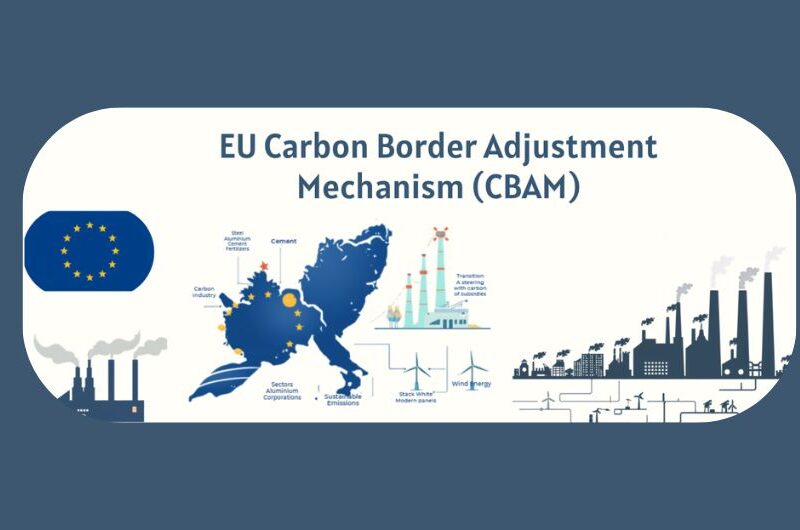
EU Carbon Border Adjustment Mechanism (CBAM)
1. The Carbon Border Adjustment Mechanism (CBAM) is the European Union’s climate-linked trade policy aimed at preventing carbon leakage.
2. Carbon leakage refers to the relocation of production from regions with strict climate policies to countries with weaker emission regulations.
3. CBAM ensures that imported carbon-intensive goods face a carbon cost similar to that paid by EU producers under the European Union Emissions Trading System (EU ETS).
4. The transitional phase of CBAM operated from October 2023 to December 2025 and required only reporting of embedded emissions without financial payments.
5. The definitive implementation phase of CBAM began after the transitional reporting period ended.
6. Initially, CBAM covers six sectors: iron and steel, aluminium, cement, fertilizers, electricity, and hydrogen.
7. Under CBAM, EU importers must declare the embedded Greenhouse Gas (GHG) emissions in imported goods.
8. Importers are required to surrender CBAM certificates, whose prices are linked to the auction prices of the European Union Emissions Trading System (EU ETS).
9. CBAM allows deductions if an equivalent carbon price has already been paid in the exporting country.
10. The European Union has designed CBAM to be compatible with World Trade Organization (WTO) rules.
11. India is a major exporter of steel, aluminium, and fertilizers to the European Union and is significantly affected by CBAM.
12. CBAM may impose additional costs of around 20–35% on certain carbon-intensive Indian exports if cleaner production technologies are not adopted.
13. India and several developing countries argue that CBAM functions as a non-tariff trade barrier and is inconsistent with the principle of Common But Differentiated Responsibilities (CBDR) under the United Nations Framework Convention on Climate Change (UNFCCC).
14. India is developing its Carbon Credit Trading Scheme (CCTS) to establish a domestic carbon market and reduce the impact of CBAM on exports.
15. India’s long-term strategy to address CBAM includes promoting green hydrogen, scrap-based steelmaking, clean energy adoption, and seeking Mutual Recognition Agreements (MRAs) for recognition of CCTS credits.
Must Know Terms :
1.Carbon Border Adjustment Mechanism (CBAM): CBAM is the European Union’s climate-linked trade policy to prevent carbon leakage. It applies a carbon cost on imported carbon-intensive goods entering the European Union.
2. Carbon Leakage: Carbon leakage happens when industries shift production from countries with strict climate rules to countries with weaker emission rules. CBAM aims to prevent this by equalising carbon costs.
3. European Union Emissions Trading System (EU ETS): EU ETS is the European Union’s carbon pricing system. CBAM certificate prices are linked to EU ETS auction prices.
4. Greenhouse Gas (GHG) Emissions: GHG emissions refer to gases responsible for global warming. Under CBAM, importers must declare embedded GHG emissions in imported goods.
5. Common But Differentiated Responsibilities (CBDR): CBDR is a climate principle under the United Nations Framework Convention on Climate Change (UNFCCC). Developing countries argue that CBAM violates CBDR by placing a heavier burden on them.
6. Carbon Credit Trading Scheme (CCTS): CCTS is India’s domestic carbon market mechanism. India aims to use it to reduce CBAM impact by seeking recognition of Indian carbon credits through Mutual Recognition Agreements.
MCQ :
1. With reference to the Carbon Border Adjustment Mechanism (CBAM), consider the following statements:
1. It is a climate-linked trade policy of the European Union.
2. Its primary objective is to prevent carbon leakage.
3. It imposes carbon costs only on goods produced within the European Union.
Which of the statements given above is/are correct?
A. 1 and 2 only
B. 2 only
C. 1 and 3 only
D. 1, 2 and 3
2. Carbon leakage refers to:
A. Leakage of carbon dioxide from underground storage facilities
B. Transfer of industries from countries with strict climate policies to those with weaker emission regulations
C. Carbon emissions caused by international shipping only
D. Release of greenhouse gases from agricultural land
3. The Carbon Border Adjustment Mechanism (CBAM) ensures that imported goods bear a carbon cost similar to that paid under:
A. Paris Agreement
B. Carbon Offsetting and Reduction Scheme for International Aviation (CORSIA)
C. European Union Emissions Trading System (EU ETS)
D. Kyoto Protocol
4. The transitional phase of CBAM operated during which of the following periods?
A. January 2022 – December 2023
B. October 2023 – December 2025
C. January 2024 – January 2026
D. October 2024 – December 2026
5. During the transitional phase of CBAM, importers were required to:
A. Purchase CBAM certificates
B. Pay customs duties
C. Report embedded emissions without making financial payments
D. Pay carbon tax to exporting countries
6. Which of the following sectors is NOT covered in the initial phase of CBAM?
A. Hydrogen
B. Cement
C. Pharmaceuticals
D. Aluminium
7. Under CBAM, EU importers are required to declare:
A. Customs duty paid
B. Embedded Greenhouse Gas (GHG) emissions
C. Corporate income tax
D. Labour standards followed
8. The price of CBAM certificates is linked to:
A. Brent crude oil prices
B. International carbon offset prices
C. EU Emissions Trading System (EU ETS) auction prices
D. World Bank carbon index
9. CBAM provides deductions when:
A. Exporters belong to developing countries
B. Goods are exported by MSMEs
C. An equivalent carbon price has already been paid in the exporting country
D. Products are shipped through free trade agreements
10. The European Union has designed CBAM to be compatible with the rules of:
A. IMF
B. OECD
C. WTO
D. G20
11. Which of the following Indian export sectors are expected to be significantly affected by CBAM?
1. Steel
2. Aluminium
3. Fertilizers
Select the correct answer using the code below:
A. 1 and 2 only
B. 2 and 3 only
C. 1 and 3 only
D. 1, 2 and 3
12. India and several developing countries have criticised CBAM primarily because it:
A. Eliminates all import duties
B. Violates the principle of Common But Differentiated Responsibilities (CBDR)
C. Replaces the Paris Agreement
D. Prohibits exports from developing countries
13. The Carbon Credit Trading Scheme (CCTS) of India aims to:
A. Replace the GST system
B. Develop a domestic carbon market
C. Promote digital payments
D. Regulate foreign exchange transactions
14. Which of the following measures are part of India’s long-term strategy to reduce the impact of CBAM?
1. Promotion of green hydrogen
2. Scrap-based steelmaking
3. Adoption of clean energy
Select the correct answer using the code below:
A. 1 and 2 only
B. 2 and 3 only
C. 1 and 3 only
D. 1, 2 and 3
15. With reference to Mutual Recognition Agreements (MRAs) in the context of CBAM, consider the following statement:
They are intended to facilitate the recognition of India’s Carbon Credit Trading Scheme (CCTS) credits by the European Union, thereby helping Indian exporters reduce CBAM liabilities.
Which of the following is correct?
A. Correct
B. Incorrect
C. Applicable only to developed countries
D. Applicable only to the services sector




0 comment