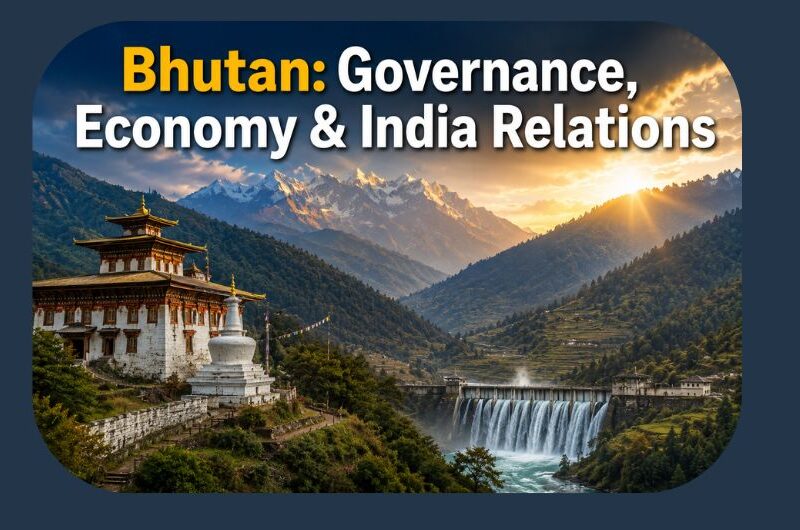
Bhutan Governance Economy and India Relations
1. Bhutan’s governance model continues to emphasise Gross National Happiness (GNH), balancing cultural traditions with democratic governance and economic modernisation.
2. Since becoming a constitutional monarchy in 2008, Bhutan has maintained political stability through cooperation between the monarchy and parliamentary institutions.
3. In 2025, Bhutan’s National Assembly was dominated by the ruling People’s Democratic Party (PDP) and the Bhutan Tendrel Party (BTP).
4. The PDP government in 2025 focused on economic growth, sustainable development, and reducing youth unemployment and brain drain.
5. Bhutan launched the Youth Engagement and Livelihood Programme (YELP) in October 2024 to address unemployment among young people.
6. According to the Ministry of Industry, Commerce and Employment, YELP supported employment for 5,969 youths by 2025.
7. Bhutan aims to reduce youth unemployment from 17.1 percent to 5.8 percent during the 13th Five-Year Plan covering 2024–2029.
8. Around 66,000 Bhutanese, equal to nearly 8.5 percent of the population, were living abroad in 2025, creating concerns over skilled migration.
9. Prime Minister Tshering Tobgay announced a three-pronged strategy in July 2025 centred on the Gelephu Mindfulness City project, the 13th Five-Year Plan, and the Bhutan 21st Century Economic Roadmap.
10. Civil service attrition in Bhutan declined from 16 percent in 2023 to 6.3 percent in 2025 due to government reforms and recruitment efforts.
11. The Royal Civil Service Commission filled 8,788 vacancies, helping Bhutan’s civil administration regain pre-pandemic operational capacity.
12. Bhutan’s economy was projected to grow by 8.93 percent in 2025, compared to 4.97 percent growth in 2024.
13. The commissioning of the 1020 MW Punatsangchu-II Hydropower Project became a major driver of Bhutan’s economic expansion in 2025.
14. India accounted for 84.28 percent of Bhutan’s total trade, remaining Bhutan’s largest trade and development partner.
15. In May 2025, the Adani Group and Druk Green Power Corporation signed a landmark MoU to expand Bhutan’s hydropower cooperation with India.
Must Know Terms :
1.GrossNationalHappiness
GrossNationalHappiness is Bhutan’s unique governance philosophy that prioritises collective well-being, environmental sustainability, cultural preservation, and balanced development over purely economic indicators. It continues to shape Bhutan’s domestic governance and policy decisions in 2025. Even while pursuing economic modernisation, hydropower expansion, and employment generation, Bhutan maintains Gross National Happiness as the guiding framework linking democratic governance, social harmony, and sustainable national development.
2.YELP
YELP stands for the Youth Engagement and Livelihood Programme launched by Bhutan in October 2024 to reduce youth unemployment and improve livelihood opportunities. By 2025, the programme had supported employment for 5,969 youths. It forms part of Bhutan’s broader effort to lower youth unemployment from 17.1 percent to 5.8 percent under the 13th Five-Year Plan while also addressing migration-related economic pressures.
3.GelephuMindfulnessCity
GelephuMindfulnessCity refers to Bhutan’s flagship development initiative aimed at promoting economic transformation, investment, and long-term employment generation. Prime Minister Tshering Tobgay identified it in 2025 as one pillar of Bhutan’s strategy to address outmigration and economic modernisation. The project seeks to combine sustainability, innovation, and mindfulness-based planning while positioning Bhutan as a regional hub for green and future-oriented economic activities.
4.PunatsangchuII
PunatsangchuII refers to the 1020 MW Punatsangchu-II Hydropower Project commissioned in Bhutan during 2025. The project significantly boosted Bhutan’s economic growth and strengthened energy cooperation with India. Hydropower exports remain central to Bhutan’s economy and bilateral relations with India. The project also reinforced India’s role as Bhutan’s leading infrastructure, energy, and development partner under their long-standing strategic partnership framework.
5.Bhutan21stCenturyRoadmap
Bhutan21stCenturyRoadmap is Bhutan’s long-term economic and governance vision aimed at modernising the economy, strengthening institutions, and addressing demographic and migration challenges. Announced as part of Prime Minister Tshering Tobgay’s three-pronged strategy in 2025, it complements the Gelephu Mindfulness City project and the 13th Five-Year Plan. The roadmap focuses on sustainable growth, employment generation, innovation, and institutional resilience in a changing global environment.
6.IndiaBhutanHydropowerPartnership
IndiaBhutanHydropowerPartnership represents the core strategic pillar of bilateral relations between India and Bhutan. India remains Bhutan’s largest development partner, investor, and energy collaborator. In 2025, cooperation expanded through power purchase agreements, the Punatsangchu-II project, and a major MoU between Adani Group and Druk Green Power Corporation. Hydropower cooperation supports Bhutan’s revenue generation while also strengthening India’s regional energy and strategic interests.
MCQ :
1. Bhutan’s governance philosophy primarily emphasises:
A) Military expansion and industrialisation
B) Gross National Happiness balancing culture and development
C) Export-led urban capitalism
D) Centralised one-party governance
2. Bhutan transitioned into a constitutional monarchy in:
A) 1998
B) 2005
C) 2008
D) 2012
3. In 2025, Bhutan’s National Assembly was mainly dominated by:
A) Druk Nyamrup Tshogpa and People’s Democratic Front
B) Bhutan National Congress and Royal Party
C) Bhutan Tendrel Party and National Democratic Alliance
D) People’s Democratic Party and Bhutan Tendrel Party
4. The People’s Democratic Party government in 2025 mainly focused on:
A) Aggressive military expansion
B) Tourism restrictions and trade reduction
C) Economic growth, sustainable development, and reducing brain drain
D) Ending hydropower cooperation with India
5. Bhutan launched the Youth Engagement and Livelihood Programme (YELP) in:
A) January 2023
B) October 2024
C) July 2025
D) March 2022
6. By 2025, YELP had supported employment for how many youths?
A) 3,969
B) 4,969
C) 5,969
D) 6,969
7. Bhutan aims to reduce youth unemployment to what level under the 13th Five-Year Plan?
A) 7.8 percent
B) 6.8 percent
C) 5.8 percent
D) 4.8 percent
8. Approximately what percentage of Bhutan’s population was living abroad in 2025?
A) 6.5 percent
B) 7.5 percent
C) 8.5 percent
D) 9.5 percent
9. Prime Minister Tshering Tobgay’s three-pronged strategy announced in July 2025 included:
A) BIMSTEC integration, defence expansion, and digital taxation
B) Gelephu Mindfulness City, 13th Five-Year Plan, and Bhutan 21st Century Economic Roadmap
C) Hydropower privatisation, border fencing, and industrial relocation
D) Currency reform, tourism restriction, and constitutional amendment
10. Civil service attrition in Bhutan declined to what level in 2025?
A) 5.3 percent
B) 6.3 percent
C) 7.3 percent
D) 8.3 percent
11. The Royal Civil Service Commission filled how many vacancies by 2025?
A) 7,788
B) 8,788
C) 9,788
D) 10,788
12. Bhutan’s projected economic growth rate for 2025 was:
A) 6.93 percent
B) 7.93 percent
C) 8.93 percent
D) 9.93 percent
13. Which hydropower project significantly boosted Bhutan’s economy in 2025?
A) Tala Hydroelectric Project
B) Mangdechhu Project
C) Kurichhu Project
D) Punatsangchu-II Hydropower Project
14. India accounted for approximately what percentage of Bhutan’s total trade?
A) 74.28 percent
B) 79.28 percent
C) 84.28 percent
D) 89.28 percent
15. In May 2025, the Adani Group signed a hydropower cooperation MoU with:
A) Bhutan Power Authority
B) Bhutan Energy Corporation
C) Royal Bhutan Hydel Agency
D) Druk Green Power Corporation

0 comment