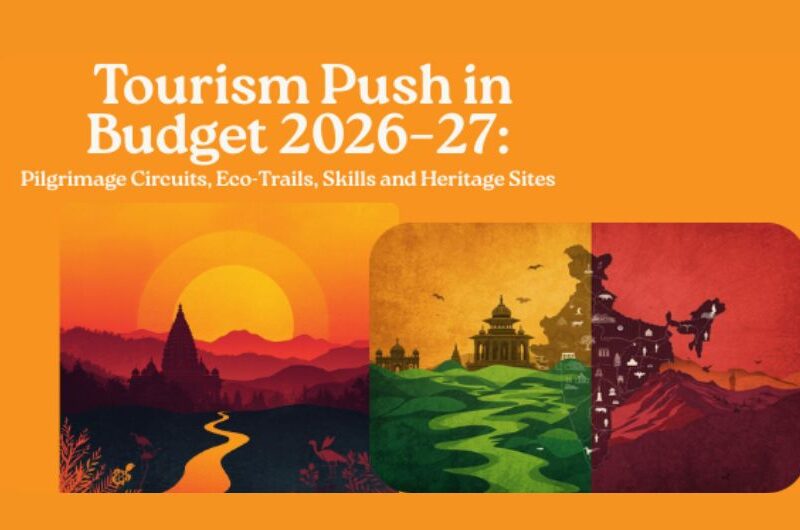
Tourism Push in Budget 2026–27: Pilgrimage Circuits, Eco-Trails, Skills and Heritage Sites
1) Union Budget 2026–27 treats tourism as a strategic growth driver; India Tourism Data Compendium 2025 shows total GDP impact 5.22% and direct share 2.72% from the tourism sector.
2) Tourism supports 13.34% of total employment in India, with direct tourism employment share at 5.82%, reflecting strong livelihood creation across hospitality, transport, handicrafts and services.
3) Budget proposes preserving temples and monasteries, creating pilgrimage centres, and improving connectivity and amenities in Arunachal Pradesh, Sikkim, Assam, Manipur, Mizoram, and Tripura.
4) A new Scheme for Development of Buddhist Circuits in the North-Eastern Region will develop and conserve monasteries, build interpretation centres, improve site connectivity, and create pilgrim amenities.
5) The scheme builds on Swadesh Darshan launched 2014–15, which developed theme-based circuits and tourism infrastructure to improve accessibility, amenities, and visitor experience.
6) Swadesh Darshan was revamped as Swadesh Darshan 2.0, focusing on responsible tourism, conservation of cultural and natural heritage, community participation, and improvement of local livelihoods.
7) As of date, 76 Swadesh Darshan projects are sanctioned with approved cost ₹5,290.33 crore; 75 projects are physically completed, showing near-full execution.
8) Budget proposes ecologically sustainable mountain and nature trails in Himachal Pradesh, Uttarakhand, Jammu & Kashmir, Araku Valley (Eastern Ghats) and Podhigai Malai (Western Ghats).
9) Eco-trails include turtle trails at nesting sites along Odisha, Karnataka and Kerala coasts, and bird-watching trails along Pulicat Lake in Andhra Pradesh, linking biodiversity with tourism.
10) India will host the first Global Big Cat Summit in 2026, inviting heads of governments and ministers from 95 big cat range countries for conservation and wildlife tourism strategy.
11) India is home to five of the world’s seven big cat species: tiger, lion, leopard, snow leopard and cheetah, strengthening its credibility in global big cat conservation leadership.
12) International Big Cat Alliance (IBCA) is a treaty-based intergovernmental organisation; its framework agreement was approved and ratified by multiple countries, with headquarters and secretariat hosted by India.
13) Budget upgrades National Council for Hotel Management and Catering Technology into a National Institute of Hospitality to improve curriculum, research, and international collaboration for tourism skills.
14) Pilot scheme will upskill 10,000 tourist guides across 20 iconic destinations using a 12-week hybrid model with classroom, field training and digital modules, in collaboration with an Indian Institute of Management (IIM).
15) Budget proposes developing 15 archaeological sites into experiential cultural destinations, including Lothal, Dholavira, Rakhigarhi, Adichanallur, Sarnath, Hastinapur and Leh Palace.
Must Know Terms :
1) Tourism GDP Impact: Tourism contributes 5.22% to India’s total GDP (overall impact), while its direct share is 2.72%, as per India Tourism Data Compendium 2025. It also supports 13.34% of total employment, with 5.82% direct tourism jobs. This shows tourism has strong multiplier effects across transport, hotels, handicrafts, food services and local markets.
2) Swadesh Darshan 2.0: Revamped version of Swadesh Darshan launched earlier in 2014–15. It focuses on responsible and sustainable tourism, conservation of cultural and natural heritage, community participation, and livelihood improvement. So far, 76 projects worth ₹5,290.33 crore are sanctioned and 75 are completed, indicating near-full implementation of tourism infrastructure projects.
3) Buddhist Circuits Scheme: A new scheme for the North-Eastern Region to develop and conserve monasteries, create interpretation centres, improve connectivity, and build pilgrim facilities. It aims to promote religious tourism while preserving heritage. The scheme supports states like Arunachal Pradesh, Sikkim, Assam, Manipur, Mizoram and Tripura, strengthening regional tourism economy.
4) Eco-Tourism Trails: Budget proposes sustainable mountain and nature trails in Himachal Pradesh, Uttarakhand, Jammu & Kashmir, Araku Valley and Podhigai Malai. It also includes turtle nesting trails in Odisha, Karnataka, Kerala and bird-watching trails at Pulicat Lake. The focus is biodiversity-linked tourism with minimal ecological damage and local income generation.
5) International Big Cat Alliance: A treaty-based intergovernmental organisation focused on conservation of big cats. India hosts its headquarters and secretariat. India will also host the first Global Big Cat Summit in 2026, with participation from 95 big cat range countries. India has five of seven global big cat species, strengthening its leadership role.
6) Heritage Destination Development: Budget proposes developing 15 archaeological sites into experiential destinations. Sites include Lothal, Dholavira, Rakhigarhi, Adichanallur, Sarnath, Hastinapur and Leh Palace. The aim is to improve visitor facilities, interpretation, and connectivity so that heritage tourism generates higher cultural value and economic benefits locally.
MCQ :
1. Tourism’s total GDP impact is reported at:
A) 2.72%
B) 3.82%
C) 5.22%
D) 6.22%
2. Tourism’s direct GDP share is reported at:
A) 1.72%
B) 2.72%
C) 3.72%
D) 5.22%
3. Tourism supports what share of total employment in India?
A) 5.82%
B) 9.34%
C) 13.34%
D) 18.34%
4. Direct tourism employment share is:
A) 2.72%
B) 4.82%
C) 5.82%
D) 13.34%
5. Budget focus for preserving temples and monasteries and improving amenities is specifically highlighted for:
A) Rajasthan, Gujarat, Maharashtra, Goa, Kerala, Tamil Nadu
B) Arunachal Pradesh, Sikkim, Assam, Manipur, Mizoram, Tripura
C) Punjab, Haryana, Uttar Pradesh, Bihar, Jharkhand, Chhattisgarh
D) Himachal Pradesh, Uttarakhand, Jammu & Kashmir, Ladakh, Delhi, Chandigarh
6. The new Buddhist circuits scheme is designed for:
A) Western India coastal belt
B) North-Eastern Region
C) Central India plateau region
D) Indo-Gangetic plains
7. Swadesh Darshan was launched in:
A) 2012–13
B) 2013–14
C) 2014–15
D) 2016–17
8. Swadesh Darshan 2.0 focuses on:
A) Only luxury tourism and metropolitan branding
B) Responsible tourism, heritage conservation, community participation, local livelihoods
C) Only adventure sports and extreme tourism
D) Only international inbound tourism campaigns
9. Number of Swadesh Darshan projects sanctioned is:
A) 75
B) 76
C) 86
D) 90
10. Approved cost of sanctioned Swadesh Darshan projects is:
A) ₹4,290.33 crore
B) ₹5,290.33 crore
C) ₹6,290.33 crore
D) ₹7,290.33 crore
11. Number of Swadesh Darshan projects physically completed is:
A) 70
B) 72
C) 75
D) 76
12. Budget proposes sustainable mountain and nature trails in Himachal Pradesh, Uttarakhand, Jammu & Kashmir, and also in:
A) Kutch and Konkan
B) Araku Valley and Podhigai Malai
C) Sundarbans and Kaziranga
D) Bundelkhand and Malwa
13. Turtle trails at nesting sites are proposed along the coasts of:
A) Gujarat, Maharashtra, Goa
B) Odisha, Karnataka, Kerala
C) Tamil Nadu, Andhra Pradesh, West Bengal
D) Maharashtra, Goa, Kerala
14. India will host the first Global Big Cat Summit in:
A) 2025
B) 2026
C) 2027
D) 2028
15. India is home to how many of the world’s seven big cat species?
A) 3
B) 4
C) 5
D) 6

0 comment