Weaving Growth: Budget 2026–27 and India’s Textile Value Chain
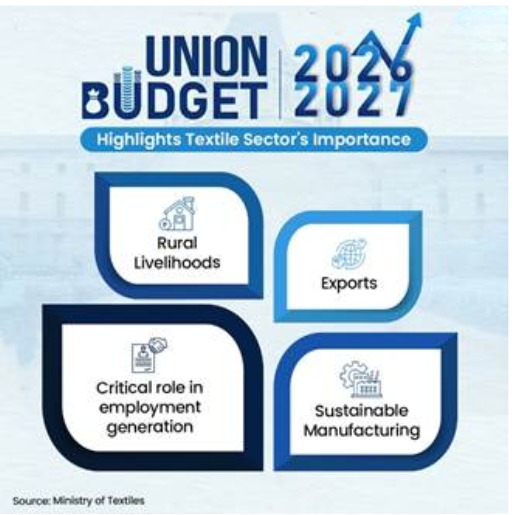
1. Union Budget 2026–27 places textiles at the centre of growth, prioritising jobs, exports, rural livelihoods, and sustainable manufacturing, with integrated policy focus from fibre production to fashion markets.
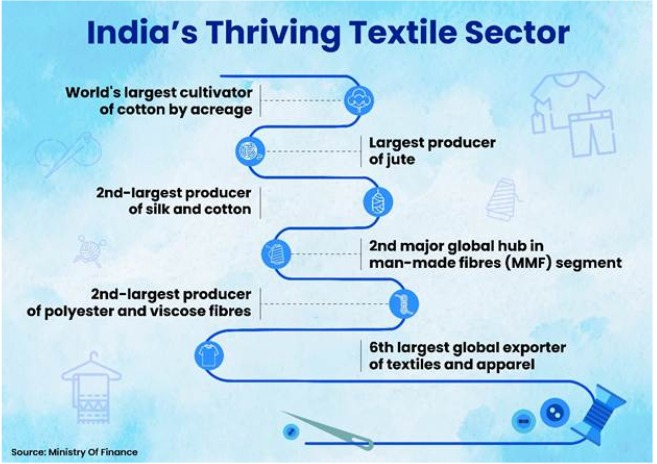
2. India’s fibre strengths include largest cotton acreage, largest jute output, second-largest silk and cotton production, major MMF hub, and second-largest polyester and viscose fibre production worldwide among nations.
3. An Integrated Programme is proposed to bolster the textile value chain, organised into five components spanning fibre self-reliance, cluster modernisation, artisan support, sustainability compliance, and skilling upgrades nationwide.
4. National Fibre Scheme supports silk, wool, jute, man-made fibres, and new-age fibres, aiming to diversify beyond cotton, spur advanced material innovation, and reduce import dependence for specialised textiles.
5. Textile Expansion and Employment Scheme modernises traditional clusters, providing capital for machinery and technology upgrades, plus common testing and certification centres, to raise productivity, quality compliance, and employment.
6. National Handloom and Handicraft Programme merges existing schemes to improve artisan incomes and market linkages, while supporting natural and vegetable dyes and dye houses via clusters and infrastructure.
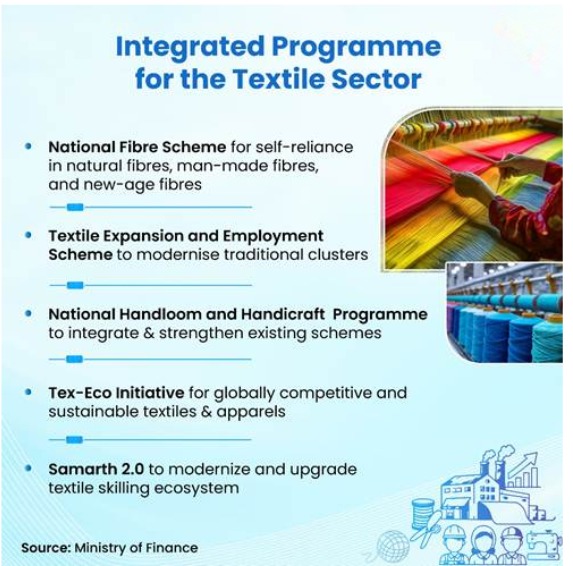
7. Tex-Eco Initiative promotes globally competitive, environmentally sustainable textiles and apparel manufacturing, aligning production with international sustainability standards and enabling access to emerging green markets and responsible sourcing requirements.
8. Samarth 2.0 upgrades the skilling framework through deeper collaboration with industry and academic institutions, aiming to supply industry-ready manpower across spinning, weaving, processing, garmenting, and allied services nationwide.
9. Mega Textile Parks will be set up in challenge mode, offering infrastructure and efficiencies, promoting value addition, and supporting technical textiles for industrial, medical, defence, and infrastructure uses.
10. Mahatma Gandhi Gram Swaraj Initiative strengthens khadi, handloom, and handicrafts via branding, market linkages, training, skilling, quality improvement, and process modernisation, benefiting weavers, village industries, youth, and ODOP.
11. Export obligation period is extended from six to twelve months for exporters using duty-free inputs in textile garments and leather goods, improving compliance flexibility and working-capital management overall.
12. TReDS is an electronic platform for financing and discounting MSME trade receivables through multiple financiers, against dues from corporates, government departments, and PSUs, including other buyers across markets.
13. Liquidity push targets textile MSMEs by mandating CPSE procurement invoices on TReDS, providing CGTMSE credit guarantees for invoice discounting, and linking GeM with TReDS for faster, cheaper finance.
14. TReDS receivables will be introduced as asset-backed securities, encouraging secondary-market participation and improving liquidity, which can widen financier interest and smooth credit flow to MSMEs during demand fluctuations.
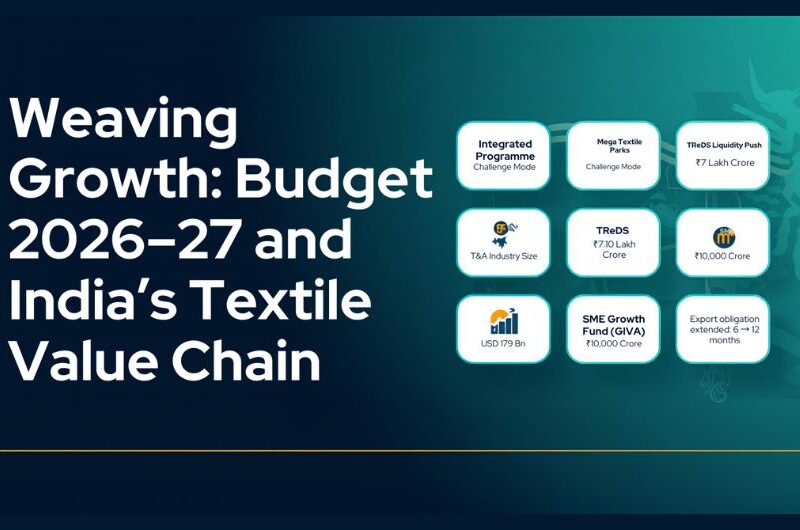
15. Indian textile and apparel industry is estimated at USD 179 billion, contributes about 2% of GDP, around 11% of manufacturing GVA, and 8.63% of exports in the economy.
Must Know terms :
1) Integrated Programme for Textile Sector (Union Budget 2026–27) —
- Announced as an integrated policy framework for the labour-intensive textile sector, covering value chain “fibre to fashion” and “village industries to global markets”.
- Built as an umbrella with 5 sub-parts: National Fibre Scheme; Textile Expansion & Employment Scheme; National Handloom & Handicraft Programme; Tex-Eco Initiative; Samarth 2.0.
- Stated policy objectives: competitiveness + self-reliance + employment generation.
- Sector context often quoted in govt briefs: textiles & apparel ~2% of GDP; ~11% of manufacturing GVA; direct employment “more than 45 million”.
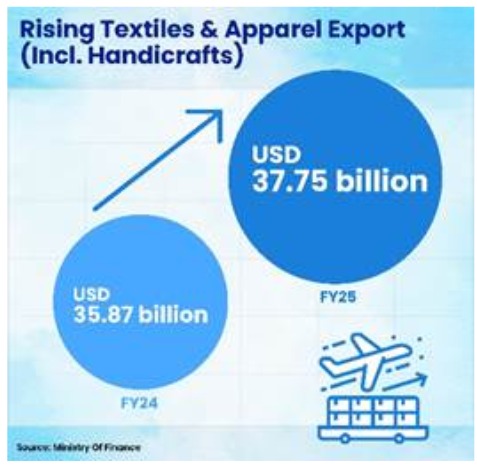
- Export context used in official notes: textiles & apparel (incl. handicrafts) 8.63% of India’s merchandise exports in 2024–25; value about USD 37.7 billion.
2) National Fibre Scheme (Budget 2026–27) —
- Explicit fibre coverage listed: natural fibres (silk, wool, jute) + man-made fibres (MMF) + “new-age fibres”.
- Core framing: “self-reliance across the fibre spectrum” and strengthening domestic fibre availability.
- Intended outcomes: reduce import dependence; diversify beyond cotton; support innovation in advanced textile materials.
- scheme is not cotton-only; it is positioned as diversification + high-performance/specialised textiles capability building.
- Linkage: it sits inside the 5-part Integrated Programme for Textile Sector (not a standalone unrelated scheme).
3) Textile Expansion and Employment Scheme (Budget 2026–27) —
- Designed specifically for modernising “traditional clusters” (cluster-focused, not single-factory only).
- Support types mentioned: capital support for machinery + technology upgradation.
- Also includes: “common testing and certification centres” (standards/compliance infrastructure).
- Stated intention: employment-intensive push—modernisation tied with job creation and competitiveness.
- Lcombines (i) capex support + (ii) shared testing/certification—both appear together in the scheme description.
4) National Handloom and Handicraft Programme (Budget 2026–27) —
- Announced to “integrate and strengthen existing schemes” (consolidation/umbrella approach).
- Target group clearly stated: weavers and artisans (handloom + handicraft ecosystem).
- Design idea: targeted support with better coherence (less fragmentation across multiple schemes).
- Positioning within Budget: part of the same 5-part textile integrated programme (not separate from it).
- Question-worthy distinction: this is about integrating schemes + ensuring targeted support; not described as machinery capex or fibre R&D.
5) Tex-Eco Initiative (Budget 2026–27) —
- Purpose line: promote “globally competitive and sustainable textiles and apparels”.
- Sustainability is framed as competitiveness enabler (export-market readiness + sustainable manufacturing).
- Included as the 4th sub-part inside the 5-part Integrated Programme.
- name suggests ecology; official wording ties it directly to sustainable textiles + global competitiveness (not only pollution control).
- Differentiator vs other sub-parts: focuses on sustainability + competitiveness, whereas “Expansion & Employment” focuses on clusters/capex/testing.
6) TReDS (Trade Receivables Discounting System) —
- RBI definition: an electronic platform to facilitate financing/discounting of MSME trade receivables through multiple financiers.
- Receivables can be due from: corporates and other buyers including Government Departments and PSUs.
- Key participants (RBI framing): MSME sellers, buyers, and financiers (banks/NBFC-Factors/other RBI-permitted institutions).
- Legal/regulatory base commonly cited: operated under RBI framework for payment systems (PSS Act, 2007 referenced in RBI-guideline explainers).
- invoice/bill is uploaded by MSME → buyer acceptance → financiers bid/discount → MSME gets early payment.
- Platform ecosystem (SIDBI page): TReDS platforms include RXIL; the other two platforms are M1xchange and Invoicemart.
Key Takeaways
a.The Union Budget 2026-27places Textiles at the centre of growth strategy with focus on employment, exports, rural livelihoods and sustainable manufacturing.
b.Push for scale and modern manufacturingthrough mega textile parks and support for MMF and technical textiles.
c.MSMEs and artisans supportedthrough liquidity measures, cluster modernisation and skilling initiatives.
d.Policy direction emphasises scale, sustainability and competitivenessto strengthen India’s position in global textile value chains.
MCQ
1. With reference to Union Budget 2026–27 and textiles, consider the following statements:
1. Textiles are prioritised for employment, exports, rural livelihoods, and sustainable manufacturing.
2. The policy approach explicitly targets the value chain from fibre to fashion.
Which of the statements given above is/are correct?
A) 1 only
B) 2 only
C) Both 1 and 2
D) Neither 1 nor 2
2. Consider the following pairs about India’s textile-fibre strengths as stated:
1. Cotton — World’s largest cultivator by acreage
2. Jute — World’s largest producer
3. Polyester and viscose fibres — Second-largest producer
How many pairs given above are correctly matched?
A) Only one
B) Only two
C) All three
D) None
3. The Integrated Programme for the textile sector in Budget 2026–27 is structured around how many sub-components?
A) Three
B) Four
C) Five
D) Six
4. National Fibre Scheme aims to support:
A) Only cotton and jute to consolidate natural fibre dominance
B) Natural fibres plus man-made and new-age fibres to expand the fibre spectrum
C) Only man-made fibres to reduce cotton dependence
D) Only technical textiles for defence and infrastructure uses
5. Textile Expansion and Employment Scheme includes which of the following?
1. Capital support for machinery and technology upgradation
2. Establishment of common testing and certification centres
3. Direct export subsidies linked to destination markets
Select the correct answer using the code below:
A) 1 and 2 only
B) 2 and 3 only
C) 1 and 3 only
D) 1, 2 and 3
6. National Handloom and Handicraft Programme, as described, includes financial assistance for:
1. Promotion of natural and vegetable dyes
2. Establishment of dye houses
Which of the statements given above is/are correct?
A) 1 only
B) 2 only
C) Both 1 and 2
D) Neither 1 nor 2
7. Tex-Eco Initiative is best described as:
A) A programme to replace imports of cotton with domestic cotton varieties
B) A sustainability-focused push aligning textiles and apparel manufacturing with international standards
C) A tariff-reform mechanism for lowering duties on textile inputs
D) A scheme limited to handloom branding and ODOP market access
8. Samarth 2.0 focuses on which of the following outcomes?
A) Replacing cluster modernisation with artisan welfare transfers
B) Creating industry-ready skilled manpower through deeper industry–academia collaboration
C) Limiting training to traditional looms and khadi production only
D) Converting TReDS receivables into export credit instruments
9. Mega Textile Parks are proposed to be set up:
A) Only in PPP mode with state-wise fixed allocations
B) In challenge mode with integrated infrastructure and scale efficiencies
C) Only as brownfield expansions of existing clusters
D) Exclusively to house handloom and handicraft units
10. Technical textiles, in the described policy direction, have applications in:
1. Industrial
2. Medical
3. Defence
4. Infrastructure
Select the correct answer using the code below:
A) 1 and 2 only
B) 1, 2 and 3 only
C) 2, 3 and 4 only
D) 1, 2, 3 and 4
11. Mahatma Gandhi Gram Swaraj Initiative emphasises:
1. Global market linkage and branding
2. Streamlined training, skilling, and quality improvement
3. Process modernisation supporting ODOP
Select the correct answer using the code below:
A) 1 only
B) 1 and 2 only
C) 2 and 3 only
D) 1, 2 and 3
12. The Budget measure for exporters using duty-free imported inputs extends the export obligation period from:
A) 3 months to 6 months
B) 6 months to 12 months
C) 9 months to 18 months
D) 12 months to 24 months
13. With reference to TReDS, consider the following statements:
1. It enables financing and discounting of MSME trade receivables via multiple financiers.
2. Receivables can be due from corporates, government departments, and PSUs.
Which of the statements given above is/are correct?
A) 1 only
B) 2 only
C) Both 1 and 2
D) Neither 1 nor 2
14. Measures announced to enhance TReDS effectiveness include which of the following?
1. Mandatory use of TReDS by CPSEs for procurement from MSMEs
2. Credit guarantee support through CGTMSE for invoice discounting on TReDS
3. Linking GeM with TReDS for faster, lower-cost financing
Select the correct answer using the code below:
A) 1 and 2 only
B) 2 and 3 only
C) 1 and 3 only
D) 1, 2 and 3
15. Consider the following statements about the Indian textile and apparel (T&A) industry as stated:
1. Estimated size is USD 179 billion.
2. It contributes about 2% to GDP and around 11% to manufacturing GVA.
3. It accounts for 8.63% of exports.
Which of the statements given above is/are correct?
A) 1 only
B) 1 and 2 only
C) 2 and 3 only
D) 1, 2 and 3

0 comment