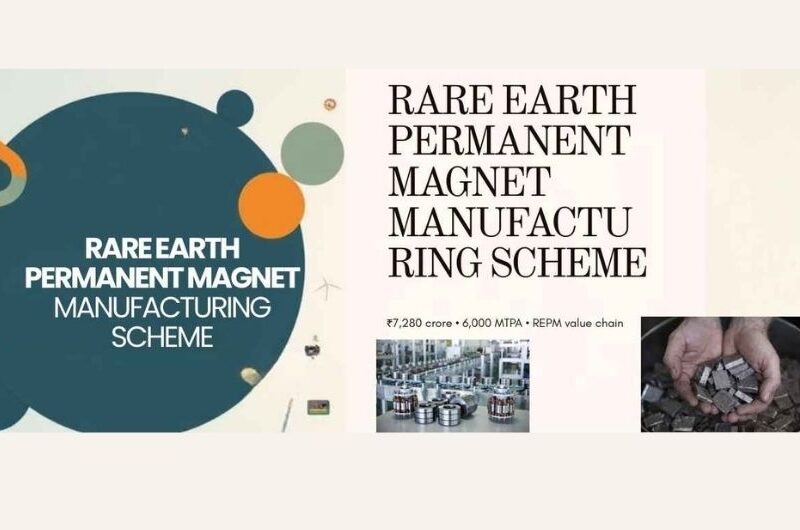
Rare Earth Permanent Magnet Manufacturing Scheme
Key Takeaways
- Government approves ₹7,280 crore scheme to establish domestic integrated REPM manufacturing ecosystem.
- Creates 6,000 MTPA domestic capacity covering the full value chain, from rare-earth oxides to finished magnets.
- Strengthens self-reliance for critical sectors such as electric mobility, renewable energy, electronics, aerospace and defence.
- Supported by strong rare-earth resource availability and policy initiatives including NCMM and MMDR Act reforms.
- Enhances India’s participation in global advanced-materials value chains while reducing import dependence and enabling long-term industrial growth.
1.Government approved a ₹7,280 crore scheme to promote sintered rare earth permanent magnet manufacturing, targeting expansion of national industrial capability and output overall capacity.
2.The scheme will create 6,000 MTPA integrated domestic REPM capacity, covering the full value chain from rare earth oxide to finished magnets in India.
3.REPMs deliver high magnetic strength and stability, enabling efficient use in EV motors, wind turbines, electronics, aerospace platforms, and defence systems globally today widely.
4.A domestic REPM ecosystem can cut import dependence for e-mobility, renewables, electronics, aerospace and defence, strengthening strategic supply-chain resilience at scale for India’s industries.
5.India holds about 13.15 million tonnes of monazite reserves, containing an estimated 7.23 million tonnes of rare earth oxides forming a substantial resource base.
6.Rare earth oxide resources occur in coastal beach sands, teri/red sands and inland alluvium across Andhra Pradesh, Odisha, Tamil Nadu, Kerala, West Bengal, Jharkhand.
7.Hard-rock regions of Gujarat and Rajasthan have identified 1.29 million tonnes of in-situ rare earth oxide resources, supporting longer-term domestic supply security and planning.
8.Geological Survey added 482.6 million tonnes of rare earth ore resources through exploration, indicating strong potential for downstream industry development nationally in coming years.
9.Despite progress in local magnet production, import dependence remained high during 2022–23 to 2024–25, reaching 59.6–81.3% value and 84.8–90.4% volume for these products overall.
10.REPM consumption is projected to double by 2030, driven by e-mobility growth, renewable deployment, electronics manufacturing expansion, and strategic defence applications worldwide by then.
11.Capacity will be allocated through global competitive bidding to up to five beneficiaries; each may receive up to 1,200 MTPA to ensure diversification adequately.
12.The incentive package includes ₹6,450 crore sales-linked incentives over five years and ₹750 crore capital subsidy to support advanced plant establishment nationwide implementation efforts.
13.Implementation spans seven years: two years for facility setup, followed by five years of REPM sales-based incentive payouts, ensuring timely capacity creation and delivery.
14.The initiative supports green technologies by supplying materials for energy-efficient motors and wind power systems, aligning directly with Net Zero 2070 vision targets also.
15.The scheme complements NCMM launched January 2025, MMDR Amendment 2023, MSP, IPEF, iCET partnerships, and KABIL efforts for overseas mineral acquisition and security goals.
MCQ:
1. With reference to the ₹7,280 crore initiative, consider the following statements:
I) It targets sintered rare earth permanent magnet manufacturing.
II) It aims to expand national industrial capability and output.
Which of the statements given above is/are correct?
A. I only
B. II only
C. Both I and II
D. Neither I nor II
2. The integrated domestic capacity proposed under the scheme is:
A. 1,200 MTPA
B. 3,000 MTPA
C. 6,000 MTPA
D. 7,280 MTPA
3. The scheme’s integration across the value chain is best described as:
A. Finished magnets only
B. Rare earth oxide to finished magnets
C. Mining to rare earth oxide only
D. Component assembly to final products only
4. Rare earth permanent magnets are specifically described as having:
A. Low magnetic strength and low stability
B. High magnetic strength and stability
C. High electrical conductivity and ductility
D. Low density and high thermal insulation
5. Which of the following sectors are directly cited as key users of REPM?
A. EV motors, wind turbines, electronics, aerospace, defence systems
B. Cement, textiles, fertilizers, shipping, retail
C. Agriculture, fisheries, forestry, hospitality, tourism
D. Railways, ports, steel, banking, insurance
6. Consider the following statements about India’s monazite reserves:
1) They are about 13.15 million tonnes.
2) They contain an estimated 7.23 million tonnes of rare earth oxides.
Which of the statements given above is/are correct?
A. 1 only
B. 2 only
C. Both 1 and 2
D. Neither 1 nor 2
7. Rare earth oxide resources in coastal and inland settings are cited across several states. Which one of the following is NOT listed?
A. Kerala
B. Jharkhand
C. Andhra Pradesh
D. Punjab
8. Hard-rock in-situ rare earth oxide resources of about 1.29 million tonnes are identified in:
A. Gujarat and Rajasthan
B. Odisha and West Bengal
C. Tamil Nadu and Kerala
D. Maharashtra and Andhra Pradesh
9. Geological Survey exploration added rare earth ore resources of:
A. 48.26 million tonnes
B. 482.6 million tonnes
C. 4,826 million tonnes
D. 728.0 million tonnes
10. During 2022–23 to 2024–25, import dependence for magnets remained high. The stated ranges were:
A. Value: 20–40%; Volume: 30–50%
B. Value: 59.6–81.3%; Volume: 84.8–90.4%
C. Value: 84.8–90.4%; Volume: 59.6–81.3%
D. Value: 10–25%; Volume: 70–85%
11. REPM consumption is projected to:
A. Halve by 2030 due to substitution
B. Remain constant until 2030
C. Double by 2030, driven by e-mobility, renewables, electronics, strategic uses
D. Double by 2047, driven only by electronics
12. Consider the following about beneficiary allocation:
1) Allocation is through global competitive bidding.
2) There can be up to five beneficiaries.
3) Each beneficiary can receive up to 1,200 MTPA.
Which of the statements given above is/are correct?
A. 1 and 2 only
B. 2 and 3 only
C. 1 and 3 only
D. 1, 2 and 3
13. The incentive structure includes which of the following?
A. ₹6,450 crore sales-linked incentives and ₹750 crore capital subsidy
B. ₹7,280 crore sales-linked incentives and ₹6,450 crore capital subsidy
C. ₹750 crore sales-linked incentives and ₹6,450 crore capital subsidy
D. Only capital subsidy; no sales-linked incentives
14. The seven-year implementation is structured as:
A. 5 years setup + 2 years incentive payouts
B. 2 years setup + 5 years sales-based incentive payouts
C. 7 years setup; incentives after completion
D. 1 year setup + 6 years payouts
15. The scheme is stated to be complementary to which of the following sets?
A. NCMM (Jan 2025), MMDR Amendment 2023, MSP, IPEF, iCET, KABIL overseas mineral efforts
B. NCMM (Jan 2023), MMDR 2025, MSP, BRICS, KABIL domestic retail efforts
C. NCMM (Dec 2024), MMDR 2019, MSP, QUAD, iCET, KABIL port modernization
D. NCMM (Jan 2025), MMDR 2023, MSP, SAARC, iCET, KABIL fisheries initiative




0 comment