
National Security Budget 2026–27: Modernisation, Indigenous Procurement, and Veterans’ Support
1. FY 2026–27 defence allocation is ₹7.85 lakh crore, highest among ministries; 15.19% higher than FY 2025–26 BE, forming 14.67% of total expenditure, and prioritises modernisation, self-reliance, veterans’ welfare.
2. Defence budget rose from ₹2.53 lakh crore in 2013–14 to ₹7.85 lakh crore in 2026–27, adding about ₹5.32 lakh crore, roughly tripling in thirteen years, nominal rupee terms.
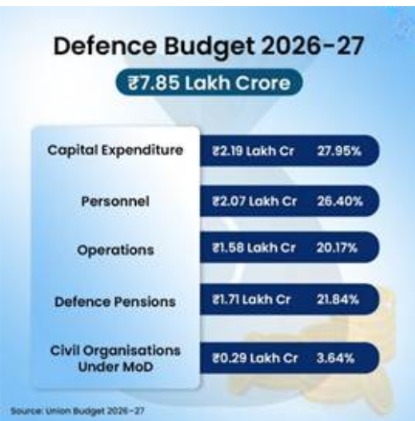
3. Defence outlay split: 27.95% capital; 20.17% revenue for sustenance and operational preparedness; 26.40% pay and allowances; 21.84% pensions; 3.64% civil organisations and attached offices, highlighting heavy personnel-linked spending.
4. Capital head for Defence Forces in FY 2026–27 is over ₹2.19 lakh crore, 21.84% above FY 2025–26 BE, accelerating platform upgrades and capability creation across services this year.
5. Within the ₹2.19 lakh crore capital head, ₹1.85 lakh crore is earmarked for capital acquisition, about 24% higher than FY 2025–26, enlarging new procurement headroom for big-ticket projects.
6. Planned acquisitions cover next-generation fighter aircraft, advanced weapons, ships, submarines, UAVs and drones, expanding precision strike, surveillance, sea denial and unmanned force multipliers for all three armed services.
7. Border Roads Organisation capital allocation increases to ₹7,394 crore in FY 2026–27, supporting strategic connectivity by modernising tunnels, bridges, roads and defence-relevant airfields in frontier areas at pace.
8. ₹975 crore is provided for an optical-fibre-cable network for Defence Services, improving secure communications, data throughput, redundancy and jointness across tri-service commands and field formations during high-tempo operations.
9. ₹1.39 lakh crore is earmarked for procurement from domestic defence industries, boosting indigenous supply chains, local value addition and import substitution in platforms, spares, ammunition and electronics ecosystem.
10. Around 75% of the capital acquisition budget is reserved for domestic defence industries in FY 2026–27, ensuring steady orders for DPSUs, MSMEs, private primes, start-ups and academia partners.
11. Customs duty on imported raw materials to make aircraft parts for defence MRO is proposed exempt, reducing maintenance costs, spares prices, and downtime for operational fleets across services.
12. DRDO allocation rises to ₹29,100.25 crore in FY 2026–27 from ₹26,816.82 crore in FY 2025–26; ₹17,250.25 crore is set aside for capital expenditure, supporting labs, trials, and prototyping.
13. About 25% of Defence R&D budget is open to industry, start-ups and academia; 15 DRDO–Industry–Academia Centres of Excellence span 82 research verticals for targeted technology development, nationwide collaboration.
14. DRDO partners with around 2,000 industries for manufacturing; technologies are transferred to Indian firms at zero transfer-of-technology fee, accelerating commercialisation, scaling and broader innovation diffusion into production lines.
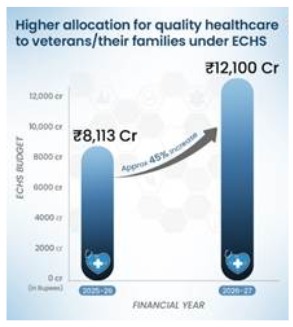
15. ECHS gets ₹12,100 crore in FY 2026–27, 45.49% above FY 2025–26 BE; defence pensions exceed ₹1.71 lakh crore, serving 34+ lakh pensioners via SPARSH, and authorised agencies nationwide.
Must Know Terms :
1.SPARSH (System for Pension Administration – Raksha)
- Digital pension disbursement platform for defence pensioners with direct credit to bank accounts.
- Reported coverage: ~31 lakh onboarded out of ~32 lakh defence pensioners (statement reported 29 March 2025).
- Reported facilitation network: 200+ Defence Accounts Department offices, 16 bank branches, and ~5 lakh Common Service Centres supporting pensioners.
- Reported service improvement: legacy discrepancies resolved in up to 87% cases; average grievance disposal time reduced from 56 days (April 2025) to 20 days (later official update).
2.ECHS (Ex-Servicemen Contributory Health Scheme)
Effective from: 1 April 2003.
Designed for cashless medicare for ex-servicemen pensioners and eligible dependents through polyclinics, service medical facilities, government hospitals, and empanelled private/specified AYUSH hospitals.
Sanctioned network: 427 ECHS polyclinics in India + 6 polyclinics in Nepal; 30 Regional Centres.
Polyclinics provide outpatient care (consultation, essential investigations, medicines); specialised and inpatient care is through service hospitals/government hospitals/empanelled private hospitals.
3.MTRE (Medical Treatment Related Expenditure)
- Budget head used for meeting medical treatment costs under the ex-servicemen healthcare ecosystem (especially settlement of treatment bills/claims under ECHS).
- The term is used in defence/ex-servicemen welfare budgeting as the expenditure line that directly maps to treatment payments, including higher outgo when rates are revised or claim volumes rise.
- Audit and media reporting have linked MTRE shortfalls to delayed payments and carried-forward liabilities in certain periods (context: hospital empanelment reimbursements).
4.BRO (Border Roads Organisation)
- Raised on: 7 May 1960.
- Border Roads Development Board (BRDB) structure: Prime Minister as Chairman; Defence Minister as Deputy Chairman (coordination and faster execution).
- Mandate focus: strategic road infrastructure in remote and border areas, supporting both defence mobility and regional connectivity.
5.MRO (Maintenance, Repair and Overhaul)
- Aviation servicing ecosystem covering scheduled/unscheduled maintenance of aircraft, engines, components, and associated tooling/testing.
- Tax reform: GST on aircraft MRO services reduced from 18% to 5% with full input tax credit, effective 1 April 2020.
- Import tax reform: uniform 5% IGST on imports of aircraft parts/components, testing equipment, tools and toolkits for MRO (policy announcement implemented from mid-July 2024, subject to conditions).
6.DRDO (Defence Research and Development Organisation)
- Formed in: 1958.
- Formation basis: created by amalgamating the Indian Army’s Technical Development Establishments (TDEs), the Directorate of Technical Development & Production (DTDP), and the Defence Science Organisation (DSO).
- Widely listed indigenous strategic programmes associated with DRDO’s R&D line include Agni and Prithvi missile series, Akash air defence system, Pinaka multi-barrel rocket launcher, and LCA Tejas (as flagship examples of indigenous development-to-production pathways).
MCQ :
1. In FY 2026–27, the defence allocation of ₹7.85 lakh crore is:
A. 14.67% of total Central Government expenditure
B. 12.67% of total Central Government expenditure
C. 16.47% of total Central Government expenditure
D. 10.67% of total Central Government expenditure
2. The FY 2026–27 defence allocation is higher than FY 2025–26 Budget Estimates by:
A. 11.19%
B. 12.91%
C. 15.19%
D. 18.19%
3. India’s defence budget increase from 2013–14 to 2026–27 is approximately:
A. ₹3.32 lakh crore
B. ₹4.32 lakh crore
C. ₹5.32 lakh crore
D. ₹6.32 lakh crore
4. As per the stated split, the share for capital expenditure in the defence outlay is:
A. 20.17%
B. 26.40%
C. 27.95%
D. 21.84%
5. The share earmarked for defence pensions in the outlay split is:
A. 21.84%
B. 20.17%
C. 26.40%
D. 27.95%
6. The budgetary allocation under capital head to the Defence Forces in FY 2026–27 is over:
A. ₹1.85 lakh crore
B. ₹2.19 lakh crore
C. ₹2.53 lakh crore
D. ₹1.71 lakh crore
7. Out of the capital head allocation, the earmarked amount for capital acquisition is:
A. ₹1.39 lakh crore
B. ₹1.71 lakh crore
C. ₹1.85 lakh crore
D. ₹2.19 lakh crore
8. The capital head allocation to the Defence Forces in FY 2026–27 is higher than FY 2025–26 BE by:
A. 21.84%
B. 24.00%
C. 15.19%
D. 6.56%
9. The capital acquisition earmark of ₹1.85 lakh crore represents an increase of approximately over FY 2025–26:
A. 18%
B. 20%
C. 22%
D. 24%
10. The capital allocation to the Border Roads Organisation (BRO) in FY 2026–27 is:
A. ₹6,394 crore
B. ₹7,394 crore
C. ₹8,394 crore
D. ₹9,394 crore
11. The allocation for Optical Fibre Cable based network for Defence Services is:
A. ₹795 crore
B. ₹875 crore
C. ₹975 crore
D. ₹1,075 crore
12. Procurement earmarked from domestic defence industries in FY 2026–27 is:
A. ₹1.19 lakh crore
B. ₹1.29 lakh crore
C. ₹1.39 lakh crore
D. ₹1.49 lakh crore
13. Around what share of the capital acquisition budget is reserved for domestic defence industries in FY 2026–27?
A. 65%
B. 70%
C. 75%
D. 80%
14. DRDO allocation in FY 2026–27 is stated as:
A. ₹26,816.82 crore
B. ₹27,816.82 crore
C. ₹28,816.82 crore
D. ₹29,100.25 crore
15. The ECHS allocation in FY 2026–27 is:
A. ₹10,100 crore
B. ₹11,100 crore
C. ₹12,100 crore
D. ₹13,100 crore




0 comment