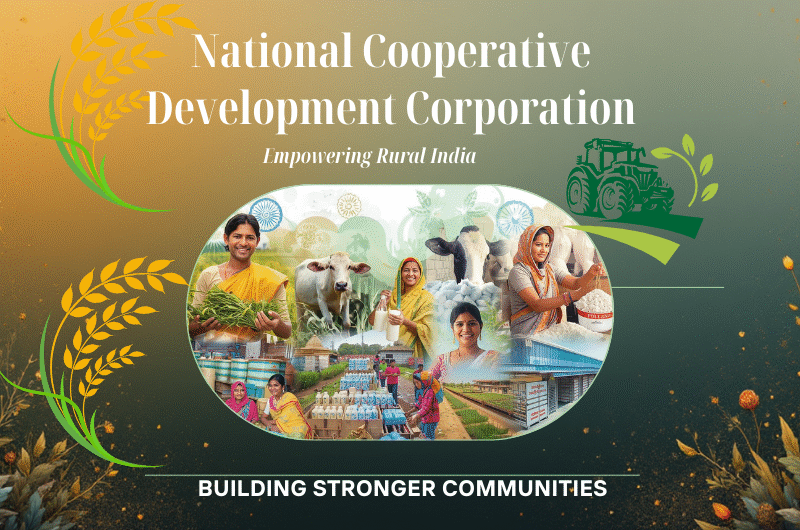
National Cooperative Development Corporation (NCDC)
Core Identity
- Statutory organisation established in 1963 under the Ministry of Cooperation to strengthen India’s cooperative movement through institutional finance and development support.
Financial Scale and Trend (Highlights)
- Disbursement in 2024–25: ₹95,182.88 crore, up from ₹5,735.51 crore in 2014–15 (sharp long-term expansion).
- Disbursement in 2025–26 (till Oct 2025): ₹49,799.06 crore.
- Cumulative assistance to cooperative sugar mills: ₹33,311.79 crore (as of March 2025).
- SC/ST cooperatives: ₹57.78 crore (FY 2021–22 to FY 2024–25).
- Women cooperatives:
– Total (FY 2021–22 to FY 2024–25): ₹4,823.68 crore
– Infrastructure (2022–2025): ₹2.37 crore
Sectoral Coverage
- Farm & allied: agriculture inputs, storage, cold chain, processing, marketing.
- Non-farm: dairy, livestock, poultry, fisheries, handloom, sericulture, women and SC/ST activities.
- Infrastructure: storage, logistics, processing plants, technology upgradation.
Key Schemes
1) Yuva Sahakar (2019–20)
- Purpose: Support innovative cooperative start-ups; emphasis on NE region, Aspirational Districts, women/SC/ST/PwD cooperatives.
- Status: 32 societies, ₹49.35 crore sanctioned, ₹3.71 crore released.
2) Ayushman Sahakar (2020–21)
- Purpose: Cooperative-led healthcare, AYUSH facilities, alignment with national health systems and digital health.
- Status: 9 societies, ₹161.90 crore sanctioned, ₹43.19 crore released.
3) Dairy Sahakar (2021–22)
- Purpose: End-to-end dairy value chain—bovine development, processing, QA, branding, export; allied services (R&D, packaging, equipment, veterinary care).
- Status: 16 societies, ₹162.28 crore sanctioned, ₹177.72 crore released.
4) Digital Sahakar (2021–22)
- Purpose: Digitisation of cooperatives; better credit access; linkage with government incentives and platforms.
- Coverage: Cooperatives, FPOs/FFPOs, SHG federations (direct or via States/UTs).
5) Deerghavadhi Krishak Punji Sahakar Yojana (2022–23)
- Purpose: Long-term capital to agricultural credit cooperatives; strengthen farm and allied activities and non-farm diversification.
- Eligible: PACS, DCCBs, StCBs, PCARDS, SCARDS.
- Status: 5 societies, ₹5,400.76 crore sanctioned, ₹2,137.00 crore released.
6) Women-Focused Schemes
- Swayam Shakti Sahakar (2022–23): Credit to women SHGs via PACS/DCCBs/StCBs/federations.
- Nandini Sahakar (2020–21): Capacity building, enterprise planning and finance for women-led cooperatives.
- Output (FY 2021–22 to FY 2024–25): 34 cooperatives, ₹6,283.71 crore sanctioned, ₹4,823.68 crore released.
Sugar Mills Support (Central Grant-in-Aid)
- Government grant ₹1,000 crore (2022–23, 2024–25).
- Credit up to ₹10,000 crore to mills for ethanol/cogeneration and working capital.
- Funding pattern eased to 90:10; term-loan interest 8.5%.
- Output: ₹10,005 crore to 56 mills.
Recent Policy Push
- Grant-in-Aid Scheme (2025–26 to 2028–29): Outlay ₹2,000 crore (₹500 crore annually) to mobilise ~₹20,000 crore from markets.
- Expected beneficiaries: ~2.9 crore members across 13,288 societies (dairy, fisheries, sugar, textiles, processing, storage, labour, women-led).
National Cooperation Policy, 2025 (Essentials)
- Vision aligned to “Sahkar-se-Samriddhi”.
- Focus: legal reform, professional management, technology adoption, transparency, cooperation among cooperatives.
- Institutional partners include major federations and financial institutions to scale and modernise the sector.
Significance
- Expands rural infrastructure, strengthens value chains, raises farm and non-farm incomes, promotes financial inclusion, and deepens women and SC/ST participation through targeted finance and modernisation.
1. The National Cooperative Development Corporation (NCDC) functions under which Ministry?
(a) Ministry of Finance
(b) Ministry of Agriculture & Farmers Welfare
(c) Ministry of Cooperation
(d) Ministry of Rural Development
2. NCDC was established in the year:
(a) 1952
(b) 1963
(c) 1975
(d) 1986
3. Which of the following best describes the nature of NCDC?
(a) Private funding agency
(b) Public sector bank
(c) Statutory development corporation
(d) Joint venture company
4. Which sector is NOT directly supported by NCDC?
(a) Dairy
(b) Fisheries
(c) Handloom
(d) Aerospace manufacturing
5. The scheme ‘Yuva Sahakar’ is primarily related to:
(a) Healthcare expansion
(b) Cooperative start-ups and innovation
(c) Fertilizer subsidy
(d) Export promotion
6. Ayushman Sahakar scheme mainly focuses on:
(a) Agricultural mechanisation
(b) Rural housing
(c) Healthcare services through cooperatives
(d) Crop insurance
7. Dairy Sahakar scheme supports:
(a) Export of dairy animals
(b) Only milk marketing
(c) End-to-end dairy sector development
(d) Cooperative training institutes
8. Which scheme promotes digital empowerment of cooperatives?
(a) Dairy Sahakar
(b) Digital Sahakar
(c) Yuva Sahakar
(d) Ayushman Sahakar
9. Deerghavadhi Krishak Punji Sahakar Yojana is aimed at:
(a) Short-term farm loans
(b) Long-term capital to agricultural credit cooperatives
(c) Fertilizer subsidy
(d) Food processing promotion
10. Under NCDC schemes, which institutions are eligible agricultural credit cooperatives?
(a) PACS
(b) DCCBs
(c) State Cooperative Banks
(d) All of the above
11. Which scheme exclusively targets women cooperatives?
(a) Yuva Sahakar
(b) Nandini Sahakar
(c) Digital Sahakar
(d) Dairy Sahakar
12. NCDC provides highest cumulative financial assistance to which sector?
(a) Fisheries
(b) Textile
(c) Cooperative sugar mills
(d) Poultry
13. The Grant-in-Aid to NCDC (2025–2029) is intended to:
(a) Provide subsidies to farmers
(b) Mobilise market funds for cooperative lending
(c) Waive loans
(d) Replace cooperative banks
14. NCDC funding pattern for sugar mill projects was revised to:
(a) 70:30
(b) 80:20
(c) 90:10
(d) 60:40
15. National Cooperation Policy 2025 mainly focuses on:
(a) Privatisation of cooperatives
(b) Market monopolies
(c) Strengthening cooperation among cooperatives
(d) Reducing rural institutions


0 comment