MISSION ZERO DUMPSITES: DRAP AND LEGACY WASTE REMEDIATION

1. DRAP launched in November 2025 to achieve Lakshya: Zero Dumpsites by October 2026, accelerating scientific remediation of long-standing municipal legacy waste across cities nationwide.
2. India has identified about 2,479 legacy dumpsites with 1,000+ tonnes waste, containing roughly 25 crore metric tonnes spread across nearly 15,000 acres nationwide today.

3. Remediation is underway at 1,428 sites, and over 62% of identified legacy waste has already been processed through biomining, segregation, and recovery pathways successfully.
4. DRAP prioritises 214 high-impact dumpsites holding nearly 80% of remaining legacy waste, spanning 30 States/UTs and covering about 200 urban local bodies nationwide collectively.
5. These 214 sites account for roughly 8.6 crore metric tonnes; projects worth about ₹6,700 crore target accelerated clearance, processing capacity, and land reclamation quickly.
6. Legacy dumpsites harm air quality, contaminate soil and groundwater, emit methane, create fire risks, and attract disease vectors, causing chronic health burdens nearby communities.
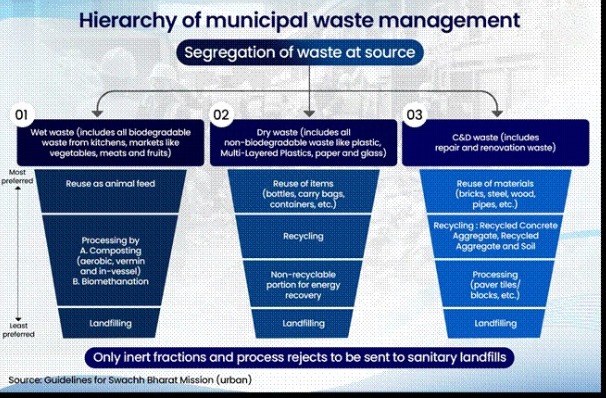
7. Strategy is double-pronged: remove existing dumpsites through remediation while preventing new ones by expanding processing facilities and scientific handling of fresh waste streams daily.
8. In 2025, 459 dumpsites across 438 cities achieved complete remediation, processing 183 lakh metric tonnes, contributing to 1,138 fully remediated sites overall nationwide cumulatively.

9. Reclaimed land after remediation is prioritised for solid waste management infrastructure or developing green cover, ensuring productive reuse rather than renewed open dumping anywhere.
10. SBM-Urban 2.0 launched in 2021 deepened progress through segregation at source, expanded processing capacity, and stronger scientific waste management systems in cities nationwide significantly.
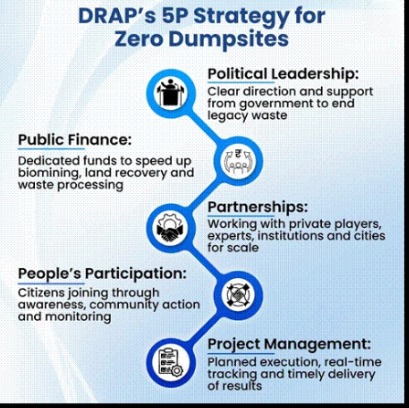
11. DRAP uses a 5P framework: Political Leadership, Public Finance, Partnerships, People’s Participation, and Project Management, ensuring accountable planning, financing, execution, and monitoring always transparently.
12. Financial support includes CFA at ₹550 per tonne, with 25%, 33%, or 50% project-cost disbursement tiers depending on city category and scale parameters defined.
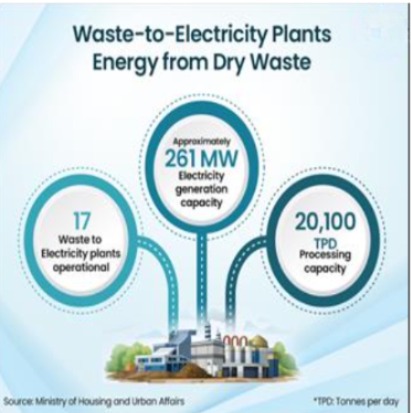
13. Partnerships route inert waste to roads via PWDs/NHAI, send RDF to cement or WtE plants, and integrate corporates, experts, NGOs for scale efficiently nationally.
14. Biomining excavates, aerates, bio-stabilises, screens, and segregates waste into fines, inert, recyclables, and combustibles, then routes fractions to appropriate reuse outlets safely, responsibly onsite.
15. Only non-reusable rejects go to scientific landfills, enabling circular economy outcomes and supporting SDGs 11, 12, and 13 with reduced methane emissions substantially nationwide.
MUST-KNOW TERMS
1. DRAP (Dumpsite Remediation Accelerator Programme): DRAP is a national accelerator launched in November 2025 to fast-track scientific cleanup of legacy municipal dumpsites and prevent new ones. It targets Lakshya: Zero Dumpsites by October 2026, prioritising 214 high-impact sites holding most remaining waste. It integrates funding, leadership adoption, partnerships, and tech-enabled monitoring so cities execute remediation quickly, transparently, and measurably, with clear nationwide milestones.
2. Legacy waste / legacy dumpsite: Legacy waste refers to decades-old mixed municipal garbage accumulated through unscientific open dumping by urban local bodies. It contaminates groundwater and soil, degrades air quality, emits methane, and creates fire and disease risks. Remediation involves scientific excavation and processing, recovery of usable fractions, disposal of only rejects in engineered landfills, and reclamation of land for infrastructure or green cover.
3. Biomining: Biomining is the scientific excavation and stabilisation of old dumpsite waste to recover resources and reduce landfill pressure. Excavated waste is aerated in windrows, where bio-cultures accelerate decomposition until stability is achieved. The material is then screened into soil-like fines, inert debris, recyclables, and combustibles, each routed for reuse, recycling, co-processing, or energy generation safely on site.
4. Refuse-Derived Fuel (RDF): RDF is the combustible, non-recyclable fraction recovered from mixed waste and biomined legacy dumpsites. It includes soiled paper, contaminated plastics, multilayer packaging, rubber, leather, wood, tyres, and thermocol. Instead of dumping, RDF is supplied to cement kilns and waste-to-energy plants as an alternative to coal, reducing fossil fuel consumption and landfill fires at scale nationwide.
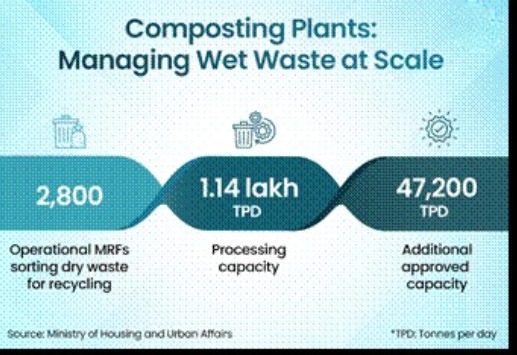
5. Material Recovery Facility (MRF): An MRF is a dedicated facility for sorting and processing recyclable materials from dry waste streams. It enhances segregation efficiency, reduces landfill load, and boosts recycling rates by separating plastics, paper, metals, glass, and cardboard into marketable fractions. Under SBM–Urban 2.0, cities are encouraged to establish at least one MRF, with mechanisation promoted for larger facilities.
6. Central Financial Assistance (CFA): CFA is per-tonne central funding support for legacy waste remediation and related waste-processing infrastructure. Under DRAP, assistance is calculated at ₹550 per tonne of legacy waste, with project-cost disbursement levels of 25%, 33%, or 50% depending on city category. It aims to ease financial constraints, accelerate remediation, and prevent formation of new dumpsites.
Key Takeaways
India is targeting “Zero Dumpsites” through the Dumpsite Remediation Accelerator Programme.
Over 61% of legacy waste has already been processed. The programme prioritises 214 high-impact sites containing nearly 80% of the remaining waste.
Remediated waste is repurposed into resources such as road-building material, filling of low-lying areas, recyclables, and Refuse-Derived Fuel.
Once dumpsites are remediated, cities benefit from cleaner air, safer groundwater, reduced fires, and reclaimed land for infrastructure or developing green cover.
MCQ
1. DRAP was launched primarily to achieve which target?
A) 100% door-to-door collection in all cities
B) Lakshya: Zero Dumpsites by October 2026
C) Ban all plastics nationwide by 2026
D) Build one landfill in every district
2. DRAP was launched in which month and year?
A) November 2025
B) January 2024
C) October 2026
D) March 2025
3. Approximately how many legacy dumpsites were identified across the country (1,000 tonnes or more)?
A) 1,428
B) 214
C) 2,479
D) 459
4. The estimated quantity of accumulated legacy waste in identified dumpsites is closest to:
A) 2.5 crore metric tonnes
B) 25 crore metric tonnes
C) 250 crore metric tonnes
D) 25 lakh metric tonnes
5. DRAP prioritises how many high-impact dumpsites for accelerated remediation?
A) 200
B) 214
C) 240
D) 247
6. The high-impact dumpsites contain approximately what share of remaining legacy waste?
A) 50%
B) 61%
C) 80%
D) 95%
7. Remediation is currently underway at how many dumpsites (as described)?
A) 1,428
B) 2,479
C) 1,138
D) 459
8. Over what share of legacy waste has already been processed (as stated)?
A) Over 25%
B) Over 50%
C) Over 62%
D) Over 80%
9. Which of the following is a key environmental risk linked to open dumpsites?
A) Reduced groundwater recharge only
B) Methane emissions and fire hazards
C) Increased soil fertility and compost formation
D) Complete elimination of vectors
10. The 5P framework includes all EXCEPT:
A) Political Leadership
B) Public Finance
C) People’s Participation
D) Price Control
11. Central Financial Assistance under the programme is calculated at:
A) ₹550 per tonne of legacy waste
B) ₹55 per tonne of legacy waste
C) ₹5,500 per tonne of fresh waste
D) ₹550 per tonne of recyclables
12. Which end-use pathway is most appropriate for RDF?
A) Direct open dumping
B) Cement kilns and waste-to-energy plants
C) Riverbed filling without treatment
D) Unlined pits near settlements
13. Which fraction is directed to scientific landfills?
A) All soil-like fines
B) All recyclables
C) Only non-reusable rejects
D) Only biodegradable waste
14. Biomining primarily involves:
A) Burning mixed waste to reduce volume
B) Excavating and stabilising old waste, then screening into fractions
C) Dumping waste in deeper trenches
D) Spraying perfumes to reduce odour
15. Land reclaimed after remediation is prioritised for:
A) New open dumping zones
B) SWM infrastructure or developing green cover
C) Only commercial malls
D) Only parking lots

0 comment