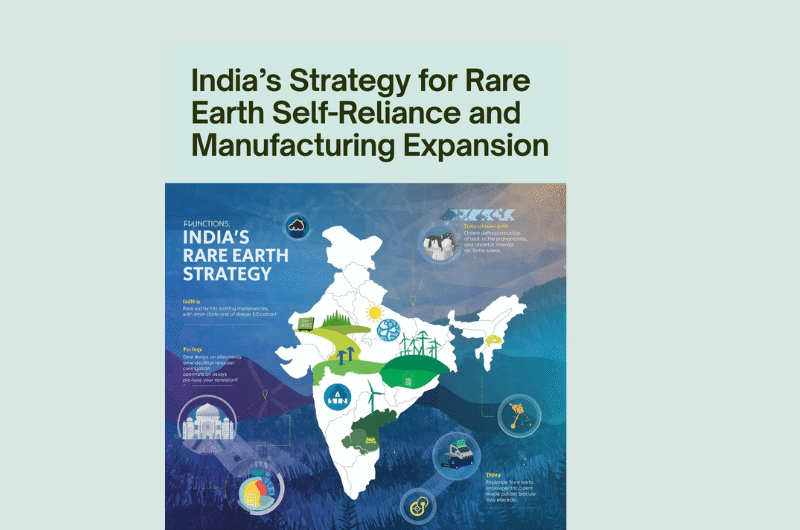
India’s Strategy for Rare Earth Self-Reliance and Manufacturing Expansion
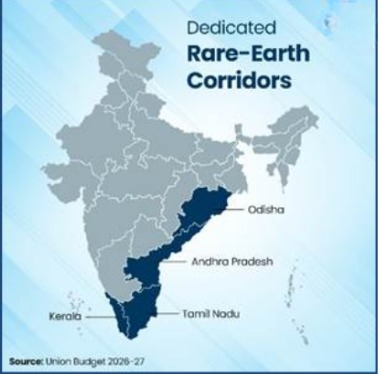
1. Union Budget 2026–27 announced Dedicated Rare Earth Corridors in Odisha, Kerala, Andhra Pradesh and Tamil Nadu, integrating mining, processing, research and REPM manufacturing to expand domestic capacity national.
2. In November 2025, the government approved a ₹7,280 crore REPM Manufacturing Scheme to create an end-to-end domestic ecosystem from rare-earth oxides to finished magnets ensuring national supply security.
3. The scheme targets creation of 6,000 MTPA integrated sintered REPM capacity, allocated among up to five beneficiaries through global competitive bidding to ensure supply security for strategic industries.
4. Over five years, ₹6,450 crore sales-linked incentives and ₹750 crore capital subsidy will support advanced facilities after a two-year gestation period for production linked to verified output milestones.
5. Rare Earth Permanent Magnets are high-strength, stable magnets essential for electric vehicle motors, wind turbine generators, electronics, aerospace systems, defence equipment and precision sensors used across strategic sectors.
6. India possesses 13.15 million tonnes of monazite containing about 7.23 million tonnes of rare-earth oxides, forming a strong domestic raw-material base for downstream permanent magnet manufacturing industries nationwide.
7. Rare-earth deposits occur across Odisha, Kerala, Andhra Pradesh, Tamil Nadu, West Bengal, Gujarat, Maharashtra and Jharkhand, mainly in coastal beach sands, teri sands and inland alluvium geological formations.
8. Additional in-situ rare-earth oxide resources of about 1.29 million tonnes have been identified in hard-rock areas of Gujarat and Rajasthan, expanding exploration potential beyond coastal mineral sands regions.
9. Geological Survey of India identified 482.6 million tonnes of rare-earth ore resources across 34 exploration projects, significantly strengthening the national raw-material inventory for future industrial scale manufacturing capacity.
10. Between 2022 and 2025, India sourced nearly 60–80 percent by value and 85–90 percent by quantity of permanent magnets from China, highlighting strategic import dependence risks nationally significant.
11. Rapid growth in electric mobility, renewable energy, electronics and defence is expected to double India’s REPM consumption by 2030, necessitating urgent domestic manufacturing expansion to meet projected demand.
12. Dedicated Rare Earth Corridors aim to strengthen mining, processing, research and manufacturing linkages, boosting local economies, R&D capacity and India’s integration into global advanced-materials value chains networks worldwide.
13. IREL India Limited, under the Department of Atomic Energy since 1963, operates processing facilities producing ilmenite, rutile, zircon, sillimanite and garnet minerals supporting strategic mineral supply chains nationally.
14. IREL operates a Rare Earth Extraction Plant in Odisha and a Rare Earth Refining Unit at Aluva, Kerala, supporting corridor-based expansion of domestic rare-earth capacity and downstream manufacturing.
15. Policy reforms under the amended MMDR Act 2023 and the National Critical Minerals Mission 2025 promote exploration, private participation and secure supply chains for critical minerals nationwide development.
Must Know Terms:
1) Rare Earth Permanent Magnets (REPMs): REPMs are high-performance magnets with very high magnetic strength and stability in compact form. They are essential for EV motors, wind turbine generators, electronics, aerospace systems, defence equipment and precision sensors. Their availability directly affects clean-energy scale-up and strategic manufacturing, so domestic REPM capacity reduces import risk and strengthens supply security.
2) Dedicated Rare Earth Corridors: These are corridor-based industrial ecosystems announced in Union Budget 2026–27 for Odisha, Kerala, Andhra Pradesh and Tamil Nadu. They aim to integrate mining, processing, research and manufacturing in mineral-rich regions. Corridors are important because they cluster infrastructure, skills and R&D, improve logistics efficiency, strengthen local economies and connect India into advanced-materials value chains.
3) REPM Manufacturing Scheme (₹7,280 crore): Approved in November 2025, this scheme supports creation of 6,000 MTPA integrated sintered REPM capacity and covers the value chain from rare-earth oxides to finished magnets. It includes five-year sales-linked incentives and capital subsidy for advanced facilities after a two-year setup period. The scheme matters for supply security in mobility, renewables, electronics and defence.
4) Monazite Deposits and Rare-Earth Oxides (REO): Monazite is a rare-earth bearing mineral that provides rare-earth oxides used in downstream products like permanent magnets. India holds 13.15 million tonnes of monazite containing an estimated 7.23 million tonnes of REO. Deposits occur in several states, mainly in coastal beach sands and also inland settings, creating a strong raw-material base for domestic manufacturing.
5) GSI Rare-Earth Ore Resource Identification: Geological Survey of India identified 482.6 million tonnes of rare-earth ore resources across 34 exploration projects. This expands the documented resource base beyond known deposits and supports planning for mining, processing and manufacturing investments. Large identified resources matter because they improve long-term supply confidence, attract industry participation and support scaling integrated rare earth value chains.
6) Import Dependence on China (2022–25): During 2022–25, permanent magnet imports were mainly sourced from China, about 60–80% by value and 85–90% by quantity. This level of dependence creates strategic vulnerability to supply disruptions and price shocks. Reducing it is important for EVs, wind energy and defence systems where magnets are critical components for performance and reliability.
Key Takeaways
- Union Budget 2026–27 announces Dedicated Rare Earth Corridors in Odisha, Kerala, Andhra Pradesh, and Tamil Nadu for mining, processing, research, and manufacturing of Rare Earth Permanent Magnets (REPMs).
- ₹7,280 crore REPM Manufacturing Scheme approved in November 2025.
- 6,000 MTPA integrated REPM capacity to be created.
- ₹6,450 crore sales-linked incentives over five years.
- ₹750 crore capital subsidy for advanced facilities.
- Geological Survey of India (GSI) has identified 482.6 million tonnes of rare-earth ore resources.
MCQ
1. The Union Budget 2026–27 announced Dedicated Rare Earth Corridors in which of the following states?
A. Odisha, Kerala, Andhra Pradesh, Tamil Nadu
B. Gujarat, Rajasthan, Maharashtra, Jharkhand
C. West Bengal, Bihar, Odisha, Assam
D. Chhattisgarh, Telangana, Karnataka, Kerala
2. The REPM Manufacturing Scheme approved in November 2025 has a total financial outlay of:
A. ₹6,450 crore
B. ₹7,280 crore
C. ₹8,000 crore
D. ₹7,750 crore
3. The targeted integrated manufacturing capacity of Rare Earth Permanent Magnets under the approved scheme is:
A. 3,000 MTPA
B. 4,500 MTPA
C. 6,000 MTPA
D. 7,500 MTPA
4. Sales-linked incentives under the REPM Manufacturing Scheme are provided for a period of:
A. Three years
B. Four years
C. Five years
D. Seven years
5. Which organisation identified 482.6 million tonnes of rare-earth ore resources in India?
A. Indian Bureau of Mines
B. Geological Survey of India
C. National Mineral Development Corporation
D. Atomic Minerals Directorate
6. Rare Earth Permanent Magnets are critically important for which of the following applications?
A. Electric vehicle motors
B. Wind turbine generators
C. Defence and aerospace systems
D. All of the above
7. India holds approximately how much monazite, containing rare-earth oxides?
A. 8.5 million tonnes
B. 10.2 million tonnes
C. 13.15 million tonnes
D. 15.6 million tonnes
8. Rare-earth deposits in India are primarily found in which geological settings?
A. Volcanic plateaus only
B. Coastal beach sands and inland alluvium
C. Mountainous igneous belts
D. Deep ocean trenches
9. In-situ rare-earth oxide resources in hard-rock areas have been identified mainly in:
A. Odisha and Tamil Nadu
B. Kerala and West Bengal
C. Gujarat and Rajasthan
D. Maharashtra and Jharkhand
10. During 2022–25, India’s dependence on imports for permanent magnets by quantity was approximately:
A. 30–40%
B. 45–55%
C. 60–70%
D. 85–90%
11. Consumption of Rare Earth Permanent Magnets in India is expected to double by which year?
A. 2028
B. 2030
C. 2035
D. 2040
12. IREL (India) Limited functions under which department?
A. Ministry of Mines
B. Ministry of Heavy Industries
C. Department of Atomic Energy
D. Ministry of Science and Technology
13. IREL operates a Rare Earth Refining Unit at:
A. Chennai
B. Visakhapatnam
C. Aluva
D. Bhubaneswar
14. Which national goal is directly supported by rare earth magnets used in electric vehicles and wind turbines?
A. Digital India
B. Net Zero 2070
C. Make in India
D. Skill India
15. The National Critical Minerals Mission was approved in:
A. January 2023
B. January 2024
C. January 2025
D. January 2026




0 comment