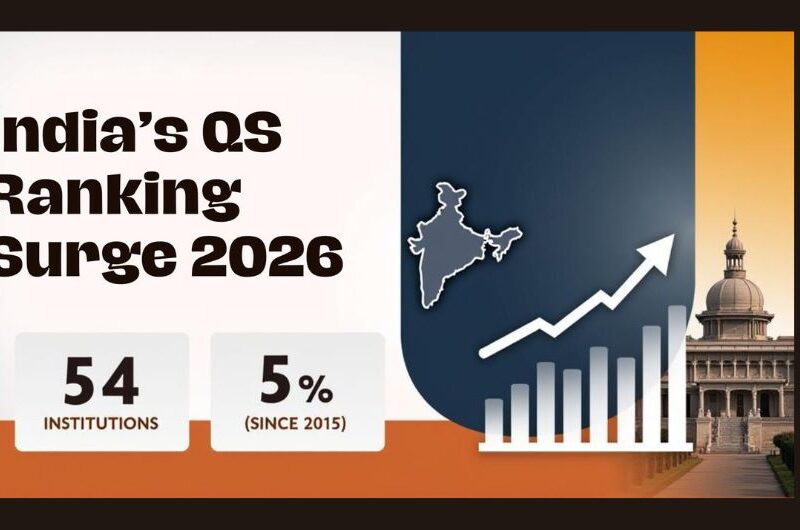
India’s QS Ranking Surge 2026
1. India placed 54 institutions in QS World University Rankings 2026, including 12 IITs and eight first-time entrants, making India the world’s fourth most represented country overall globally today.
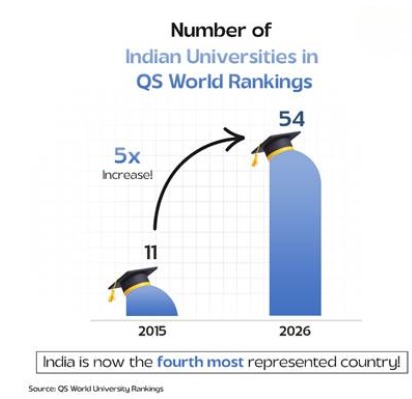
2. Representation rose from 11 ranked Indian institutions in 2015 to 54 in 2026, a five-fold decade increase that positions India as the fastest-rising G20 nation over the decade.
3. Eight debut entrants are IIT Gandhinagar, LPU, KIIT, Ashoka University, Galgotias University, Shiv Nadar University, CHRIST Bengaluru, and MRIIRS, signalling broader public–private participation across the rankings this year.
4. About 48 percent of India’s ranked universities improved their positions compared with the previous year, indicating broad performance momentum rather than isolated gains by a handful across India.
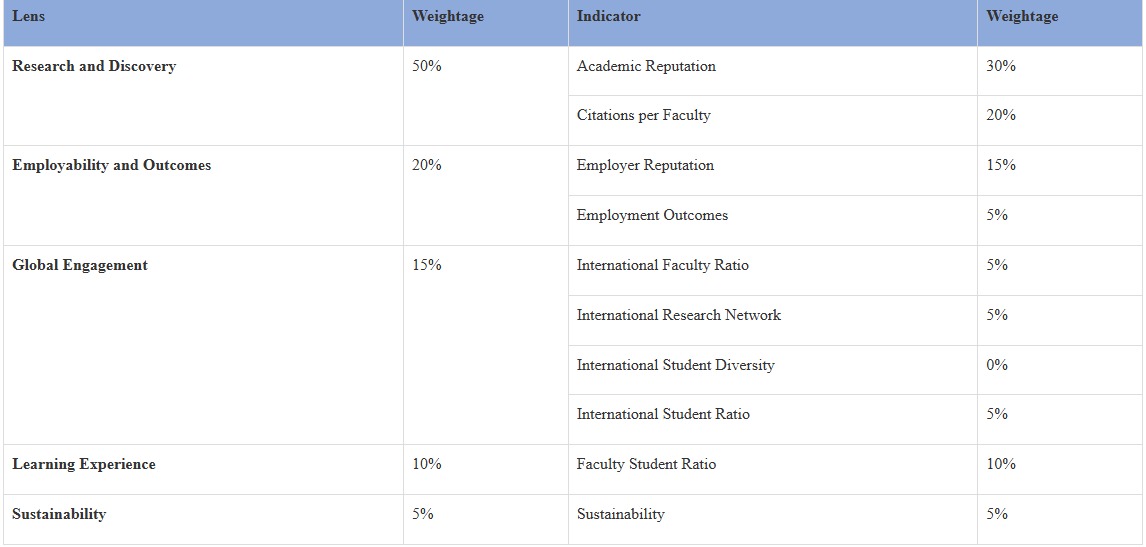
Weightings for each performance lens and indicator:
5. Six Indian institutions appear within the global top 250, highlighting a growing cluster of internationally competitive campuses across engineering, science, and multidisciplinary higher education ecosystems for India’s system.
6. IIT Delhi led India at rank 123 in 2026, improving from 150 in 2025, reflecting strengthened outcomes across the indicator mix used in QS scoring in this cycle.
7. IIT Madras recorded one of the biggest jumps, rising 47 places from 227 in 2025 to 180 in 2026, signalling rapid year-on-year advancement among Indian institutes nationwide overall.
8. Five Indian institutions feature in the global top 100 for Employer Reputation, signalling strong recruiter confidence in graduate quality, employability skills, and workplace readiness across diverse sectors nationally.
9. Eight Indian universities rank among the world’s top 100 for Citations per Faculty, posting an average score of 43.7, higher than Germany, the UK, and USA this edition.
10. QS 2026 draws on over 16 million academic papers and surveys of more than 151,000 academics and 100,000 employers, providing a large evidence base for comparative robustness overall.
11. A new indicator, International Student Diversity, was added, assessing both international student numbers and the variety of source countries; it is presently assigned zero weight within the framework.
12. International Student Ratio remains a weighted metric, while scoring was fine-tuned, meaning some indicator scores can change even when an institution’s rank stays stable across global comparisons today.
13. QS methodology is structured into lenses, indicators, and metrics: lenses group indicators by theme, indicators measure performance areas, and metrics compute precise scores for transparent cross-country score aggregation.
14. Research and Discovery carries 50% weight, comprising Academic Reputation at 30% and Citations per Faculty at 20%, making research performance the dominant driver across institutions and subject areas.
15. Employability and Outcomes weighs 20% overall, combining Employer Reputation at 15% and Employment Outcomes at 5%, linking rankings to labour-market perceptions and results for employer and reform tracking.
Key Insights from QS World University Ranking 2026
1. India has 54 universities in the QS World University Rankings 2026, making it the fourth most represented country.
2. Only the United States (192), the United Kingdom (90), and Mainland China (72) have more universities ranked than India.
3. Eight Indian institutions have entered the rankings for the first time. This is the highest number of new entrants from any country this year.
4. The number of Indian universities in the rankings has grown from 11 in 2015 to 54 in 2026. This marks a five-fold increase in just over a decade.
5. 48 percent of India’s ranked universities improved their positions compared to the previous year.
6. Six Indian institutions feature in the global top 250.
7. IIT Delhi leads the Indian contingent. It is ranked 123rd globally, rising from 150th in 2025.
8. IIT Madras recorded one of the biggest jumps, rising 47 places from 227 in 2025 to 180 in 2026.
9. A total of 12 Indian Institutes of Technology (IITs) feature in the list, highlighting their strong presence in global academia.
10. Five Indian institutions feature in the global top 100 for Employer Reputation. This reflects strong industry confidence in Indian graduates.
11. Eight Indian universities rank among the world’s top 100 for Citations per Faculty. Their average score of 43.7 is higher than that of Germany, the United Kingdom and the United States.
12. India now has a diverse mix of public and private institutions represented, including central universities, deemed-to-be universities, and technical institutes.
Top Indian Institutions in QS World University Rankings 2026 (Rank vs 2025)
| S No. | Institution | Rank (2026) | Previous Rank (2025) |
| 1 | Indian Institute of Technology Delhi (IITD) | 123 | 150 |
| 2 | Indian Institute of Technology Bombay (IITB) | 129 | 118 |
| 3 | Indian Institute of Technology Madras (IITM) | 180 | 227 |
| 4 | Indian Institute of Technology Kharagpur (IITKGP) | 215 | 222 |
| 5 | Indian Institute of Science (IISc) Bangalore | 219 | 211 |
| 6 | Indian Institute of Technology Kanpur (IITK) | 222 | 263 |
| 7 | University of Delhi | 328 | 328 |
| 8 | Indian Institute of Technology Guwahati (IITG) | 334 | 344 |
| 9 | Indian Institute of Technology Roorkee (IITR) | 339 | 335 |
| 10 | Anna University | 465 | 383 |
| 11 | Shoolini University of Biotechnology and Management Sciences | 503 | 587 |
| 12 | Indian Institute of Technology Indore | 556 | 477 |
| 13 | Jawaharlal Nehru University | 558 | 580 |
| 14 | Indian Institute of Technology BHU Varanasi (IIT BHU Varanasi) | 566 | 531 |
| 15 | Savitribai Phule Pune University | 566 | 631-640 |
| 16 | Chandigarh University | 575 | 691-700 |
| 17 | Indian Institute of Technology Hyderabad (IITH) | 664 | 681-690 |
| 18 | University of Mumbai | 664 | 711-720 |
| 19 | Birla Institute of Technology and Science | 668 | 801-850 |
| 20 | Jadavpur University | 676 | 721-730 |
| 21 | Vellore Institute of Technology (VIT), Vellore, India | 691 | 791-800 |
| 22 | Symbiosis International (Deemed University) | 696 | 641-650 |
| 23 | National Institute of Technology Tiruchirappalli | 731-740 | 701-710 |
| 24 | Jamia Millia Islamia, New Delhi | 761-770 | 851-900 |
| 25 | Thapar Institute of Engineering & Technology | 771-780 | 851-900 |
| 26 | University of Calcutta | 771-780 | 751-760 |
| 27 | IIT Gandhinagar | 801-850 | — |
| 28 | University of Hyderabad | 801-850 | 801-850 |
| 29 | Manipal Academy of Higher Education – Manipal University (MAHE) | 851-900 | 901-950 |
| 30 | O. P. Jindal Global University (JGU) | 851-900 | 1001-1200 |
| 31 | Lovely Professional University (LPU) | 901-950 | — |
| 32 | Panjab University | 901-950 | 1001-1200 |
| 33 | Saveetha Institute of Medical and Technical Sciences (SIMATS) | 901-950 | 951-1000 |
| 34 | University of Petroleum and Energy Studies (UPES) | 901-950 | 801-850 |
| 35 | Amity University | 951-1000 | 1001-1200 |
| 36 | Guru Gobind Singh Indraprastha University | 951-1000 | 1001-1200 |
| 37 | Indian Institute of Technology Bhubaneswar (IIT BBS) | 951-1000 | 951-1000 |
| 38 | Aligarh Muslim University (AMU), Aligarh | 1001-1200 | 1001-1200 |
| 39 | Amrita Vishwa Vidyapeetham | 1001-1200 | 1001-1200 |
| 40 | Banaras Hindu University | 1001-1200 | 1001-1200 |
| 41 | Kalinga Institute of Industrial Technology | 1001-1200 | — |
| 42 | SRM Institute of Science and Technology | 1001-1200 | 1001-1200 |
| 43 | Ashoka University | 1201-1400 | — |
| 44 | Chitkara University | 1201-1400 | 1201-1400 |
| 45 | Galgotias University | 1201-1400 | — |
| 46 | Osmania University, Hyderabad | 1201-1400 | 1201-1400 |
| 47 | Pondicherry University | 1201-1400 | 1201-1400 |
| 48 | Sathyabama Institute of Science and Technology | 1201-1400 | 1201-1400 |
| 49 | Shiv Nadar University | 1201-1400 | — |
| 50 | Siksha ‘O’ Anusandhan (Deemed to be University), SOA | 1201-1400 | 1201-1400 |
| 51 | CHRIST (Deemed to be University), Bengaluru | 1401+ | — |
| 52 | Indian Institute of Information Technology – Allahabad | 1401+ | 1401+ |
| 53 | Jamia Hamdard, New Delhi | 1401+ | 1201-1400 |
| 54 | Manav Rachna International Institute of Research and Studies (MRIIRS) | 1401+ | — |
Must Know Terms :
1.QS World University Rankings 2026: A global ranking framework assessing universities through indicators across research, employability, global engagement, learning experience, and sustainability. It uses large-scale publication and reputation datasets, then aggregates weighted scores into a final rank. In 2026, India’s representation rose strongly, showing improved competitiveness. The system matters because it influences perceptions, collaborations, student mobility, and employer confidence internationally.
2. International Student Diversity: A newly introduced indicator in the 2026 cycle that considers not only the number of international students but also the diversity of their countries of origin. It complements the existing International Student Ratio and aims to capture inclusivity and global reach more precisely. Even with zero weightage in 2026, it signals future emphasis and pushes institutions to broaden recruitment beyond a few geographies.
3.Citations per Faculty: A research-impact indicator measuring how frequently an institution’s published work is cited relative to its faculty size. It is used as a proxy for research influence and knowledge contribution. In 2026, several Indian institutions ranked within the global top 100 for this metric, indicating stronger research visibility. High citations can improve global collaborations and attract funding and talent.
4.Employer Reputation: An employability indicator reflecting how employers perceive the quality and work-readiness of an institution’s graduates. It is built from extensive employer surveys and helps capture labour-market outcomes beyond academic outputs. In 2026, multiple Indian institutions appeared in the global top 100 for this measure, indicating strong industry confidence. It matters because it shapes placement strength, internships, and recruitment pipelines.
5.Academic Reputation: The heaviest-weighted indicator under the research and discovery lens, capturing peer perception among academics regarding teaching and research excellence. It draws on large global surveys and tends to reward sustained brand strength and scholarly influence. Because it changes gradually, improvement requires consistent research outputs, faculty strength, and institutional visibility. It significantly affects overall rank due to its high weightage.
6.National Education Policy 2020: A reform framework aimed at improving higher education quality, governance, research culture, and global engagement. It encourages multidisciplinary institutions, flexibility, stronger accreditation, and better learning outcomes. In discussions around India’s rising presence in global rankings, NEP 2020 is often linked to momentum in institutional reforms and ecosystem strengthening. It matters because it shapes funding priorities and long-term competitiveness.
Key Takeaways
- A five-fold increase took India from 11 universities in 2015 to 54 in the QS World Rankings 2026.
• 8 Indian universities debuted, the highest for any country this year.
• 12 IITs feature, with IIT Delhi highest among Indian institutions at 123rd globally.
MCQ
1. With reference to QS World University Rankings 2026, India is stated to be the:
(a) Second most represented country
(b) Third most represented country
(c) Fourth most represented country
(d) Fifth most represented country
2. The number of ranked Indian institutions increased from 2015 to 2026 by:
(a) Two-fold
(b) Five-fold
(c) Ten-fold
(d) Three-fold
3. Which of the following is stated as the leading Indian institution in 2026?
(a) IIT Bombay
(b) IIT Delhi
(c) IISc Bengaluru
(d) IIT Madras
4. IIT Madras is stated to have moved from 227 (2025) to:
(a) 170 (2026)
(b) 180 (2026)
(c) 190 (2026)
(d) 200 (2026)
5. Consider the following statements:
1. Six Indian institutions feature in the global top 250.
2. Twelve IITs are included among the ranked Indian institutions.
Which of the statements given above is/are correct?
(a) 1 only
(b) 2 only
(c) Both 1 and 2
(d) Neither 1 nor 2
6. The highest number of new entrants from any country in 2026 is stated to be:
(a) Eight entrants
(b) Five entrants
(c) Twelve entrants
(d) Four entrants
7. Which indicator is newly introduced in this cycle and assigned zero weight?
(a) International Student Ratio
(b) International Faculty Ratio
(c) International Student Diversity
(d) Sustainability
8. In QS 2026, International Student Ratio is:
(a) Removed from scoring
(b) Retained as a weighted factor
(c) Assigned zero weight
(d) Replaced by Employment Outcomes
9. Match List-I with List-II:
List-I
(A) Research and Discovery
(B) Employability and Outcomes
(C) Sustainability
List-II
(1) 5%
(2) 20%
(3) 50%
Choose the correct answer:
(a) A-3, B-2, C-1
(b) A-2, B-3, C-1
(c) A-3, B-1, C-2
(d) A-1, B-2, C-3
10. Academic Reputation carries which stated weightage?
(a) 20%
(b) 30%
(c) 15%
(d) 10%
11. Citations per Faculty carries which stated weightage?
(a) 10%
(b) 15%
(c) 20%
(d) 30%
12. Employer Reputation is weighted at:
(a) 5%
(b) 10%
(c) 15%
(d) 25%
13. QS 2026 is stated to be based on data from:
(a) Over 1 million papers and 10,000 academics
(b) Over 16 million papers and 151,000 academics
(c) Over 5 million papers and 50,000 employers
(d) Over 20 million papers and 200,000 employers
14. Consider the following statements:
1. Five Indian institutions are in the global top 100 for Employer Reputation.
2. Eight Indian universities are in the global top 100 for Citations per Faculty.
Which of the statements given above is/are correct?
(a) 1 only
(b) 2 only
(c) Both 1 and 2
(d) Neither 1 nor 2
15. Assertion (A): QS fine-tuned its scoring method, so some scores may differ from past years even if rank is unchanged.
Reason (R): Indicator recalibration can alter computed scores without necessarily changing relative rank positions.
(a) Both A and R are true, and R is the correct explanation of A
(b) Both A and R are true, but R is not the correct explanation of A
(c) A is true, but R is false
(d) A is false, but R is true


0 comment