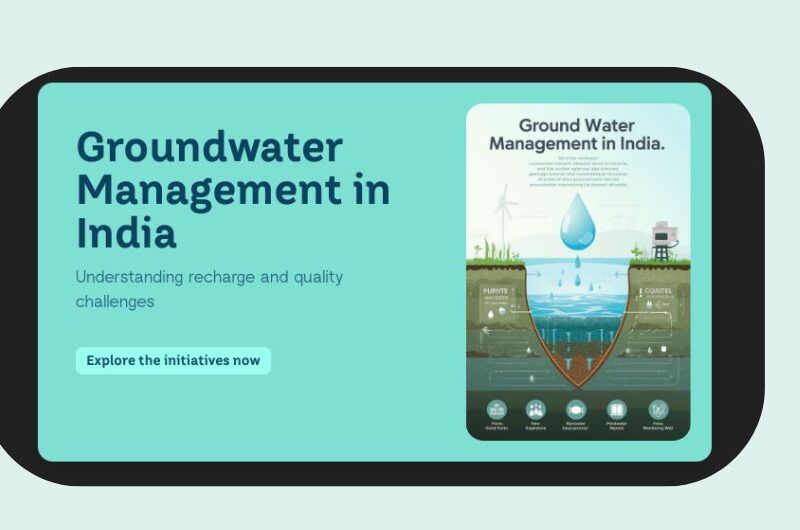
India’s Groundwater Revival: Recharge Gains, Quality Challenges, and Key Management Initiatives
“We must adopt the mantra of ‘Reduce, Reuse, Recharge, and Recycle’ to secure the nation’s water future”
~Prime Minister Shri Narendra Modi
1. Total annual groundwater recharge increased by 15 billion cubic meters in 2024, while annual extraction declined by 3 billion cubic meters compared with 2017.
2. Dynamic groundwater assessment 2024 estimates total annual recharge at 446.90 BCM, extractable resources at 406.19 BCM, and annual extraction at 245.64 BCM for planning.
3. Improved groundwater conditions were recorded in 128 assessment units compared with 2023, reflecting benefits from water bodies, tanks, conservation structures, and better management locally.
4. Recharge from tanks, ponds, and water control systems rose by 0.39 BCM in 2024 relative to 2023, continuing an upward trend nationwide for resilience.
5. Between 2017 and 2024, recharge from tanks, ponds and water control systems increased by 11.36 BCM, from 13.98 to 25.34 BCM overall over time.
6. Assessment units in the Safe category rose from 62.6% in 2017 to 73.4% in 2024, indicating broader sustainability gains across regions in many basins.
7. Over-exploited assessment units declined from 17.24% in 2017 to 11.13% in 2024, signalling reduced stress on aquifers nationwide and improving allocation for users sustainably.
8. Groundwater quality threats include arsenic, fluoride, chloride, uranium, and nitrate, creating serious health risks through direct toxicity and long-term exposure pathways in drinking supplies.
9. Elevated electrical conductivity can indicate agricultural runoff, industrial discharge, or saline intrusion, while iron contamination may cause gastrointestinal issues, requiring careful monitoring and treatment.
10. Groundwater quality assessment uses data from over 15,200 monitoring locations and 4,982 trend stations, supporting identification of critical contamination areas nationwide for timely action.
11. About 81% of groundwater samples are suitable for irrigation; in North-Eastern states, 100% samples were rated excellent for irrigation quality, supporting productivity and livelihoods.
12. MGNREGS includes water conservation and water harvesting works, strengthening rural water security and supporting recharge through community-built infrastructure assets across villages, fields, and commons.
13. Jal Shakti Abhiyan, launched in 2019, is in its fifth phase as Catch the Rain 2024, promoting rainwater harvesting via convergence in rural areas.
14. Atal Bhujal Yojana targets water-stressed gram panchayats in 80 districts across seven states, focusing on participatory groundwater management and demand-side measures with local plans.
15. Master Plan for Artificial Recharge to Groundwater proposes 1.42 crore recharge and rainwater harvesting structures to harness 185 BCM rainfall through interventions at scale.
Ground Water Assessment and Management Initiatives
These positive outcomes are the result of collaborative efforts between state and central governments. The Government of India has launched various initiatives to preserve water and ensure its availability for future generations. Key schemes include:
• Mahatma Gandhi National Rural Employment Guarantee Scheme (MGNREGS): Includes water conservation and water harvesting structures, enhancing rural water security.
• 15th Finance Commission Grants: Provides financial assistance to states for rainwater harvesting and other water conservation activities.
• Jal Shakti Abhiyan (JSA): Launched in 2019, now in its 5th phase (“Catch the Rain” 2024), focusing on rainwater harvesting and water conservation through convergence.
• Atal Mission for Rejuvenation and Urban Transformation (AMRUT) 2.0: Supports rainwater harvesting via stormwater drains and promotes groundwater recharge through ‘Aquifer Management Plans’.
• Ministry of Housing & Urban Affairs Guidelines: Promotes rainwater harvesting and water conservation through UBBL (Delhi, 2016), MBBL (2016), and URDPFI Guidelines (2014).
• Atal Bhujal Yojana (2020): Targets water-stressed Gram Panchayats in 80 districts across 7 states, focusing on participatory groundwater management.
• Pradhan Mantri Krishi Sinchai Yojana (PMKSY): Expands irrigation coverage and improves water use efficiency via Har Khet Ko Pani and water body rejuvenation components.
• Bureau of Water Use Efficiency (BWUE): Set up under the National Water Mission on 20.10.2022 to promote improved water use efficiency across sectors.
• Mission Amrit Sarovar (2022): Aims to create or rejuvenate 75 Amrit Sarovars in every district for water harvesting and conservation.
• National Aquifer Mapping (NAQUIM): Completed for over 25 lakh sq. km, supporting groundwater recharge planning and conservation strategies.
• Master Plan for Artificial Recharge to Groundwater (2020): Plans for 1.42 crore rainwater harvesting and recharge structures to harness 185 BCM of rainfall.
• CGWB Demonstration Projects: Implements artificial recharge projects under regulation schemes to enable replication by states in suitable hydro-geological settings.
• National Water Policy (2012): Advocates rainwater harvesting, water conservation, and augmentation of availability through direct use of rainfall.
• Watershed Development Component of PMKSY (WDC-PMKSY): Focuses on rainfed and degraded lands with soil conservation, rainwater harvesting, and livelihoods development.
• National Water Awards (2018): Recognizes contributions to water conservation and management; 6th National Water Awards application deadline extended to 31 January 2025.
MCQ:
1. With reference to groundwater trends in 2024, consider the following statements:
1. Total annual groundwater recharge increased compared to the 2017 assessment.
2. Annual groundwater extraction declined compared to the 2017 assessment.
Which of the statements given above is/are correct?
A. 1 only
B. 2 only
C. Both 1 and 2
D. Neither 1 nor 2
2. As per the dynamic groundwater assessment 2024, the total annual groundwater recharge is assessed at:
A. 245.64 BCM
B. 406.19 BCM
C. 446.90 BCM
D. 15 BCM
3. As per the dynamic groundwater assessment 2024, the extractable groundwater resource is assessed at:
A. 245.64 BCM
B. 406.19 BCM
C. 446.90 BCM
D. 128 BCM
4. As per the dynamic groundwater assessment 2024, the annual groundwater extraction is assessed at:
A. 245.64 BCM
B. 406.19 BCM
C. 446.90 BCM
D. 25.34 BCM
5. Improvements in groundwater conditions in 2024, compared to 2023, were recorded in how many assessment units?
A. 73 units
B. 81 units
C. 128 units
D. 185 units
6. Recharge from tanks, ponds and water control systems (WCS) in 2024 increased by how much compared to 2023?
A. 0.39 BCM
B. 3.90 BCM
C. 11.36 BCM
D. 15.00 BCM
7. Recharge from tanks, ponds and WCS increased from 13.98 BCM in 2017 to 25.34 BCM in 2024. The increase is:
A. 0.39 BCM
B. 3.00 BCM
C. 11.36 BCM
D. 25.34 BCM
8. The percentage of assessment units under the Safe category increased from 62.6% in 2017 to 73.4% in 2024. Consider the following statements:
1. The share of Safe units increased over the period.
2. The share of Over-exploited units also increased over the period.
Which of the statements given above is/are correct?
A. 1 only
B. 2 only
C. Both 1 and 2
D. Neither 1 nor 2
9. The percentage of Over-exploited assessment units declined to 11.13% in 2024 from:
A. 62.6% in 2017
B. 17.24% in 2017
C. 73.4% in 2017
D. 15.00% in 2017
10. Which of the following pollutants were highlighted as key groundwater quality concerns?
A. Arsenic, Fluoride, Chloride, Uranium, Nitrate
B. Lead, Mercury, Cadmium, Chromium, Zinc
C. Sulphate, Phosphate, Potassium, Calcium, Magnesium
D. Methane, Ethane, Propane, Butane, Benzene
11. Elevated electrical conductivity (EC) in groundwater may indicate:
A. Only high dissolved oxygen levels
B. Agricultural runoff, industrial discharge, or saline intrusion
C. Exclusive presence of fluoride contamination
D. Only natural mineral taste without contamination
12. Groundwater quality analysis for 2024 drew insights from data collected at over:
A. 1,520 monitoring locations and 498 trend stations
B. 15,200 monitoring locations and 4,982 trend stations
C. 4,982 monitoring locations and 15,200 trend stations
D. 52,300 monitoring locations and 2,626 trend stations
13. According to the assessment highlighted, what proportion of groundwater samples are suitable for irrigation?
A. 62%
B. 73%
C. 81%
D. 100%
14. Which among the following is correctly matched?
A. North-Eastern states – 100% groundwater samples rated excellent for irrigation
B. North-Eastern states – 81% groundwater samples rated excellent for irrigation
C. All states – 100% groundwater samples rated excellent for irrigation
D. North-Eastern states – 62.6% groundwater samples rated excellent for irrigation
15. The Master Plan for Artificial Recharge to Groundwater (2020) envisages:
A. 1.42 lakh structures to harness 185 BCM rainfall
B. 1.42 crore structures to harness 185 BCM rainfall
C. 185 crore structures to harness 1.42 BCM rainfall
D. 1.42 crore structures to harness 15 BCM rainfall

0 comment