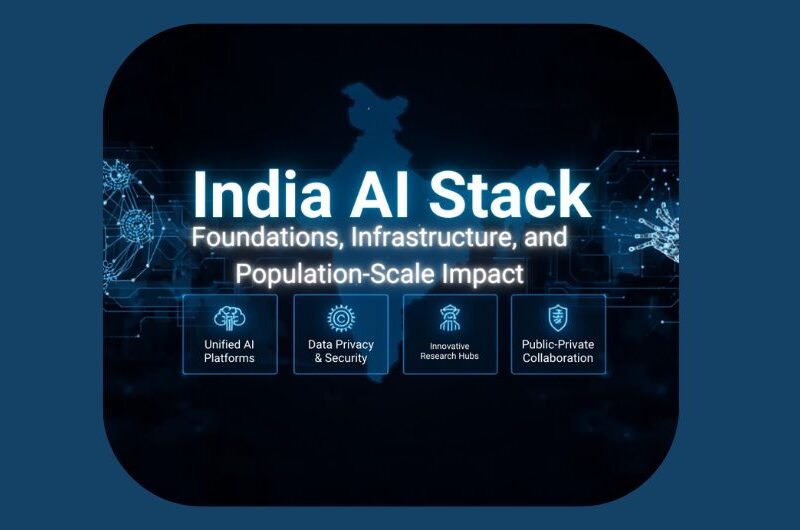
India’s AI Stack: Foundations, Infrastructure, and Population-Scale Impact
1. India’s AI vision emphasises democratisation: AI should benefit every citizen, support public welfare, and remain people centric, enabling “AI for Humanity” rather than limited elite control alone anywhere.
2. India’s AI Stack integrates tools and infrastructure to build, deploy, and operate AI reliably at population scale through five layers: applications, models, compute, data centres, networks, and energy.
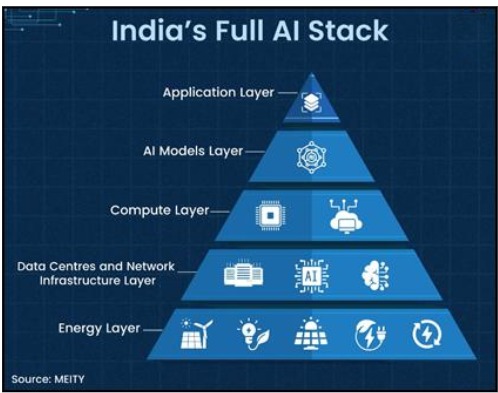
3. The application layer delivers user-facing AI services such as health diagnostics, farming advisories, chatbots, and translation, embedding AI into healthcare, education, agriculture, finance, governance, transport, and climate action.
4. AI advisory deployments in agriculture, including implementations in Andhra Pradesh and Maharashtra, improve sowing decisions, raise yields, and boost input efficiency, with reported productivity gains reaching 30–50 percent.
5. In education, NEP 2020 integrates AI learning via CBSE curricula, DIKSHA, and YUVAi, building practical skills; in justice, e-Courts Phase III uses AI for translation and scheduling.
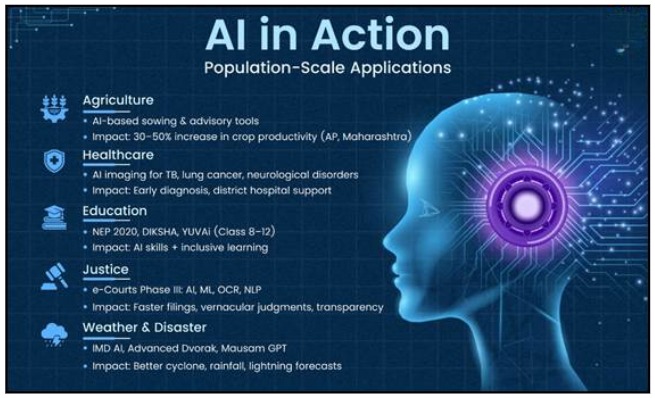
6. IMD applies AI for advanced forecasting of rainfall, cyclones, fog, lightning, and fires, and supports farmers through tools like Mausam GPT, strengthening disaster response and early warning systems nationwide.
7. Under the IndiaAI Mission, 12 indigenous AI models are being developed for India-specific use cases, while startups receive subsidised compute with up to 25 percent of costs supported directly.
8. BharatGen is building India-centric foundation and multimodal models, scaling from billions to trillions of parameters, to serve research, startups, and public-sector applications across domains securely.
9. IndiaAIKosh functions as a national repository for datasets, models, and tools; by December 2025, it hosted 5,722 datasets and 251 models from 54 entities across 20 sectors online.
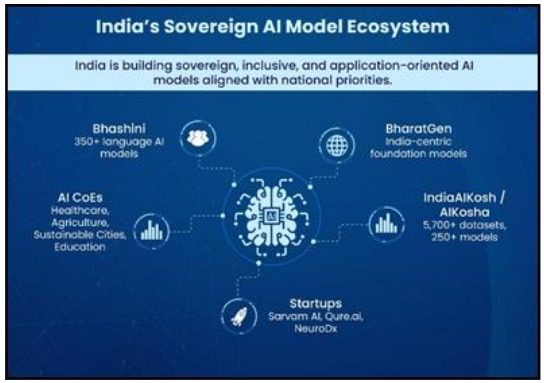
10. Bhashini, under the National Language Translation Mission, hosts over 350 AI models for speech recognition, machine translation, text-to-speech, OCR, and language detection, expanding multilingual digital access.
11. The IndiaAI Compute Portal offers compute as a service, providing shared cloud access to 38,000 GPUs and 1,050 TPUs at subsidised rates under ₹100 per hour for startups nationwide.
12. A secure national GPU cluster of 3,000 next-generation GPUs is being established for sovereign strategic applications, alongside 10 approved semiconductor projects under the ₹76,000 crore mission.
13. The National Supercomputing Mission has deployed over 40 petaflops across IITs, IISERs, and research institutions; PARAM Siddhi-AI and AIRAWAT support workloads like NLP, weather prediction, and drug discovery.
14. India has about 3 percent of global data centre capacity, roughly 960 MW installed, projected to reach 9.2 GW by 2030; Mumbai–Navi Mumbai leads with over 25 percent share.
15. India met peak power demand of 242.49 GW in FY 2025–26 with shortages limited to 0.03 percent; installed capacity reached 509.7 GW, with over 51 percent from non-fossil sources.
Must Know Terms :
1. AI Stack
AI Stack refers to the complete layered ecosystem enabling artificial intelligence to function at scale. It integrates applications, AI models, compute infrastructure, data centres, networks, and energy systems. This structure ensures reliable deployment, seamless integration, scalability, and real-world usability of AI across sectors such as governance, healthcare, agriculture, education, industry, and public services nationwide.
2.Application Layer
The application layer represents the user-facing dimension of artificial intelligence, where advanced algorithms translate into practical services. It includes tools like health diagnostics, agricultural advisories, language translation, education platforms, and governance systems. This layer determines AI’s societal impact by embedding intelligence into everyday decision-making, service delivery, productivity enhancement, and citizen-centric digital solutions.
3.AI Model Layer
The AI model layer functions as the cognitive core of artificial intelligence systems. It involves training algorithms on vast datasets to recognize patterns, generate predictions, and enable intelligent responses. Indigenous model development ensures relevance to local languages, contexts, and public needs, strengthening technological sovereignty, reducing external dependence, and aligning AI outcomes with national developmental priorities.
4.Compute Infrastructure
Compute infrastructure provides the processing power required to train and operate AI models efficiently. It includes GPUs, TPUs, NPUs, supercomputers, and cloud-based resources. Affordable and shared access to compute lowers entry barriers for startups and research institutions, accelerates innovation, supports large-scale experimentation, and enables population-scale AI deployment across diverse sectors.
5.Data Centres and Networks
Data centres and digital networks form the backbone enabling AI systems to store, process, and transmit data reliably. High-speed broadband, optical fibre, and 5G connectivity ensure low-latency performance, real-time analytics, and nationwide reach. Expanding domestic data centre capacity strengthens digital resilience, supports cloud services, and anchors AI infrastructure within national jurisdiction.
6.Energy Layer
The energy layer sustains continuous AI operations by supplying reliable and affordable electricity to data centres and computing systems. AI workloads are energy-intensive, making power availability critical for scalability. Increasing reliance on non-fossil energy sources, storage systems, and nuclear options aligns AI expansion with sustainability, grid stability, and long-term environmental commitments.
MCQ:
1. The concept of an AI Stack primarily refers to:
A) A single AI application used by governments
B) A layered ecosystem enabling AI deployment at scale
C) A hardware-only framework for AI computation
D) A regulatory mechanism for AI governance
2. The core objective behind building a population-scale AI Stack is to:
A) Promote private monopolies in technology
B) Restrict AI access to research institutions
C) Ensure inclusive and scalable AI deployment
D) Replace conventional digital infrastructure
3. Which layer of the AI Stack directly interacts with end users?
A) Compute layer
B) AI model layer
C) Application layer
D) Energy layer
4. AI-powered health diagnostics, agricultural advisories, and chatbots belong to the:
A) Model training layer
B) Data infrastructure layer
C) Application layer
D) Energy layer
5. The AI model layer is best described as the:
A) Storage unit for raw data
B) Brain of AI systems
C) Power supply unit of AI
D) User interface of AI platforms
6. Development of indigenous AI models mainly supports:
A) Higher hardware imports
B) Increased data localisation costs
C) Technological sovereignty and relevance
D) Reduced public-sector usage
7. Compute infrastructure in AI primarily determines:
A) User interface quality
B) Data ownership
C) Scale, speed, and efficiency of AI models
D) Legal accountability of AI systems
8. GPUs and TPUs are mainly associated with which AI Stack layer?
A) Application layer
B) Model layer
C) Compute layer
D) Network layer
9. Shared and subsidised access to compute resources mainly aims to:
A) Centralise AI development
B) Lower innovation entry barriers
C) Replace private cloud services
D) Limit startup participation
10. Data centres are essential for AI because they:
A) Regulate AI ethics
B) Host and operate AI systems
C) Design AI algorithms
D) Train human resources
11. High-speed networks such as broadband and 5G primarily enable:
A) Energy efficiency in AI chips
B) Real-time AI deployment and data transfer
C) Model accuracy improvement
D) Reduction in AI training costs
12. Expanding domestic data centre capacity strengthens:
A) Import dependency
B) Digital resilience and sovereignty
C) Manual service delivery
D) Energy consumption inefficiency
13. The energy layer is critical to AI systems because AI workloads are:
A) Seasonal and temporary
B) Low-power dependent
C) Energy-intensive and continuous
D) Independent of electricity supply
14. Increasing the share of non-fossil fuel energy supports AI growth by:
A) Raising operational uncertainty
B) Limiting data centre expansion
C) Ensuring sustainable and reliable power
D) Reducing digital connectivity
15. The integrated strengthening of all AI Stack layers primarily ensures:
A) Experimental use of AI only
B) Fragmented digital services
C) Scalable, reliable, and inclusive AI deployment
D) Exclusive access for private corporations


0 comment