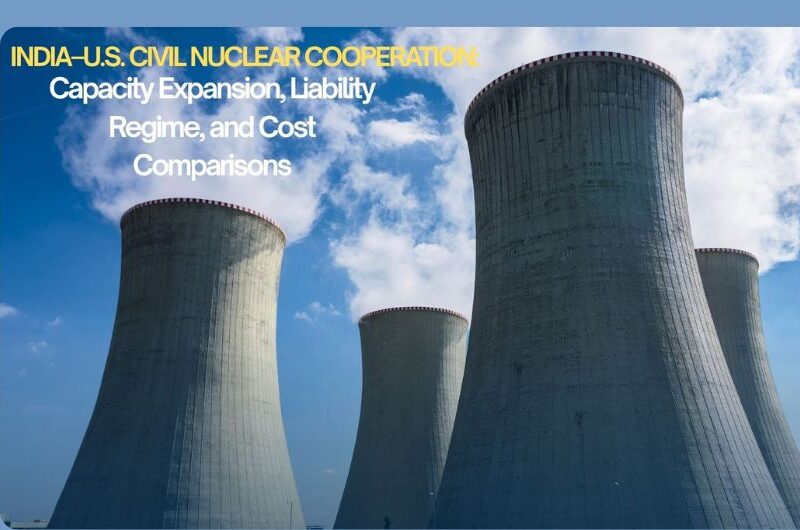
India–U.S. Civil Nuclear Cooperation: Capacity Expansion, Liability Regime, and Cost Comparisons
1. India planned a $182 billion nuclear expansion, targeting capacity growth from 5,780 MW across 21 operating reactors to 14,600 MW by 2020 and 63,000 MW by 2032.
2. Nuclear power formed 2.57% of India’s installed generation capacity of 224,680.24 MW as on 31 December 2014, with a long-term target of 25% by 2050.
3. The 25 January summit between Prime Minister Narendra Modi and President Barack Obama reported “understandings” on civil nuclear liability and administrative arrangements, with detailed text still pending finalisation.
4. U.S. vendors saw India as a major market; the U.S. had not built new nuclear plants since 1973 after 103 plants were erected in the previous decade, supporting industry revival expectations.
5. Westinghouse received land at Chhaya-Mithi Virdi, Gujarat, for six 1,110 MW AP1000 pressurised water reactors; pre-project groundwork activity was completed during 2012.
6. GEH was allotted land at Kovvada, Andhra Pradesh, to build six 1,520 MW Generation III+ ESBWRs, with the first concrete pour expected early that year.
7. The India–U.S. process began with the July 2005 joint statement by Manmohan Singh and George W. Bush, later followed by the 2008 civil nuclear deal signature.
8. India’s Civil Liability for Nuclear Damages Act, 2010 extends liability beyond operators to suppliers, designers, and builders, while the U.S. urged limiting liability solely to operators.
9. The U.S. also sought an administrative arrangement for monitoring U.S.-supplied nuclear material, but India maintained IAEA safeguards apply, leading Washington to drop multi-layered oversight.
10. India proposed a nuclear insurance pool rather than amending the 2010 law; GIC Re considered a ₹750 crore bond within a planned ₹1,500 crore compensation fund structure.
11. The Act caps operator recourse against suppliers at $244 million; the Government of India covers additional compensation up to 300 million IMF SDRs, stated as about $420 million.
12. Beyond that ceiling, access to international compensation requires joining the IAEA Convention on Supplementary Compensation (CSC); India signed in 2010, with U.S. expectations of near-term ratification.
13. Indigenous 700 MW PHWR projects showed cost increases: Gorakhpur units 1–2 approved at ₹20,594 crore, and Kaiga units 5–6 at ₹22,000 crore, exceeding earlier PHWR unit costs.
14. U.S. AP1000 costs escalated: Vogtle units 3–4 rose from $14 billion to $16.2 billion; Indian 1,400 MW PHWRs were priced around $3.5 billion in comparison.
15. NPCIL, under DAE, designs, builds, operates and maintains Indian nuclear plants, claiming about 407 reactor-years of safe operating experience and standardized PHWR scaling from 220 MW to 540 MW and 700 MW.
Must Know Terms :
1. Chhaya-Mithi
Chhaya-Mithi refers to the Chhaya–Mithi Virdi coastal area in Bhavnagar district, Gujarat, earlier chosen for a 6,000 MW nuclear park linked to Westinghouse plans. The site became a focal point for land acquisition and regulatory scrutiny. In March 2017, the government informed the National Green Tribunal that the project would be shifted due to delays in land acquisition.
2.MithiVirdi
MithiVirdi is the village tag used for the same Gujarat nuclear site, often written as Chhaya-Mithivirdi. It was associated with six large Westinghouse reactors and preliminary ground activity reported in 2012. Legal and local opposition surfaced, including challenges to coastal regulation approvals. In June 2017, reports said NPCIL abandoned the Gujarat plan and formally proposed shifting it to Andhra Pradesh.
3.Kovvada
Kovvada is a proposed nuclear site in Andhra Pradesh. In a Lok Sabha written reply on 3 December 2024, the Union government said discussions were in progress with Westinghouse for a viable proposal to build six 1000-MW reactors. The reply added that 2,079.66 acres for the main plant area had been acquired and mutated in NPCIL’s name.
4.ESBWR
ESBWR means Economic Simplified Boiling Water Reactor, a GE Hitachi design using natural circulation and passive safety features. The U.S. Nuclear Regulatory Commission reviewed the ESBWR Design Control Document and completed design certification rulemaking, transmitting the final rule to the Commission on 1 August 2014. NRC documentation lists the design at about 4,500 MWt thermal for licensing commercial.
5.AP1000
AP1000 is Westinghouse’s Generation III+ pressurised water reactor design used in the United States and China. In Georgia, Plant Vogtle Unit 3 entered commercial operation on 31 July 2023 and Unit 4 on 29 April 2024. In China, AP1000 units reached commercial operation in 2018, including Sanmen-1 (21 September 2018) and Haiyang-2 (January 2019), supporting wider approvals thereafter.
6.PriceAnderson
PriceAnderson refers to the U.S. Price–Anderson Act, enacted in 1957 to set a federal framework for nuclear incident liability and compensation. It requires financial protection for operators and provides an industry risk-sharing pool for major accidents. Congress renewed the regime through the Price-Anderson Amendments Act of 2005, extending key provisions to 31 December 2025 nationwide coverage.
MCQ
1. India’s planned nuclear capacity expansion targets which sequence?
A) 5,780 MW → 14,600 MW by 2020 → 63,000 MW by 2032
B) 5,780 MW → 25,000 MW by 2020 → 63,000 MW by 2032
C) 21 reactors → 14,600 reactors by 2020 → 63,000 reactors by 2032
D) 2.57% → 14.6% by 2020 → 63% by 2032
2. As on 31 December 2014, nuclear power’s share in India’s installed generation capacity was:
A) 0.57%
B) 1.25%
C) 2.57%
D) 5.78%
3. The long-term target mentioned for nuclear power’s share in India’s power mix by 2050 is:
A) 10%
B) 15%
C) 20%
D) 25%
4. The 25 January summit note primarily recorded:
A) Full public text of the liability and monitoring agreement
B) “Understandings” on liability and administrative arrangements, with details still to be finalised
C) India’s accession to the NPT
D) Immediate commissioning dates for U.S.-built reactors in India
5. The site identified for six Westinghouse AP1000 reactors in Gujarat was:
A) Kaiga
B) Narora
C) Chhaya–Mithi Virdi
D) Tarapur
6. The proposed site identified for six GEH ESBWR reactors in Andhra Pradesh was:
A) Kovvada
B) Rawatbhatta
C) Gorakhpur
D) Kakrapar
7. The two sticking points included India’s liability law and:
A) India’s refusal to accept any IAEA safeguards
B) A U.S.-insisted “administrative arrangement” for tracking U.S.-supplied nuclear material
C) India’s demand for U.S. ratification of the NPT
D) A ban on all uranium imports into India
8. The approach used to address supplier-liability concerns without amending the 2010 law was:
A) A nuclear insurance pool to indemnify suppliers
B) Total removal of supplier recourse
C) Transfer of all reactors to private operators
D) Suspension of safeguards permanently
9. In the insurance pool plan, GIC Re considered an insurance-linked bond of:
A) ₹150 crore
B) ₹750 crore
C) ₹1,500 crore
D) ₹20,594 crore
10. The operator’s recourse against a supplier was limited to:
A) $420 million
B) $244 million
C) 300 million SDRs
D) $10 billion
11. The government coverage beyond the supplier-recouse cap was up to:
A) 300 million IMF SDRs (about $420 million)
B) 244 million IMF SDRs (about $244 million)
C) 10 billion IMF SDRs (about $10 billion)
D) 750 million IMF SDRs (about $122 million)
12. The convention referenced for accessing wider compensation beyond national limits was:
A) Basel Convention
B) Stockholm Convention
C) Convention on Supplementary Compensation (CSC)
D) Wassenaar Arrangement
13. Which statement correctly matches the cost comparison given?
A) Indian PHWRs were costlier per MW than AP1000s at Vogtle
B) Vogtle AP1000 units 3–4 rose from $14B to $16.2B, while Indian 1,400 MW PHWRs were around $3.5B
C) GEH ESBWR projects in the U.S. were cheaper than Indian PHWRs
D) Indian PHWR costs were not provided in any form
14. NPCIL’s accumulated safe operating experience was stated as about:
A) 103 reactor-years
B) 224.68 reactor-years
C) 407 reactor-years
D) 5,780 reactor-years
15. Which option correctly pairs the plant and commercial operation dates for AP1000 in Georgia?
A) Vogtle Unit 3: 31 July 2023; Vogtle Unit 4: 29 April 2024
B) Vogtle Unit 3: 29 April 2024; Vogtle Unit 4: 31 July 2023
C) Vogtle Unit 3: 21 September 2018; Vogtle Unit 4: January 2019
D) Vogtle Unit 3: 1 August 2014; Vogtle Unit 4: 31 December 2025



0 comment