India High Growth and Resilient Economy
1. Real GDP and Gross Value Added are projected to grow by 7.4% and 7.3% respectively in FY26, while real GDP growth for FY27 is projected in the range of 6.8% to 7.2%.
2. Average headline inflation during April to December 2025 stood at 1.7%, the lowest since the beginning of the Consumer Price Index series.
3. The Reserve Bank of India reduced its FY26 inflation forecast from 2.6% to 2.0% in December 2025, while the IMF projected 2.8% inflation for FY26.
4. Agriculture and allied activities are estimated to grow by 3.1% in FY26, while agricultural Gross Value Added expanded by 3.6% in the first half of FY26.
5. Allied agricultural segments such as livestock and fisheries recorded steady growth of around 5% to 6%, helping diversify rural income sources.
6. The industrial sector is projected to grow by 6.2% in FY26, compared with 5.9% in FY25, while manufacturing Gross Value Added rose by 7.72% in Q1 and 9.13% in Q2 of FY26.
7. Production Linked Incentive schemes across 14 sectors attracted over ₹2 lakh crore of actual investment, generated production and sales above ₹18.7 lakh crore, and created more than 12.6 lakh jobs by September 2025.
8. India’s Global Innovation Index ranking improved from 66th in 2019 to 38th in 2025, reflecting stronger innovation-linked industrial capacity.
9. The services sector is estimated to grow by 9.1% in FY26, up from 7.2% in FY25, with its share reaching 53.6% of GDP in H1 FY26 and 56.4% of GVA.
10. India became the world’s seventh-largest exporter of services, with its share in global services trade rising from 2% in 2005 to 4.3% in 2024.
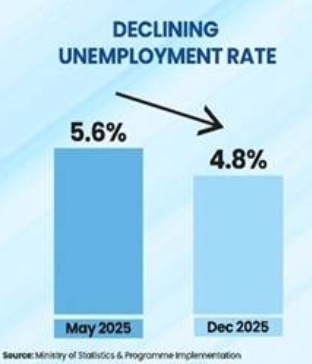
11. Total employment in Q2 FY26 stood at 56.2 crore persons, while the Labour Force Participation Rate reached 56.1%, Worker Population Ratio 53.4%, and unemployment rate declined to 4.8% in December 2025.
12. Female Labour Force Participation Rate rose to 35.3% in December 2025, and the e-Shram portal had registered more than 31 crore unorganised workers by January 2026, with women forming over 54%.
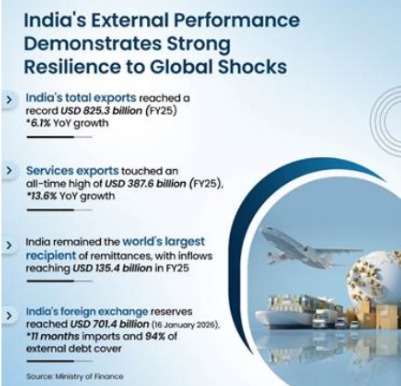
13. India’s total exports reached USD 825.3 billion in FY25 and USD 418.5 billion in H1 FY26, while services exports touched an all-time high of USD 387.5 billion in FY25.
14. Foreign exchange reserves stood at USD 701.4 billion on 16 January 2026, providing around 11 months of import cover and covering over 94% of external debt.
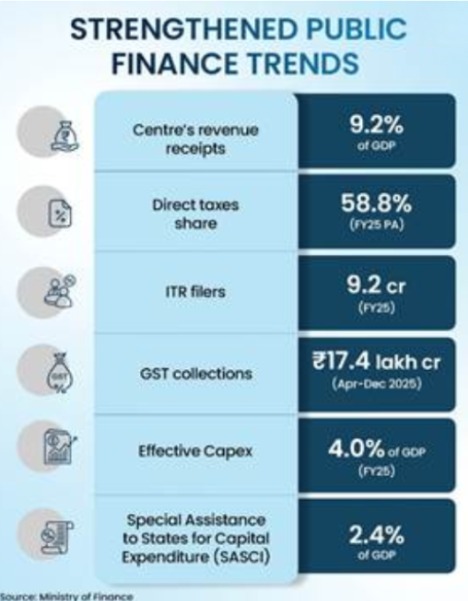
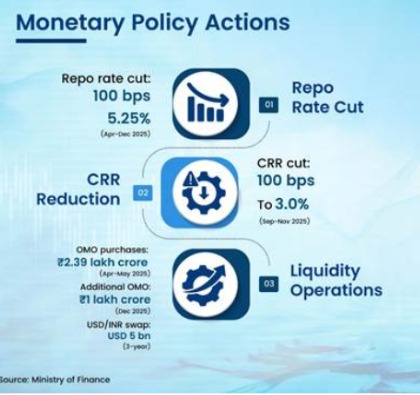
15. Repo rate was reduced by 100 basis points between April and December 2025 to 5.25%, Gross GST collections during April to December 2025 reached ₹17.4 lakh crore, and the Financial Inclusion Index rose from 64.2 to 67.0.
Must Know Terms :
1. Buoyancy
Revenue buoyancy reflects how strongly government revenue rises when the economy expands. In recent fiscal trends, revenue receipts improved from about 8.5% of GDP during FY16–FY20 to 9.2% in FY25. Stronger non-corporate tax collections played a major role, increasing from nearly 2.4% of GDP before the pandemic to around 3.3% in the post-pandemic period across the economy.
2.Disinflation
Disinflation means inflation is still positive but rising at a slower rate than before. During April–December 2025, average headline inflation fell to 1.7%, the lowest since the Consumer Price Index series began. India also recorded one of the sharpest declines among major emerging economies in 2025, with headline inflation dropping by about 1.8 percentage points over 2024 levels.
3.GVA
Gross Value Added (GVA) measures the value created by different sectors after subtracting input costs. For FY26, GVA is projected to grow by 7.3%. Agriculture supported stability, manufacturing accelerated to 7.72% in Q1 and 9.13% in Q2, while services reached a 56.4% share in total GVA, showing the dominance of modern and tradable sectors in the economy.
4.SASCI
SASCI stands for Special Assistance to States for Capital Expenditure. It is a central support mechanism designed to encourage states to maintain and expand productive capital spending. Under this arrangement, states were incentivised to keep capital expenditure around 2.4% of GDP in FY25. The scheme supports infrastructure creation, strengthens public investment quality, and improves long-term growth capacity across regions.
5.Intermediation
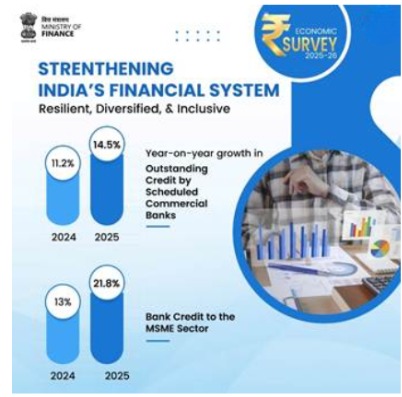
Financial intermediation is the process through which banks and financial institutions move savings into loans, investments, and productive economic activity. In December 2025, the money multiplier rose to 6.21 from 5.70 a year earlier, showing improved banking efficiency. Broad money growth reached 12.1%, while scheduled commercial bank credit growth climbed to 14.5%, indicating stronger transmission of liquidity.
6.Financialisation
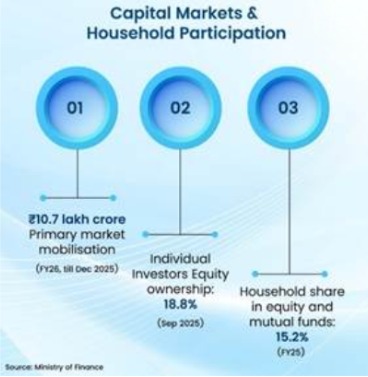
Financialisation refers to the growing shift of household savings toward market-linked financial instruments instead of only traditional deposits or physical assets. In India, the share of equity and mutual funds in annual household financial savings rose from around 2% in FY12 to over 15.2% in FY25. Individual investors’ share in equity ownership also reached 18.8% by September 2025.
Key Takeaways
A. India’s growth remains robust, with real GDP growth for FY27 projected in the range of 6.8-
7.2%.
B. Inflation fell to historic lows, averaging 1.7% in April-December 2025.
C. All major sectors contributed to growth, with agriculture stabilising rural demand,
manufacturing gaining momentum, and services leading expansion.
D.India’s total exports reached record levels of USD 825.3 billion in FY25 and USD 418.5 billion
in H1 FY26
E. Fiscal position strengthened, with improved revenue buoyancy, rising capital expenditure,
and enhanced credibility reflected in sovereign rating upgrades.
F. Monetary conditions turned supportive, repo rate at 5.25% as of December 2025.
MCQ :
1. Real GDP growth for FY26 is projected at:
A) 7.4%
B) 7.3%
C) 6.8%
D) 9.1%
2. Gross Value Added for FY26 is projected to grow by:
A) 6.2%
B) 7.3%
C) 5.9%
D) 7.2%
3. Real GDP growth for FY27 is projected in which range?
A) 5.8% to 6.2%
B) 6.8% to 7.2%
C) 7.4% to 7.8%
D) 4.0% to 5.0%
4. Average headline inflation during April to December 2025 stood at:
A) 2.8%
B) 2.0%
C) 1.7%
D) 2.6%
5. In December 2025, the Reserve Bank of India reduced its FY26 inflation forecast to:
A) 2.0%
B) 2.6%
C) 1.7%
D) 2.8%
6. Agriculture and allied activities are estimated to grow by how much in FY26?
A) 5.0%
B) 3.6%
C) 3.1%
D) 6.2%
7. Manufacturing Gross Value Added in Q2 of FY26 grew by:
A) 7.72%
B) 9.13%
C) 6.2%
D) 7.3%
8. Production Linked Incentive schemes covered how many sectors?
A) 12
B) 16
C) 10
D) 14
9. By September 2025, actual investment attracted under Production Linked Incentive schemes exceeded:
A) ₹18.7 lakh crore
B) ₹1 lakh crore
C) ₹2 lakh crore
D) ₹53 lakh crore
10. India’s Global Innovation Index rank improved to which position in 2025?
A) 38th
B) 66th
C) 56th
D) 48th
11. The services sector is estimated to grow by how much in FY26?
A) 7.2%
B) 9.1%
C) 6.8%
D) 5.25%
12. India’s share in global services trade reached what level in 2024?
A) 2%
B) 1.8%
C) 3.2%
D) 4.3%
13. Total employment in Q2 FY26 stood at:
A) 31 crore
B) 53.4 crore
C) 56.2 crore
D) 35.3 crore
14. Foreign exchange reserves as on 16 January 2026 stood at:
A) USD 825.3 billion
B) USD 418.5 billion
C) USD 387.5 billion
D) USD 701.4 billion
15. India’s Financial Inclusion Index rose to what level in March 2025?
A) 64.2
B) 67.0
C) 56.1
D) 58.8




0 comment