Ganga Rejuvenation: Projects, Standards, and Basin Strategy
1. Namami Gange began in June 2014 as an integrated mission for pollution abatement, conservation, and rejuvenation of National River Ganga.
2. The programme originally had ₹20,000 crore outlay up to March 2021, later extended to March 2026 with ₹22,500 crore.
3. For 2025–26, the National Ganga Plan has an outlay of ₹3,400 crore to expand treatment and improve water quality.
4. The stated aim includes achieving prescribed bathing standards through stronger sewage treatment and industrial discharge regulation by 2025.
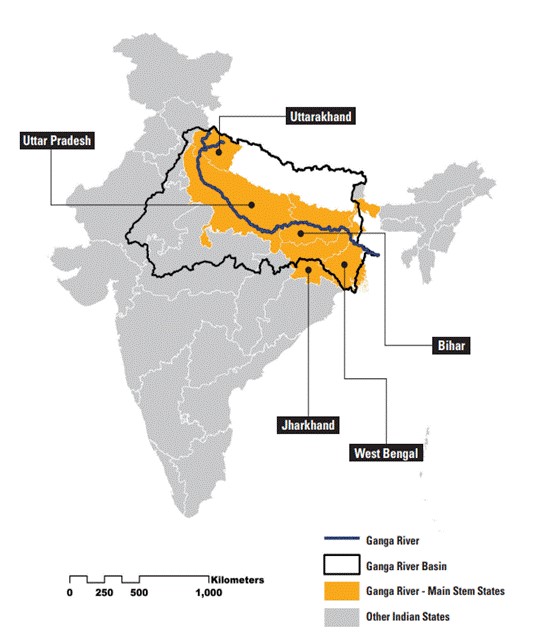
5. The Ganga basin is India’s largest, covering about 27% land area and supporting nearly 47% of the population.
6. The basin spans more than 11 states, with around 65.57% land under agriculture and 3.47% under water bodies.
7. Despite high precipitation share, the basin remains highly water-stressed, reflecting low per-capita rainwater availability.
8. Rejuvenation vision emphasizes Aviral Dhara, Nirmal Dhara, and protection of geological and ecological integrity.
9. Basin management planning follows an integrated river-basin approach with multi-sectoral and multi-agency interventions.
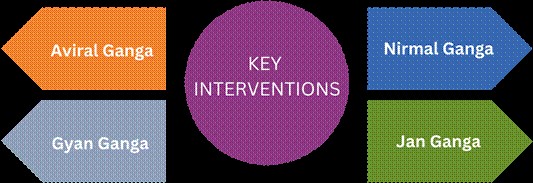
10. Four intervention pillars include pollution abatement, ecological flow improvement, people–river connect, and research-policy support.
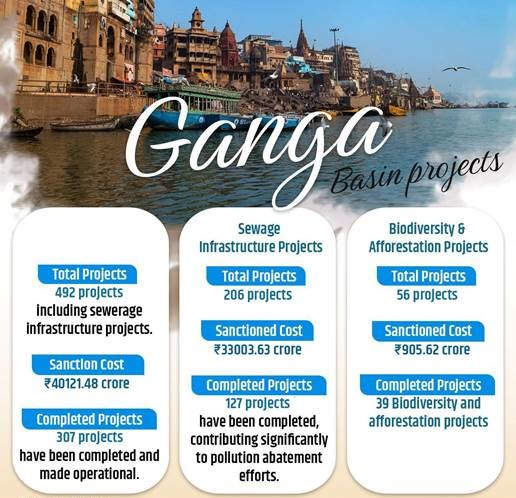
11. By 31 January 2025, 492 projects worth ₹40,121.48 crore had been initiated under the mission framework.
12. Of these, 307 projects were completed and operational, indicating substantial progress across multiple intervention areas.
13. Sewage infrastructure remains central: 206 projects were initiated with ₹33,003.63 crore sanctioned for implementation.
14. Sewerage outcomes include 127 completed projects that directly reduce untreated sewage inflows into the river system.
15. Biodiversity and afforestation actions include 56 projects with over ₹905.62 crore committed, and 39 already completed.
MCQ
1. With reference to the Namami Gange programme, consider the following statements:
1. It was approved as an integrated conservation mission in June 2014.
2. It was approved as a flagship programme by the Union Government.
3. Its twin objectives include pollution abatement and rejuvenation of the Ganga.
Which of the statements given above is/are correct?
(a) 1 and 2 only
(b) 2 and 3 only
(c) 1 and 3 only
(d) 1, 2 and 3
2. The extended budgetary outlay of the Namami Gange Programme up to March 2026 is:
(a) ₹20,000 crore
(b) ₹22,500 crore
(c) ₹3,400 crore
(d) ₹40,121.48 crore
3. The financial outlay mentioned for the National Ganga Plan for the year 2025–26 is:
(a) ₹905.62 crore
(b) ₹3,400 crore
(c) ₹22,500 crore
(d) ₹33,003.63 crore
4. The Ganga River Basin is described as:
(a) Covering about 47% of India’s land mass and supporting 27% population
(b) Covering about 27% of India’s land mass and supporting about 47% population
(c) Covering about 11% of India’s land mass and supporting about 65.57% population
(d) Covering about 27% of India’s land mass and supporting about 27% population
5. As per the given description, the majority share of the Ganga basin land-use is under:
(a) Water bodies
(b) Agriculture
(c) Forests
(d) Urban settlements
6. The trio of terms most directly linked to the stated vision of Ganga rejuvenation is:
(a) Jal Shakti, Swachhata, Sanitation
(b) Aviral Dhara, Nirmal Dhara, Ecological integrity
(c) Carbon neutrality, Circularity, Climate resilience
(d) Flood control, Inland navigation, Hydropower
7. The Ganga River Basin Management Plan (GRBMP) is stated to be developed by:
(a) A consortium of seven IITs
(b) A consortium of seven IIMs
(c) A consortium of seven Central Universities
(d) A consortium of seven national laboratories
8. Match the following intervention pillars:
List-I
A. Nirmal Ganga
B. Aviral Ganga
C. Jan Ganga
D. Gyan Ganga
List-II
1. Pollution abatement
2. Improving ecology and flow
3. People–river connect
4. Research and policy support
Select the correct answer using the code given below:
(a) A-2, B-1, C-3, D-4
(b) A-1, B-2, C-3, D-4
(c) A-1, B-3, C-2, D-4
(d) A-3, B-2, C-1, D-4
9. As of 31 January 2025, the total number of projects launched and their value were:
(a) 307 projects worth ₹40,121.48 crore
(b) 492 projects worth ₹40,121.48 crore
(c) 492 projects worth ₹33,003.63 crore
(d) 206 projects worth ₹40,121.48 crore
10. As of 31 January 2025, the number of completed and operational projects was:
(a) 127
(b) 206
(c) 307
(d) 492
11. Consider the following statements:
1. Sewage infrastructure projects initiated were 206 in number.
2. Funds sanctioned for sewage infrastructure projects were ₹33,003.63 crore.
3. Completed sewerage projects were 127 in number.
Which of the statements given above is/are correct?
(a) 1 only
(b) 1 and 2 only
(c) 2 and 3 only
(d) 1, 2 and 3
12. The recently approved project in Varanasi included interception and diversion of the Durga Drain and construction of a sewage treatment plant of:
(a) 17 MLD
(b) 60 MLD
(c) 75 MLD
(d) 127 MLD
13. The Varanasi project mentioned is stated to be based on:
(a) DBOT model
(b) EPC model
(c) Hybrid annuity model
(d) TOT model
14. The approved initiative to prevent untreated sewage from entering Varuna in Bhadohi includes STPs of capacities:
(a) 60, 17 and 5 MLD
(b) 20, 6.25 and 4.5 MLD
(c) 17, 5 and 3 MLD
(d) 75, 60 and 3 MLD
15. With reference to biodiversity and afforestation under the programme, consider the following statements:
1. 56 projects were undertaken with funding commitment over ₹905.62 crore.
2. 39 such projects have been successfully concluded.
Which of the statements given above is/are correct?
(a) 1 only
(b) 2 only
(c) Both 1 and 2
(d) Neither 1 nor 2

0 comment