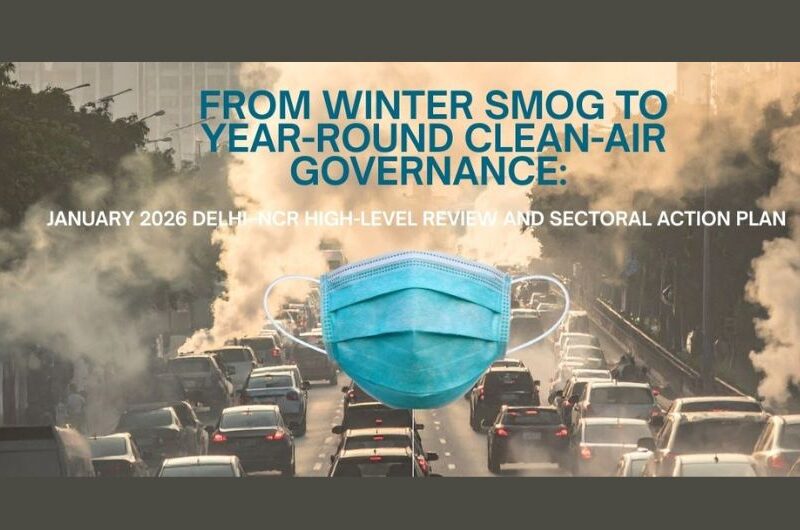
From Winter Smog to Year-Round Clean-Air Governance: January 2026 Delhi–NCR High-Level Review and Sectoral Action Plan
1. Delhi–NCR’s winter pollution remains extreme; on 28 December 2025, Delhi recorded “hazardous” air with AQI 530, highlighting repeated seasonal spikes and worsening multi-year deterioration trends.
2. Short-term controls have included GRAP (Graded Response Action Plan) and routine mist-spray systems on central road verges to suppress dust, yet overall ambient air quality has not improved to acceptable levels.
3. A high-level NCR air-pollution review was held on 12 January 2026, chaired by the Union Environment Minister, with Delhi’s Chief Minister and senior Union/Delhi officials.
4. A fresh scientific source-apportionment effort was announced to precisely identify pollution contributors, enabling targeted structural action instead of repeated emergency restrictions and scattered, short-duration interventions.
5. A reduction target was articulated: cut air pollution across the National Capital Region by 15–20% by end-2026, implying measurable outcomes across sectors and agencies.
6. The source-identification study began in January 2026, led by institutions including TERI (The Energy and Resources Institute), IIT Delhi, IITM (Indian Institute of Tropical Meteorology, Pune), and ARAI (Automotive Research Association of India) to generate updated datasets.
7. Vehicular emissions received priority; smart traffic management is planned at 62 identified congestion hotspots to reduce idling, stop–go movement, and concentrated emission build-up corridors.
8. Proposed transport enforcement includes strict action against polluting vehicles, a special registration drive, and expanded ANPR (Automatic Number Plate Recognition) systems for detection, compliance tracking, and penalties.
9. Demand-management options were also discussed, including staggered office timings, alongside strengthening public transport and last-mile connectivity to reduce reliance on private vehicles.
10. Industrial controls noted progress: 227 of 240 NCR industrial estates have shifted to PNG (Piped Natural Gas), yet unplanned industrial activity outside designated zones remains problematic.
11. Directions were issued for strict action against illegally operating and non-conforming industrial units, aiming to curb emissions from units bypassing fuel norms, siting rules, and compliance checks.
12. The Central Pollution Control Board issued notices to 88 units lacking OCEMS (Online Continuous Emission Monitoring Systems); closure actions were set to commence from 23 January 2026 for non-installation.
13. Road dust was treated as a core contributor: end-to-end paving and mission-mode plantation of local shrub varieties were emphasized, involving youth groups and civic bodies.
14. Over 3,300 km of Delhi roads are planned for redevelopment within the coming year, with dust-control measures and traffic management integrated into execution and monitoring frameworks.
15. Construction and demolition waste controls were stressed: designate C&D waste sites, halt demolition during peak pollution periods, and partner with recycling associations to reduce open dumping.
Must Know Terms :
1.#SourceApportionmentStudy
- Delhi PM2.5 source split (IIT-Kanpur study cited in public summaries): road dust 38%, vehicular 20%, domestic 12%, industrial 11%, concrete batching 6%, hotels/restaurants 3%, MSW burning 3%, diesel gensets 2%, industrial-area sources 2%, and cremation/aircraft/medical incinerators 1% each.
- Same study’s Delhi PM10 split (widely cited): road dust 56%, vehicular 9% (other shares distributed across construction, industry, biomass/garbage burning, etc.).
- These percentages are used as “receptor-model” style outputs: they convert measured chemical fingerprints in PM into source contributions.
2.#CongestionHotspotMapping
- City traffic choke-point identification (Delhi official statement reported by PTI): 233 traffic choke points identified; 123 of these fall under PWD.
- Hotspot mapping (pollution-source mapping at priority locations): 13 hotspots mapped with 57 distinct pollution sources identified; Mundka and Anand Vihar recorded 7 sources each in that mapping.
- A later Delhi government update reported identification of 62 hotspots for PM10-focused actions (dusty roads, construction activity, and traffic congestion flagged as dominant drivers).
3.#ANPREnforcement
- ANPR-led enforcement was linked with a sharp jump in PUC e-challans: ~163,000 PUC challans issued in 2025 (till late July), versus 68,000 in all of 2024; 43,500 in 2022; and 36,000 in 2021.
- GRAP enforcement snapshot (late Dec 2025): 1,114 challans generated via ANPR cameras during a focused enforcement drive; 2,500+ vehicles penalised for PUC-related violations over two days; 28 PUC centres suspended in the same action window.
4.#OCEMSCompliance
- OCEMS = real-time stack emission monitoring connected to the central server for continuous tracking of key pollutants.
- Compliance gap figure reported by CPCB leadership (Delhi–NCR): 2,254 “highly polluting” industries had not installed and connected OCEMS to the CPCB server at the time of the statement.
- Deadline-based direction reported for Delhi–NCR red-category units: installation of OCEMS and surveillance/PTZ cameras to be ensured by end-2025 in specified sectors (food/food processing, textiles, metal processing).
5.#MechanisedRoadSweeping
- Identified road-length target (Delhi compiled multi-agency data, Feb 2024): 7,964.69 km of roads identified for mechanised sweeping per day.
- Actual mechanised sweeping achieved (same dataset): 3,055.7 km/day on average → 38.37% of identified daily road-length.
- Planning norm cited in enforcement meetings: approximately 1 sweeping machine per 40 km to close the coverage gap.
6.#CNDWasteRecycling
- Processing capacity and plant count (Delhi civic system, reported figures): 5 C&D waste processing plants (Burari, Rani Khera, Shastri Park, Bakkarwala, Okhla) with combined capacity reported at ~5,500 tonnes/day.
- Plant-wise capacities reported in Delhi news records: Burari 2,000 TPD; Bakkarwala 1,000 TPD; Shastri Park 1,000 TPD; Rani Khera reported around 1,000–1,500 TPD in different updates.
- Daily generation benchmark often used for Delhi: ~5,500–6,000 tonnes/day of C&D waste, implying near-full utilisation is required to avoid open dumping and secondary dust.
MCQ:
1. Delhi experienced “hazardous” air quality with an AQI of 530 on:
A) January 12, 2026
B) December 28, 2025
C) January 23, 2026
D) February 6, 2023
2. The high-level review meeting on Delhi–NCR air pollution was chaired by:
A) Shri Kirti Vardhan Singh
B) Shri Bhupender Yadav
C) Shri Manjinder Singh Sirsa
D) Smt. Rekha Gupta
3. The meeting took place on:
A) Monday, January 12, 2026
B) Monday, January 23, 2026
C) Monday, December 28, 2025
D) Monday, October 12, 2024
4. The stated target to curb air pollution in the NCR by end-2026 is:
A) 5–10%
B) 10–12%
C) 15–20%
D) 25–30%
5. The new scientific study to pinpoint sources of pollution was initiated from:
A) October 2024
B) January 2026
C) December 2025
D) March 2026
6. Which of the following is NOT listed among the institutions conducting the study?
A) TERI
B) IIT Delhi
C) IITM Pune
D) ISRO
7. Smart traffic management was discussed for how many identified congestion hotspots?
A) 42
B) 62
C) 88
D) 227
8. Automatic Number Plate Recognition system is referred to as:
A) OCEMS
B) ANPR
C) CPCB
D) GRAP
9. The measure discussed to reduce dependency on private vehicles emphasised:
A) Higher parking fees only
B) Strengthening public transport and last-mile connectivity
C) Banning all diesel vehicles immediately
D) Converting all roads into one-way corridors
10. In NCR, how many industrial estates were noted to have already shifted to PNG?
A) 88 out of 240
B) 227 out of 240
C) 240 out of 240
D) 62 out of 240
11. The continuing concern mentioned regarding industrial activity was:
A) Zero compliance monitoring in designated estates
B) Unplanned activity outside designated industrial zones/estates
C) Total shutdown of legal industrial estates
D) Complete shift back from PNG to coal
12. CPCB issued notices to how many units for not installing OCEMS?
A) 62
B) 88
C) 227
D) 240
13. Closure actions linked to OCEMS non-compliance were to commence from:
A) January 12, 2026
B) January 23, 2026
C) December 28, 2025
D) October 23, 2024
14. Redevelopment of roads in Delhi planned in the coming year was stated as over:
A) 1,300 km
B) 2,300 km
C) 3,300 km
D) 4,300 km
15. For Construction & Demolition (C&D) waste, one measure stressed was to:
A) Encourage demolition during peak pollution periods
B) Ban recycling partnerships
C) Designate C&D waste sites and halt demolition during peak pollution periods
D) Allow only open dumping at roadside locations


0 comment