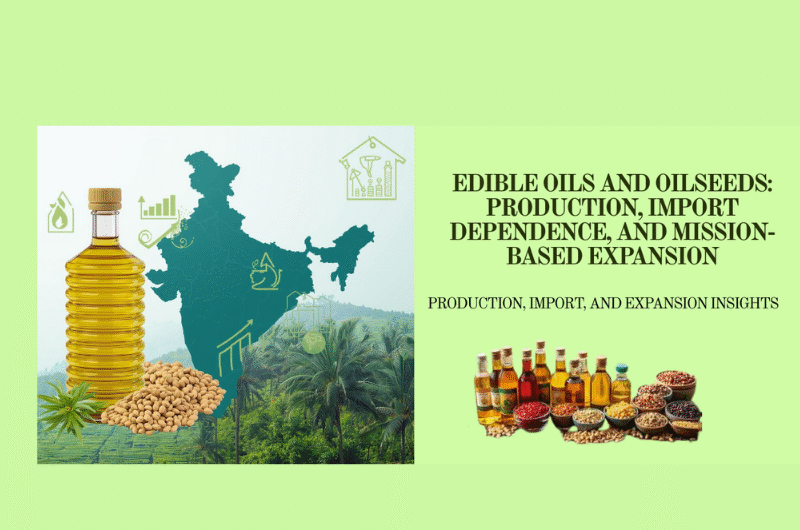
Edible Oils and Oilseeds: Production, Import Dependence, and Mission-Based Expansion
Key Takeaways
- According to a NITI Aayog report (August 2024), India ranks firstglobally in the production of rice bran oil, castor seed, safflower, sesame, and niger.
- National Mission on Edible Oils (NMEO)aims to strengthen the country’s oilseed ecosystem and achieve Atmanirbharta in edible oil production.
- The NMEO–OP (Oil Palm) aims to bring 5 lakh hectaresunder oil palm cultivation by 2025–26 and increase crude palm oil production to 28 lakh tonnes by 2029–30.
- By November 2025, 50 lakh hectareshave been covered, bringing the total coverage of oil palm in the country to 6.20 lakh hectares. Crude Palm Oil (CPO) production has risen from 1.91 lakh tonnes in 2014-15 to 3.80 lakh tonnes in 2024-25.
- NMEO–OS (Oil Seeds) aims to increase oilseed production from 39 to 7 million tonnesby 2030–31 through cluster-based interventions and improved seed systems.
1. Edible oils are central to food and nutritional security; oilseeds supply dietary fats, energy, vitamins, and support farmer livelihoods as key cash crops nationwide.
2. Domestic edible oil demand has outpaced production; rural consumption rose to 10.58 kg/year and urban to 11.78 kg/year by 2022-23, indicating strong shift overall.
3. Total edible oil output was 12.18 million tonnes in 2023-24, meeting about 44% of demand, leaving substantial reliance on imports for stability nationally today.
4. Import dependence declined from 63.2% in 2015-16 to 56.25% in 2023-24, yet rising consumption still pressures foreign exchange, prices, and supply security for households.
5. India contributes 15-20% of global oilseed area but only 6-7% of vegetable oil output, reflecting yield gaps, limited expansion, and efficiency constraints per hectare.
6. Nine major oilseeds occupy 14.3% of gross cropped area; about 76% oilseed area is rainfed, heightening climate vulnerability, yield instability, and income risk overall.
7. Rajasthan, Madhya Pradesh, Gujarat, and Maharashtra contribute over 77% of national oilseed output, showing regional concentration, crop specialisation, and supply dependence in key years.
8. National Mission on Edible Oils uses two pillars: expand oil palm cultivation and improve traditional oilseeds productivity, seed systems, processing capacity, and market linkages.
9. Oil palm yields far more oil per hectare than traditional oilseeds; Andhra Pradesh and Telangana account for about 98% of current production, leading adoption.
10. Oil palm mission targets 6.5 lakh hectares by 2025-26 and crude palm oil 28 lakh tonnes by 2029-30; coverage reached 6.20 lakh hectares nationally.
11. Price assurance for fresh fruit bunches links farmer returns to a viability price, cushioning international crude palm oil volatility and improving predictable income stability.
12. Input assistance for oil palm rose to Rs. 29,000 per hectare; added support covers maintenance, intercropping, drip irrigation, and old garden rejuvenation support packages.
13. Oilseeds mission targets 33 million hectares, 69.7 million tonnes output, and 2,112 kg/ha yield by 2030-31, raising domestic edible oil availability over seven years.
14. Over 600 value-chain clusters deliver quality seeds, training, and advisory services; post-harvest infrastructure support improves collection, extraction efficiency, recovery, and farmer returns at scale.
15. Seed planning and traceability use a rolling plan portal; SHGs and Krishi Sakhis support data updates, while research notified 432 varieties since 2014 commercially.
MCQ:
1. With reference to edible oils, consider the following statements:
I. They are a major source of dietary fats and support nutritional security.
II. Oilseeds function as important cash crops for many farming households.
Which of the statements given above is/are correct?
A. I only
B. II only
C. Both I and II
D. Neither I nor II
2. As per the given data, the level of import dependence for edible oils in 2023–24 was closest to:
A. 36%
B. 44%
C. 56%
D. 63%
3. Consider the following pairs:
I. Rural per capita edible oil consumption (2022–23) — 10.58 kg/year
II. Urban per capita edible oil consumption (2022–23) — 11.78 kg/year
Which of the pairs given above is/are correctly matched?
A. I only
B. II only
C. Both I and II
D. Neither I nor II
4. Total edible oil production mentioned for 2023–24 was:
A. 8.18 million tonnes
B. 10.18 million tonnes
C. 12.18 million tonnes
D. 14.18 million tonnes
5. India’s share in global oilseed area and vegetable oil output is best described as:
A. 5–7% area; 15–20% output
B. 15–20% area; 6–7% output
C. 25–30% area; 10–12% output
D. 10–12% area; 25–30% output
6. With reference to oilseeds cultivation, consider the following statements:
I. Nine major oilseeds occupy about 14.3% of the gross cropped area.
II. Around three-fourths of oilseed area is rainfed.
Which of the statements given above is/are correct?
A. I only
B. II only
C. Both I and II
D. Neither I nor II
7. Which of the following groups of States together contribute over 77% of national oilseed output, as stated?
A. Punjab, Haryana, Uttar Pradesh, Bihar
B. Rajasthan, Madhya Pradesh, Gujarat, Maharashtra
C. Andhra Pradesh, Telangana, Tamil Nadu, Karnataka
D. West Bengal, Odisha, Chhattisgarh, Jharkhand
8. The mission framework described for edible oils is based primarily on:
A. Import substitution through tariff bans alone
B. Expansion of oil palm and improvement of traditional oilseeds
C. Replacement of oilseeds by cereals in rainfed areas
D. Exclusive focus on refining capacity without farm interventions
9. Oil palm is emphasised in policy primarily because it:
A. Requires no irrigation and thrives only in arid climates
B. Has significantly higher oil yield per hectare than traditional oilseeds
C. Produces edible oil without any processing requirement
D. Has the shortest gestation period among all crops
10. Current oil palm production is described as being concentrated mainly in:
A. Andhra Pradesh and Telangana
B. Rajasthan and Gujarat
C. Punjab and Haryana
D. Odisha and West Bengal
11. The oil palm expansion target mentioned for 2025–26 was:
A. 2.5 lakh hectares
B. 4.5 lakh hectares
C. 6.5 lakh hectares
D. 8.5 lakh hectares
12. The crude palm oil production target mentioned for 2029–30 was:
A. 18 lakh tonnes
B. 28 lakh tonnes
C. 38 lakh tonnes
D. 48 lakh tonnes
13. Price assurance for fresh fruit bunches is designed mainly to:
A. Fix prices permanently regardless of market conditions
B. Link farmer returns to a viability price to buffer international volatility
C. Replace procurement systems for cereals
D. Reduce processing capacity in favour of raw exports
14. The input assistance for oil palm cultivation mentioned was increased to:
A. Rs. 19,000 per hectare
B. Rs. 24,000 per hectare
C. Rs. 29,000 per hectare
D. Rs. 34,000 per hectare
15. The oilseeds mission target for 2030–31 includes which of the following?
I. 33 million hectares coverage
II. 69.7 million tonnes production
III. 2,112 kg/ha yield
Select the correct answer using the code given below:
A. I only
B. I and II only
C. II and III only
D. I, II and III




0 comment