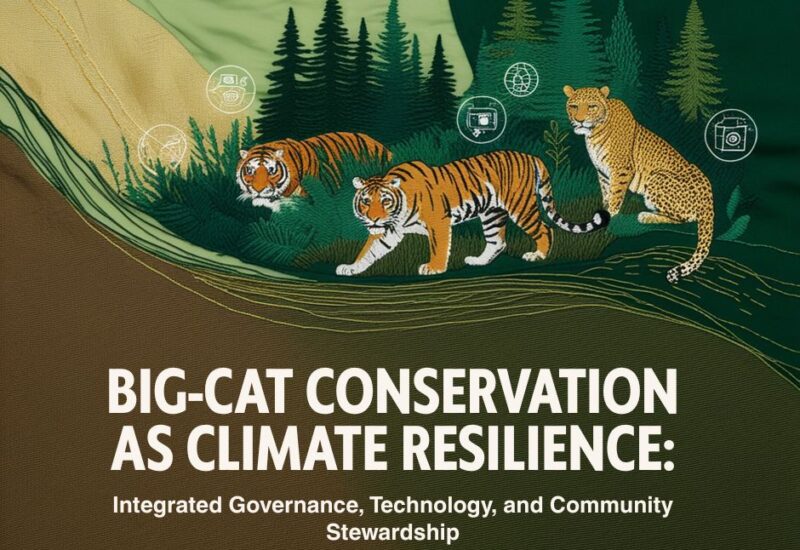
Big-Cat Conservation as Climate Resilience: Integrated Governance, Technology, and Community Stewardship
1. Climate action is described as increasingly linking conservation, technology, and diplomacy into a holistic governance approach, reducing fragmented planning and improving coherence across sectors and landscapes.
2. Biodiversity protection is treated as a climate instrument, aligning habitat security with mitigation, adaptation, and long-term resilience, supported by statutory protections for continuity beyond political cycles.
3. Conservation frames ecosystems as living assets, emphasising stewardship and interdependence; climate and biodiversity positions prioritise ecological integrity beyond narrow human welfare measures alone.
4. Biodiversity goals reinforce climate commitments by protecting carbon sinks, stabilising hydrology, and reducing vulnerability to extremes, positioning conservation as risk management against floods, droughts, and heat.
5. Climate strategies aim for integrated outcomes—emissions reduction, biodiversity health, water security, and livelihoods—supported by coordinated monitoring, enforcement, research, and policy screening across institutions.
6. A big-cat conservation alliance is described as an international platform to protect flagship species while strengthening wider habitat and biodiversity outcomes across multiple landscapes and governance contexts.
7. The framework focuses on seven major big cats, using their ecological roles to anchor protection of forests, grasslands, mountains, and river catchments through shared responsibility and cooperation.
8. Protecting apex predator landscapes safeguards entire food webs; predators regulate herbivore pressure, enabling regeneration and preserving vegetation that supports carbon storage and ecosystem stability.
9. Protected habitats deliver ecosystem services including microclimate stability, soil retention, moisture conservation, reduced erosion and landslide risks, and stronger catchment protection for water security.
10. Mountain predators serve as indicators of high-altitude ecosystem stability; declines can signal warming impacts, habitat shrinkage, and downstream hydrological disruption affecting seasonal river flows.
11. Conservation supports long-term social and economic value via regulated climates, reduced disaster impacts, and protection of genetic resources that can strengthen future food security under climate stress.
12. Protected landscape expansion includes inviolate core zones, buffers for managed use and coexistence, and corridors that maintain genetic exchange and reduce fragmentation under climate-driven shifts.
13. Conservation planning extends beyond park boundaries to farms, rivers, grasslands, and meadows; infrastructure in sensitive zones requires mitigation to reduce mortality and ecological disruption.
14. Wildlife-friendly infrastructure uses underpasses and overpasses to maintain connectivity while preserving traffic efficiency; large mitigation structures are described as demonstration sites for compatibility.
15. Modern conservation systems use camera traps, statistical models, AI image processing, satellite tracking, thermal surveillance, GIS mapping, and app-based smart patrols, anchored by community benefits and stewardship.
Must Know Terms :
1.Conservation–Climate Integration
Conservation–Climate Integration: The evidence base treats biodiversity protection as a climate tool and climate action as a biodiversity tool. IPCC AR6 WGII states safeguarding biodiversity and ecosystems is fundamental to climate-resilient development. The Kunming–Montreal Global Biodiversity Framework sets a quantified 2030 conservation benchmark: at least 30% of terrestrial, inland water, and coastal/marine areas to be effectively conserved through “well-connected” and equitably governed systems, integrated into wider landscapes.
2.Big-Cat Alliance Framework
Big-Cat Alliance Framework: India’s International Big Cat Alliance (IBCA) is framed around conservation of seven big cats: Tiger, Lion, Leopard, Snow Leopard, Puma, Jaguar, and Cheetah. The platform logic is cross-border: shared best practices, capacity building, and coordinated actions against habitat loss, poaching, and illegal wildlife trade across range states, with a single umbrella for multiple flagship big-cat programmes rather than species-wise silos.
3.Apex Predators and Trophic Balance
Apex Predators and Trophic Balance: Large carnivores regulate prey and mesopredators, stabilising food webs via direct predation and “fear effects.” A landmark Science review documents cascading ecosystem changes after predator guild loss, including shifts in pollinators, seed dispersers, herbivory pressure, woody recruitment, bird abundance, and even soil carbon/nitrogen ratios (example case: Lago Guri islands after fragmentation). In Indian landscapes, tiger recovery metrics also reflect top-predator status—All India Tiger Estimation 2022 reports a minimum of 3,167 tigers.
4.Corridors and Connectivity
Corridors and Connectivity: Connectivity is operationalised as mapped movement linkages between source populations to reduce isolation and enable dispersal. Government reporting states NTCA and WII mapped 32 major tiger corridors at macro/landscape scale, with management interventions operationalised through Tiger Conservation Plans mandated under Section 38V of the Wildlife (Protection) Act, 1972. Corridor thinking is now integrated into land-use screening, mitigation siting, and conflict-response planning around source areas.
5.Wildlife-Compatible Infrastructure Mitigation
Wildlife-Compatible Infrastructure Mitigation: The highest-evidence package is crossing structures plus exclusion fencing. A synthesis reports ~86% reduction in reported wildlife-vehicle collisions when crossings are paired with adequate fencing. A frequently cited real-world example is Banff National Park: along a 23-km highway section, crossing structures plus fencing reduced wildlife collisions by ~80% overall and by ~96% for common large ungulates (deer/elk), demonstrating measurable safety and conservation returns.
6.Tech-Enabled Monitoring and Smart Patrols
Tech-Enabled Monitoring and Smart Patrols: India’s core protected-area field platform is M-STrIPES (Monitoring System for Tigers – Intensive Protection and Ecological Status). Technical stack reported by WII: GPS + GPRS + remote sensing for field data capture, database creation, GIS/statistical analysis, and patrol-route mapping to tighten spatial coverage and response. The governance intent is measurable: digitised patrol effort, geo-tagged observations, and faster detection of threats (signs, camps, snares, wildlife crime indicators) for action by reserve management.
MCQ
1. The passage frames biodiversity protection primarily as:
(a) Separate from climate policy
(b) A climate instrument supporting mitigation and adaptation
(c) Only a tourism strategy
(d) Only a legal compliance issue
2. Conservation is positioned as risk management because it lowers exposure to:
(a) Only earthquakes
(b) Floods, droughts, heat stress, and ecological collapse
(c) Only market volatility
(d) Only urban congestion
3. The alliance framework described focuses on:
(a) Three large herbivores
(b) Seven major big cats
(c) Ten marine mammals
(d) Five migratory birds
4. Protecting apex predator landscapes is described as safeguarding:
(a) Only single-species outcomes
(b) Whole food webs and ecosystems
(c) Only hunting revenues
(d) Only urban parks
5. Predators contribute to trophic balance mainly by:
(a) Increasing overgrazing
(b) Regulating herbivore numbers and enabling regeneration
(c) Eliminating vegetation
(d) Replacing soil organisms
6. Protected habitats are described as supporting water security mainly through:
(a) Removing catchments
(b) Protecting streams and river catchments
(c) Increasing saline intrusion
(d) Blocking rainfall
7. Decline of mountain predators can signal:
(a) Stable snow ecosystems
(b) Warming impacts and habitat shrinkage
(c) Increased coral growth
(d) Reduced monsoon variability
8. Inviolate core zones primarily:
(a) Maximise extraction
(b) Limit disturbance for regeneration and breeding stability
(c) Replace buffers
(d) Eliminate corridors
9. Buffer zones mainly:
(a) Increase edge pressures
(b) Provide managed use spaces while supporting integrity
(c) Remove coexistence needs
(d) Replace legal protections
10. Corridors are important because they:
(a) Increase fragmentation
(b) Maintain genetic exchange and movement
(c) Stop adaptation
(d) Eliminate conflict automatically
11. Infrastructure through sensitive zones requires:
(a) No mitigation
(b) Mitigation to reduce mortality and fragmentation
(c) Only higher tolls
(d) Only fencing everywhere
12. Underpasses and overpasses are described as:
(a) Traffic-only projects
(b) Safe crossings supporting connectivity
(c) Coral restoration tools
(d) Flood-control gates
13. Wildlife estimation has shifted toward:
(a) Only indirect signs
(b) Camera traps and statistical models
(c) Only oral reports
(d) Only drone imagery without models
14. AI analysis mainly helps by:
(a) Slowing decisions
(b) Accelerating identification and trend detection
(c) Replacing field patrols fully
(d) Ending monitoring need
15. Conservation success near forests is linked to:
(a) Excluding communities entirely
(b) Tangible benefits and local ownership
(c) Removing education channels
(d) Ignoring livelihood dependence




0 comment