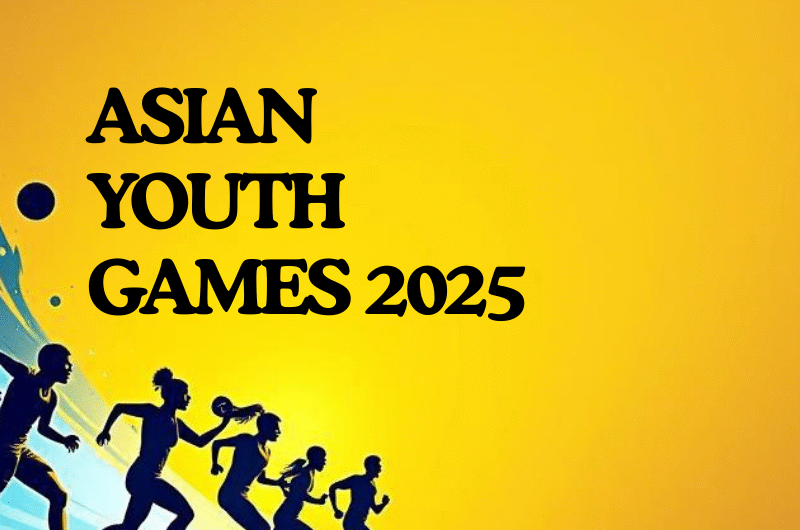
ASIAN YOUTH GAMES 2025
INTRODUCTION
The Asian Youth Games (AYG) is a continental-level multi-sport event organised under the Olympic Council of Asia (OCA) to identify, nurture and prepare young athletic talent from across Asia. The Games target athletes aged 14–18 and function as a structured pathway to elite international competitions such as the Asian Games and the Olympic Games. Beyond competition, AYG promotes cultural integration, discipline, leadership and sporting ethics among Asia’s youth.
ORIGIN AND EVOLUTION
The concept of the Asian Youth Games emerged after Singapore submitted a successful bid to host the Youth Olympic Games in 2010. Recognising the need for a continental youth platform, the OCA approved the creation of AYG in 2008. Singapore was unanimously awarded the hosting rights for the inaugural edition. Since then, the event has grown in scale, sports diversity and participant nations, reflecting Asia’s rising sporting ambitions.
INDIA’S OVERALL PERFORMANCE TRAJECTORY
ASIAN YOUTH GAMES 2009 – SINGAPORE
India participated in the first edition with emerging-level infrastructure and exposure. The Indian team secured:
Gold – 5
Silver – 3
Bronze – 3
Total – 11 medals
Overall Rank – 11th
This edition laid the foundation for India’s youth sports ecosystem and international presence.
ASIAN YOUTH GAMES 2013 – NANJING, CHINA
India showed clear signs of growth with increased exposure, broader participation and better training inputs:
Gold – 3
Silver – 4
Bronze – 7
Total – 14 medals
Overall Rank – 10th
Indian athletes expanded into new disciplines and demonstrated improved consistency.
ASIAN YOUTH GAMES 2025 – MANAMA, BAHRAIN
After a gap of more than a decade, India returned with its strongest performance ever:
Gold – 13
Silver – 18
Bronze – 17
Total – 48 medals
Overall Rank – 6th
India’s medals increased more than four times compared to 2009 and more than three times compared to 2013, marking a historic breakthrough.
EVENT SCALE – 2025
Participating countries – 45
Athletes – Over 4,000
Sports – 26
Indian contingent – 229 athletes
Male – 107
Female – 122
Officials – 90
SPORTS-WISE EXCELLENCE – INDIA 2025
Beach Wrestling:
Gold – 3, Silver – 2
India ranked first in this discipline.
Wrestling:
Gold – 3, Silver – 2, Bronze – 2
India emerged as one of the strongest wrestling nations at youth level.
Boxing:
Gold – 4, Silver – 2, Bronze – 1
Boxing was India’s highest gold-winning sport.
Kabaddi:
Both boys’ and girls’ teams won gold in the sport’s debut appearance at AYG, remaining unbeaten throughout the event.
GENDER PARITY AND WOMEN EMPOWERMENT
Medal Distribution:
Girls – 26 medals (54.17%)
Boys – 19 medals (39.58%)
Mixed – 3 medals (6.25%)
Gold Medals:
Girls – 9
Boys – 4
Women contributed 69.23% of total gold medals.
Out of 77 medal winning athletes:
Female – 46
Male – 31
This shows India’s success in implementing gender-inclusive sports policy and grassroots female participation.
RECOGNITION AND INCENTIVES
The Prime Minister congratulated Indian athletes and appreciated their discipline and determination.
Reward Announced by Indian Olympic Association:
Gold Medal – ₹5 lakh
Silver Medal – ₹3 lakh
Bronze Medal – ₹2 lakh
Fourth place finish – ₹50,000
Coach incentive – ₹1 lakh
Kabaddi teams (each) – ₹10 lakh
This reflects direct incentivisation of performance and recognition of coaching ecosystem.
Institutional Support Framework:
Ministry of Youth Affairs & Sports
Sports Authority of India
National Sports Federations
Government Schemes Driving Success:
Khelo India Programme
Target Olympic Podium Scheme (TOPS)
State level sports academies and scholarships
Talent identification and athlete tracking systems
CONCLUSION
India’s historic performance at Asian Youth Games 2025 confirms the success of long-term policy intervention in youth sports development. It highlights improvements in physical infrastructure, sports science, athlete nutrition, international exposure, psychological training and competitive mindset.
The Games demonstrate India’s shift from participation-based to performance-based sporting culture. With the next edition scheduled in Uzbekistan in 2029, India is well-positioned to emerge as a consistent youth sports power in Asia.
MCQs
1. The Asian Youth Games (AYG) is conducted under the authority of:
(a) International Olympic Committee
(b) Asian Games Federation
(c) Olympic Council of Asia
(d) National Olympic Committees
2. The primary age group targeted by the Asian Youth Games is:
(a) 10–14 years
(b) 12–16 years
(c) 14–18 years
(d) 16–21 years
3. The idea of the Asian Youth Games was directly inspired by:
(a) Asian Games 2006
(b) Commonwealth Games 2010
(c) Singapore’s Youth Olympics bid
(d) Beijing Olympics
4. The inaugural Asian Youth Games were held in:
(a) Beijing
(b) Singapore
(c) Nanjing
(d) Bangkok
5. India’s medal tally at the first Asian Youth Games in 2009 was:
(a) 9
(b) 10
(c) 11
(d) 12
6. In which edition did India finish 10th in the medal standings?
(a) Singapore 2009
(b) Nanjing 2013
(c) Manama 2025
(d) Doha 2017
7. India’s best-ever performance at the Asian Youth Games came in:
(a) 2009
(b) 2013
(c) 2025
(d) 2021
8. At Asian Youth Games 2025, India won a total of:
(a) 44 medals
(b) 46 medals
(c) 48 medals
(d) 50 medals
9. India’s overall ranking at Asian Youth Games 2025 was:
(a) 4th
(b) 5th
(c) 6th
(d) 7th
10. Which sport brought India the highest number of gold medals in AYG 2025?
(a) Wrestling
(b) Beach Wrestling
(c) Kabaddi
(d) Boxing
11. India topped the medal tally in which discipline in AYG 2025?
(a) Boxing
(b) Wrestling
(c) Beach Wrestling
(d) Kabaddi
12. Kabaddi at the Asian Youth Games 2025 is significant because:
(a) India lost the final match
(b) It replaced Wrestling
(c) It was played only by boys
(d) It was introduced for the first time
13. Which statement accurately reflects gender participation in India’s team at AYG 2025?
(a) Men were more in number than women
(b) Women participation was exactly equal to men
(c) Women outnumbered men
(d) Only boys participated
14. Women athletes contributed approximately what percentage of India’s total medals in 2025?
(a) 45%
(b) 50%
(c) 54%
(d) 60%
15. The next Asian Youth Games are scheduled to be held in:
(a) Japan
(b) South Korea
(c) Uzbekistan
(d) Thailand

0 comment