India’s Carbon Credit Trading Scheme
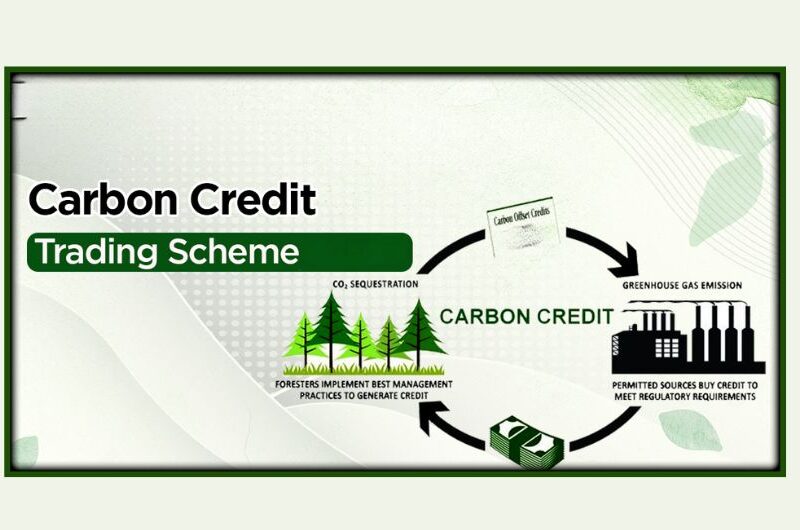
1. The Carbon Credit Trading Scheme (CCTS) is India’s national framework for reducing Greenhouse Gas (GHG) emissions through carbon pricing and the creation of the Indian Carbon Market (ICM).
2. CCTS was introduced under the Energy Conservation (Amendment) Act, 2022 and shifts the focus from energy-efficiency targets to direct reduction of carbon emissions.
3. The scheme operates through two components: the Compliance Mechanism for obligated industries and the Offset Mechanism for voluntary entities and projects.
4. Under the Compliance Mechanism, energy-intensive industries are assigned legally binding Greenhouse Gas Emission Intensity (GEI) reduction targets.
5. An obligated company that reduces emissions beyond its prescribed target receives Carbon Credit Certificates (CCCs).
6. One Carbon Credit Certificate represents the reduction or removal of one tonne of carbon dioxide equivalent (tCO₂e).
7. Companies that fail to meet their emission-intensity targets must purchase Carbon Credit Certificates from the domestic market or face non-compliance penalties.
8. The Offset Mechanism allows non-obligated entities in sectors such as agriculture, forestry, renewable energy, and waste management to register emission-reduction or removal projects voluntarily.
9. Carbon Credit Certificates under the Offset Mechanism are issued only after the actual emission reductions of a project are measured, reported, and independently verified.
10. The National Steering Committee for Indian Carbon Market (NSCICM), co-chaired by the Ministry of Power and the Ministry of Environment, Forest and Climate Change, provides overall policy direction.
11. The Bureau of Energy Efficiency (BEE) acts as the scheme administrator, develops technical standards, monitors compliance, and issues Carbon Credit Certificates.
12. Grid Controller of India Limited (Grid-India) functions as the national electronic registry for recording ownership and transfer of carbon credits.
13. The Central Electricity Regulatory Commission (CERC) regulates carbon-credit trading, while exchanges such as the Indian Energy Exchange (IEX) and Power Exchange India Limited (PXIL) provide trading platforms.
14. The compliance framework covers nine energy-intensive sectors: aluminium, cement, chlor-alkali, pulp and paper, petroleum refineries, petrochemicals, textiles, iron and steel, and fertilizers.
15. Surplus Carbon Credit Certificates can be banked without a fixed limit for future use, but borrowing credits against future emission reductions is not permitted.
Must Know Terms :
1.Carbon Credit Trading Scheme (CCTS): CCTS is India’s national carbon market framework introduced under the Energy Conservation (Amendment) Act, 2022. It promotes reduction of greenhouse gas emissions through carbon pricing and the Indian Carbon Market (ICM).
2. Indian Carbon Market (ICM): The Indian Carbon Market is the domestic platform where Carbon Credit Certificates (CCCs) are traded. It enables industries and eligible entities to buy and sell carbon credits to meet emission reduction obligations.
3. Carbon Credit Certificate (CCC): A Carbon Credit Certificate represents the reduction or removal of one tonne of carbon dioxide equivalent (tCO₂e). It is issued to entities that successfully reduce emissions beyond their prescribed targets.
4. Greenhouse Gas Emission Intensity (GEI): GEI measures the amount of greenhouse gas emissions generated per unit of output. Under CCTS, energy-intensive industries are assigned legally binding GEI reduction targets.
5. National Steering Committee for Indian Carbon Market (NSCICM): NSCICM is the apex policy-making body for the Indian Carbon Market. It is co-chaired by the Ministry of Power and the Ministry of Environment, Forest and Climate Change (MoEFCC).
6. Bureau of Energy Efficiency (BEE): BEE is the administrator of the Carbon Credit Trading Scheme. It develops technical standards, monitors compliance, verifies emission reductions, and issues Carbon Credit Certificates (CCCs).
MCQ:
1. With reference to the Carbon Credit Trading Scheme (CCTS), consider the following statements:
It is India’s national framework for reducing greenhouse gas emissions through carbon pricing.
It was introduced under the Energy Conservation (Amendment) Act, 2022.
It established the Indian Carbon Market (ICM).
Which of the statements given above are correct?
A. 1 and 2 only
B. 2 and 3 only
C. 1 and 3 only
D. 1, 2 and 3
2. Assertion (A): CCTS shifts India’s climate policy from energy-efficiency targets towards direct carbon emission reductions.
Reason (R): The scheme assigns Greenhouse Gas Emission Intensity (GEI) reduction targets to obligated industries.
A. Both A and R are true, and R is the correct explanation of A.
B. Both A and R are true, but R is not the correct explanation of A.
C. A is true, but R is false.
D. A is false, but R is true.
3. Which of the following are components of the Carbon Credit Trading Scheme (CCTS)?
Compliance Mechanism
Offset Mechanism
Renewable Purchase Mechanism
Select the correct answer using the code below.
A. 1 and 2 only
B. 2 and 3 only
C. 1 and 3 only
D. 1, 2 and 3
4. Match List-I with List-II:
List-I List-II
A. BEE 1. Scheme Administrator
B. Grid-India 2. National Registry
C. CERC 3. Market Regulator
D. NSCICM 4. Apex Policy Body
Codes:
A. A-1, B-2, C-3, D-4
B. A-2, B-1, C-4, D-3
C. A-3, B-4, C-2, D-1
D. A-1, B-3, C-4, D-2
5. With reference to Carbon Credit Certificates (CCCs), consider the following statements:
One CCC represents one tonne of carbon dioxide equivalent (tCO₂e).
CCCs are issued only to industries covered under the Compliance Mechanism.
CCCs can be purchased by companies that fail to meet their emission targets.
Which of the statements given above is/are correct?
A. 1 and 3 only
B. 2 only
C. 1 only
D. 1, 2 and 3
6. Under the Compliance Mechanism, obligated industries are assigned:
A. Renewable Purchase Obligations
B. Greenhouse Gas Emission Intensity (GEI) reduction targets
C. Renewable Energy Certificates
D. Biodiversity conservation targets
7. Which of the following sectors are covered under the Compliance Mechanism of CCTS?
Aluminium
Cement
Iron and Steel
Fertilizers
Select the correct answer using the code below.
A. 1 and 2 only
B. 3 and 4 only
C. 1, 2 and 3 only
D. 1, 2, 3 and 4
8. Assertion (A): The Offset Mechanism is voluntary.
Reason (R): It allows agriculture, forestry, renewable energy, and waste management projects to generate Carbon Credit Certificates after verification.
A. Both A and R are true, and R is the correct explanation of A.
B. Both A and R are true, but R is not the correct explanation of A.
C. A is true, but R is false.
D. A is false, but R is true.
9. Which one of the following correctly describes the role of Grid Controller of India Limited (Grid-India)?
A. Regulates carbon credit trading
B. Issues Carbon Credit Certificates
C. Maintains the national electronic carbon credit registry
D. Verifies emission reduction projects
10. Match List-I with List-II:
List-I List-II
A. IEX 1. Carbon Credit Trading Platform
B. PXIL 2. Carbon Credit Trading Platform
C. BEE 3. Administrator
D. CERC 4. Market Regulator
Codes:
A. A-1, B-2, C-3, D-4
B. A-2, B-1, C-4, D-3
C. A-3, B-4, C-1, D-2
D. A-4, B-3, C-2, D-1
11. Consider the following statements regarding the National Steering Committee for Indian Carbon Market (NSCICM):
It is the apex policy-making body for the Indian Carbon Market.
It is co-chaired by the Ministry of Power and the Ministry of Environment, Forest and Climate Change.
It functions as the market regulator.
Which of the statements given above is/are correct?
A. 1 and 2 only
B. 2 only
C. 1 and 3 only
D. 1, 2 and 3
12. Which of the following statements regarding banking and borrowing of Carbon Credit Certificates is correct?
A. Both banking and borrowing are permitted.
B. Banking is prohibited, but borrowing is allowed.
C. Banking is allowed without a fixed limit, but borrowing is not permitted.
D. Both banking and borrowing are prohibited.
13. With reference to the Bureau of Energy Efficiency (BEE), consider the following statements:
It administers the Carbon Credit Trading Scheme.
It develops technical standards.
It issues Carbon Credit Certificates.
Which of the statements given above are correct?
A. 1 and 2 only
B. 2 and 3 only
C. 1 and 3 only
D. 1, 2 and 3
14. Which of the following entities can voluntarily register projects under the Offset Mechanism?
Agriculture
Forestry
Renewable Energy
Waste Management
Select the correct answer using the code below.
A. 1 and 2 only
B. 2 and 3 only
C. 1, 3 and 4 only
D. 1, 2, 3 and 4
15. Consider the following statements:
CERC regulates carbon credit trading in India.
IEX and PXIL provide trading platforms for Carbon Credit Certificates.
Carbon Credit Certificates can currently be traded only within India unless specifically permitted under international arrangements.
Which of the statements given above are correct?
A. 1 and 2 only
B. 2 and 3 only
C. 1 and 3 only
D. 1, 2 and 3




0 comment