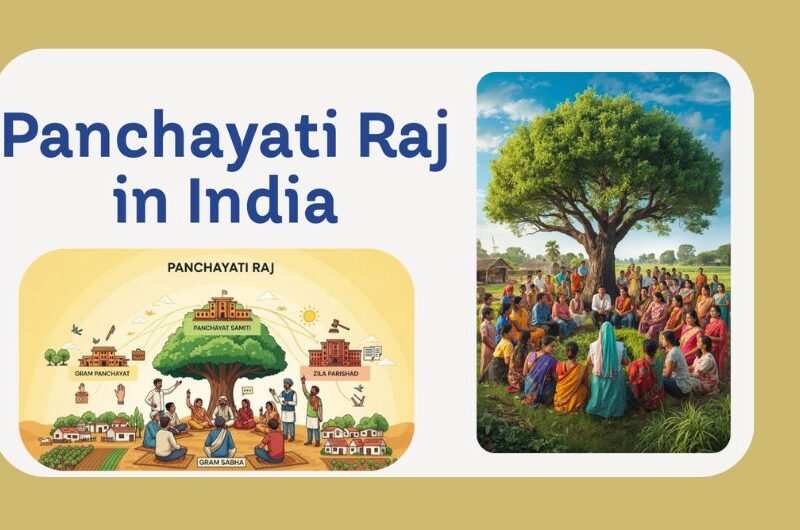
Panchayati Raj in India
1. National Panchayati Raj Diwas is observed every year on 24 April and marks the implementation of the 73rd Constitutional Amendment Act, 1992, which came into force in 1993.
2. The 73rd Constitutional Amendment granted constitutional status to Panchayati Raj Institutions, and provisions relating to Panchayats were placed in Part IX of the Constitution of India.
3. India has more than 2.5 lakh Panchayats and about 24.04 lakh elected representatives, of whom nearly 49.75 percent are women.
4. The Panchayati Raj system in India follows a three-tier structure consisting of Gram Panchayat at village level, Block Panchayat at intermediate level, and District Panchayat at district level.
5. The Gram Sabha is the general body of all registered voters in a village, is the only permanent unit in the Panchayati Raj system, and is not one of its three tiers.
6. The Balwant Rai Mehta Committee in 1957 recommended a three-tier Panchayati Raj structure, and Rajasthan became the first state to implement it in 1959.
7. More than 95 percent of villages now have 3G or 4G connectivity, strengthening last-mile governance and digital service delivery in rural India.
8. Common Service Centres are operated by more than 6.5 lakh Village Level Entrepreneurs, while around 2.18 lakh Gram Panchayats are service-ready and nearly 2.14 lakh are already connected.
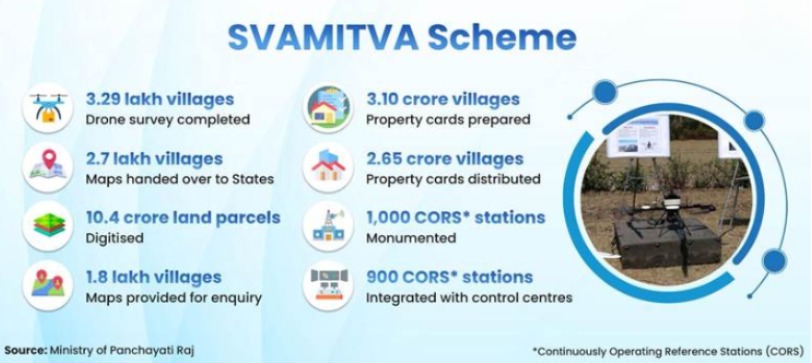
9. Under SVAMITVA, as on 11 March 2026, drone survey was completed in 3.29 lakh villages out of the targeted 3.44 lakh villages.
10. Under SVAMITVA, 3.10 crore property cards were prepared for 1.87 lakh villages, and 2.65 crore property cards were distributed.
11. SabhaSaar is an AI-based tool for automatic preparation of Gram Sabha meeting minutes, supports 23 regional languages through Bhashini, and was used by over 1 lakh Gram Panchayats by January 2026.
12. In 2025–26, over 2.55 lakh Gram Panchayats uploaded development plans on eGramSwaraj, more than 2.59 lakh onboarded PFMS integration, and ₹53,342 crore was transferred through the interface.
13. Gram Urja Swaraj covers 2,080 Gram Panchayats, of which 2,020 use solar energy, 60 use hydel power, 69 use wind energy, and 106 use biogas systems.
14. Under RGSA in 2025–26, over 45 lakh participants received training, 33,142 exposure visits were conducted, 632 Panchayat Learning Centres were set up, and 1,087 Gram Panchayat Bhawans were constructed.
15. The PESA Act, 1996 applies to Fifth Schedule areas in 10 states, covers 77,564 villages, 22,040 Panchayats, and 664 Blocks, and Odisha is the only PESA state that has not notified State PESA Rules.
Must Know Terms :
1.GramSabha
Gram Sabha is the general body of all registered voters in a village and forms the foundation of democracy under Panchayati Raj. It is the only permanent unit in the system and is not one of the three tiers. Its powers are decided by state law. It approves plans, reviews expenditure, raises local issues, and strengthens accountability through direct participation.
2. SVAMITVA
SVAMITVA is a central sector scheme launched on 24 April 2021 to map rural inhabited areas using drones and GIS technology. It aims to provide legal ownership records through property cards, reduce land disputes, and support planning. By 11 March 2026, drone survey was completed in 3.29 lakh villages out of 3.44 lakh targeted, with 3.10 crore property cards prepared.
3. eGramSwaraj
eGramSwaraj is a digital platform for Panchayats that supports planning, progress reporting, financial management, and asset tracking. It is linked with PFMS, enabling online transfer and real-time payments. In 2025–26, over 2.55 lakh Gram Panchayats uploaded development plans, more than 2.59 lakh onboarded PFMS integration, and ₹53,342 crore was transferred through the eGramSwaraj-PFMS interface across Panchayati Raj Institutions nationwide effectively.
4. RGSA
RGSA, or Rashtriya Gram Swaraj Abhiyan, is a centrally sponsored scheme for strengthening Panchayati Raj Institutions through capacity building, institutional development, and infrastructure support. In 2025–26, over 45 lakh participants received training, 33,142 exposure visits were conducted, 632 Panchayat Learning Centres were set up, and 1,087 Gram Panchayat Bhawans were constructed to improve governance and grassroots administrative capacity nationwide effectively.
5. PESA
PESA, or the Provisions of the Panchayats (Extension to the Scheduled Areas) Act, 1996, extends Panchayat provisions to Fifth Schedule tribal areas. It applies in 10 states and covers 77,564 villages, 22,040 Panchayats, and 664 Blocks. It supports Gram Sabha-led governance in tribal regions. Nine states have notified State PESA Rules, while Odisha remains the only exception among PESA states.
6. SabhaSaar
SabhaSaar is an Artificial Intelligence-based tool that automatically prepares minutes of Gram Sabha meetings from audio and video recordings. It uses Artificial Intelligence and Natural Language Processing to create structured documentation, reducing manual effort and improving accountability. The tool supports 23 regional languages through Bhashini integration. By January 2026, it had been used by more than 1 lakh Gram Panchayats.
MCQ :
1. National Panchayati Raj Diwas is observed every year on:
A) 26 January
B) 24 April
C) 15 August
D) 2 October
2. The 73rd Constitutional Amendment Act, which granted constitutional status to Panchayati Raj Institutions, came into force in:
A) 1993
B) 1992
C) 1994
D) 1991
3. Provisions relating to Panchayats in the Constitution of India are contained in:
A) Part III
B) Part IV
C) Part IX
D) Part XI
4. India has about how many elected representatives in Panchayati Raj Institutions?
A) 20.04 lakh
B) 24.04 lakh
C) 22.40 lakh
D) 25.40 lakh
5. Women constitute nearly what percentage of elected representatives in Panchayati Raj Institutions?
A) 39.75 percent
B) 44.75 percent
C) 49.75 percent
D) 52.75 percent
6. Which of the following correctly represents the three-tier structure of Panchayati Raj in India?
A) Gram Panchayat, Block Panchayat, District Panchayat
B) Gram Sabha, Block Panchayat, District Panchayat
C) Gram Panchayat, Zila Sabha, District Council
D) Gram Sabha, Mandal Panchayat, District Panchayat
7. The Balwant Rai Mehta Committee, which recommended the three-tier Panchayati Raj structure, was appointed in:
A) 1956
B) 1957
C) 1958
D) 1959
8. Which state became the first to implement the Panchayati Raj system in 1959?
A) Uttar Pradesh
B) Madhya Pradesh
C) Rajasthan
D) Bihar
9. The Gram Sabha is:
A) the highest tier of Panchayati Raj
B) the intermediate tier between village and district
C) the general body of all registered voters in a village
D) a temporary body created only during elections
10. Under SVAMITVA, as on 11 March 2026, drone survey had been completed in:
A) 3.10 lakh villages
B) 3.44 lakh villages
C) 2.65 lakh villages
D) 3.29 lakh villages
11. Under SVAMITVA, how many property cards had been prepared for villages?
A) 2.65 crore
B) 3.10 crore
C) 1.87 crore
D) 3.44 crore
12. SabhaSaar supports how many regional languages through Bhashini integration?
A) 18
B) 20
C) 23
D) 25
13. In 2025–26, how much money was transferred through the eGramSwaraj-PFMS interface?
A) ₹43,342 crore
B) ₹52,342 crore
C) ₹53,342 crore
D) ₹63,342 crore
14. Under RGSA in 2025–26, how many Panchayat Learning Centres were set up?
A) 532
B) 632
C) 732
D) 832
15. The PESA Act, 1996 applies to Fifth Schedule areas in how many states?
A) 8
B) 9
C) 10
D) 11



0 comment