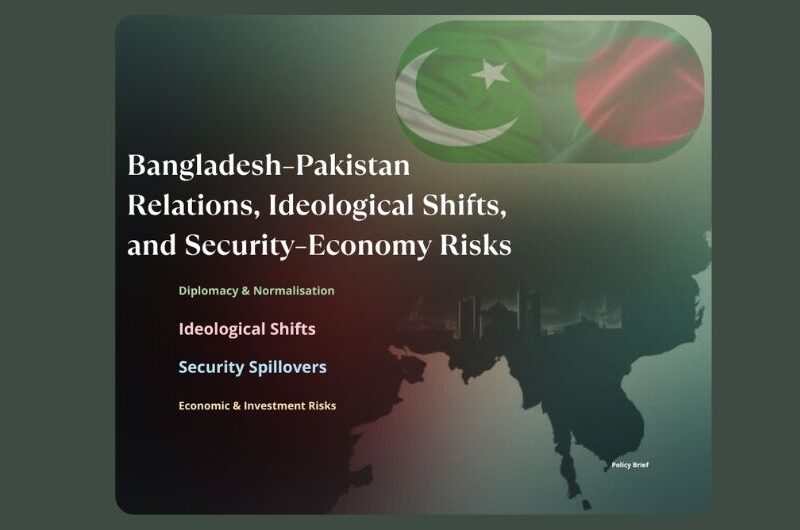
Bangladesh–Pakistan Relations, Ideological Shifts, and Security–Economy Risks
1. In 1974, Bangladesh and Pakistan established diplomatic relations under Sheikh Mujibur Rahman, despite discomfort among liberation supporters and war survivors, prioritising state interests, recognition, and stability.
2. From 1974 through 2025, relations persisted despite political upheavals; the Awami League governed roughly two decades, yet ties were never severed, indicating institutional continuity in Dhaka.
3. After Mujib’s assassination, Pakistan gained strategic benefit as orientations shifted; pro-Pakistan segments inside Bangladesh became more confident, and engagement rose when political Islam and anti-India narratives strengthened.
4. Official diplomacy maintained embassies, visas, and formal channels, but broad social trust remained limited, as 1971 memories stayed politically sensitive and symbolically charged across generations and institutions.
5. Pakistan avoided sustained outreach to Bangladesh’s progressive mainstream; cultural soft power like music, literature, and theatre was rarely leveraged, leaving engagement dominated by politics and symbolism.
6. Cricket became a high-visibility influence channel, especially during India–Pakistan fixtures, amplifying emotional mobilisation and sometimes sharpening anti-India sentiment within media discourse beyond conventional diplomatic messaging.
7. Legal travel to Pakistan can trigger future visa scrutiny elsewhere, discouraging students and professionals; reduced mainstream travel allows politically motivated networks to dominate cross-border contacts and narratives.
8. Concerns persist about clandestine financing via informal transfers, intermediaries, and smuggling corridors; early destabilisation tactics reportedly used ultra-left violence when overt religious militancy lacked domestic space.
9. From the 1980s onward, fundamentalist organisations increased visibility and external linkages; after 2024 upheavals, closer engagement coincided with stronger Islamist political influence in interim arrangements.
10. Bangladesh’s traditional Muslim practice blended Sufi devotion and riverine culture; Jamaat ideology draws on Maududi’s political Islam, prioritising state-centric order over plural social traditions.
11. Empowerment of hardline actors can pressure mainstream Muslims, minorities, and cultural practitioners; reports of attacks on temples and shrines signal contestation over heritage, freedom, and communal security.
12. Multiple militant organisations are reported operating in Bangladesh; leadership nodes in Pakistan enable training linkages and ideological diffusion across South Asian militant ecosystems over time.
13. Instability interacts negatively with investment confidence: growth slowed from about six percent to under four; FDI retreats, buyers reduce orders, and firms pivot toward trading over manufacturing.
14. Security spending can crowd out welfare, health, and education; border insecurity can trigger arms-spiral dynamics, while Teknaf disruptions and Rohingya camp violence heighten recruitment vulnerability.
15. Myanmar frontiers, coastal smuggling, Sundarbans policing challenges, and Hill Tracts fragility can compound risk; durable stability needs balanced diplomacy, pluralism, border management, and economic confidence.
Must Know Terms :
1.Normalisation and Institutional Continuity
Normalisation and Institutional Continuity: “Normalisation” is the shift from ad-hoc, personality-driven rule to routine, rules-based governance where institutions keep functioning across leadership changes. A widely used cross-country proxy is the World Bank’s Worldwide Governance Indicators (WGI), published annually since 1996 and covering 200+ economies through 2024. WGI aggregates 35 data sources into six comparable dimensions (Voice & Accountability, Political Stability, Government Effectiveness, Regulatory Quality, Rule of Law, Control of Corruption), allowing continuity to be tracked year-on-year.
2.Soft Power and Selective Appeal
Soft Power and Selective Appeal: Soft power is the ability to secure preferred outcomes through attraction rather than coercion or payment. Quantification is now routine: Brand Finance’s Global Soft Power Index 2025 measures all 193 UN member states via public perception scoring. In 2025, the United States ranked #1 with an overall score of 79.5/100; China ranked #2 with 72.8/100; the UK ranked #3. “Selective appeal” means a state’s attractiveness is not uniform—scores can mask sharp differences by audience, region, or issue-pillar.
3.Informal Finance and Covert Networks
Informal Finance and Covert Networks: Informal value transfer systems (IVTS) like hawala move value without conventional bank settlement, often using brokers and netting across locations. The IMF and World Bank have documented hawala as a major informal funds-transfer channel, particularly in the Middle East and South Asia, and a policy focus post-9/11 due to misuse risks. FATF typologies classify “hawala and similar service providers” and document how weak licensing/registration, thin records, and limited suspicious-transaction reporting make them vulnerable to money laundering and terrorist financing when unregulated or complicit.
4.Maududism and Political Islam
Maududism and Political Islam: Maududism refers to the political thought associated with Mawlana Abul A‘la Mawdudi (1903–1979), who founded Jamaʿat-i Islami in 1941. Britannica notes his core political project was reforming society toward an Islamic political system and influencing Pakistan’s constitutional direction after 1947. His writings popularised modern Islamist vocabulary around God’s sovereignty as the source of law, an Islamic state as an organising principle, and party-based cadre mobilisation for societal Islamisation through education, organisation, and politics.
5.Investment Confidence and Manufacturing Horizon
Investment Confidence and Manufacturing Horizon: A hard metric for forward-looking investor intent is the Kearney FDI Confidence Index (FDICI), which ranks markets likely to attract the most FDI over the next three years. The 2025 FDICI is based on a proprietary survey of 536 senior executives (surveyed January 2025), all from firms with US$500 million+ annual revenues, headquartered in 30 countries across sectors. “Manufacturing horizon” in practice reflects this planning window: capex decisions lock in supply-chain geography, permitting, and workforce ramp-up typically over multi-year (often 2–5 year) cycles.
6.Border-Security Spillovers
Border-Security Spillovers: Cross-border security shocks routinely spill into refugee flows, smuggling corridors, and fiscal/administrative stress in neighbouring states. UNHCR reports that by end-2024, 123.2 million people were forcibly displaced worldwide; reported refugees total 42.7 million. These displacement magnitudes become border-security variables: screening capacity, camp logistics, policing of trafficking networks, and management of grey-zone flows (cash, fuel, arms, narcotics) along frontier districts, especially when conflicts persist without political settlement.
MCQ
1. Bangladesh and Pakistan established diplomatic relations in:
(a) 1965 (b) 1971 (c) 1974 (d) 1985
2. The text states relations persisted from 1974 through:
(a) 2010 (b) 2015 (c) 2020 (d) 2025
3. Cricket is described as influencing sentiment mainly during:
(a) Bangladesh–Sri Lanka fixtures (b) India–Pakistan fixtures (c) Australia–England fixtures (d) IPL auctions
4. Legal travel to Pakistan may discourage mainstream travel because it can:
(a) Lower fuel prices (b) Trigger future visa scrutiny elsewhere (c) Remove all screening (d) End professional mobility
5. The text links increased Pakistan engagement to domestic forces emphasising:
(a) Political Islam and anti-India narratives (b) Pacific trade corridors (c) Arctic governance (d) Space policy reforms
6. Early destabilisation in the 1970s is described as framed through:
(a) Ultra-left violence (b) Maritime piracy (c) Currency speculation (d) Cyber sabotage
7. From the 1980s onward, the text notes increased visibility of:
(a) Fundamentalist organisations (b) Arctic research teams (c) Space startups (d) Sports academies
8. Jamaat ideology is described as drawing on:
(a) Gandhian economics (b) Maududi’s political Islam (c) Confucian ethics (d) Keynesian macroeconomics
9. The text describes Bangladesh’s traditional Muslim practice as historically blending:
(a) Sufi devotion and riverine culture (b) Desert nomadism and monasticism (c) Arctic hunting and animism (d) Industrial unionism and secularism
10. The text reports GDP growth slowed from about six percent to:
(a) under five (b) under four (c) under three (d) under two
11. Rising instability is described as causing export buyers to:
(a) Increase orders (b) Reduce orders (c) Ignore supply risk (d) End compliance audits
12. Teknaf insecurity is described as affecting livelihoods by:
(a) Expanding vineyards (b) Abducting fishermen and disrupting marine activity (c) Building rail corridors (d) Increasing glacier melt
13. The Sundarbans corridor is described as difficult to police, creating vulnerability for:
(a) Trafficking and contraband movement (b) Volcano eruptions (c) Desertification only (d) Airport congestion
14. Rohingya camps are described as recruitment-vulnerable when:
(a) Aid declines and unemployment rises (b) Rainfall increases slightly (c) Tourism booms (d) Tax revenues surge
15. The text argues sustainable stability requires balancing diplomacy with:
(a) Internal pluralism, border management, and economic confidence (b) Only weapons spending (c) Only cultural bans (d) Only trade boycotts



0 comment