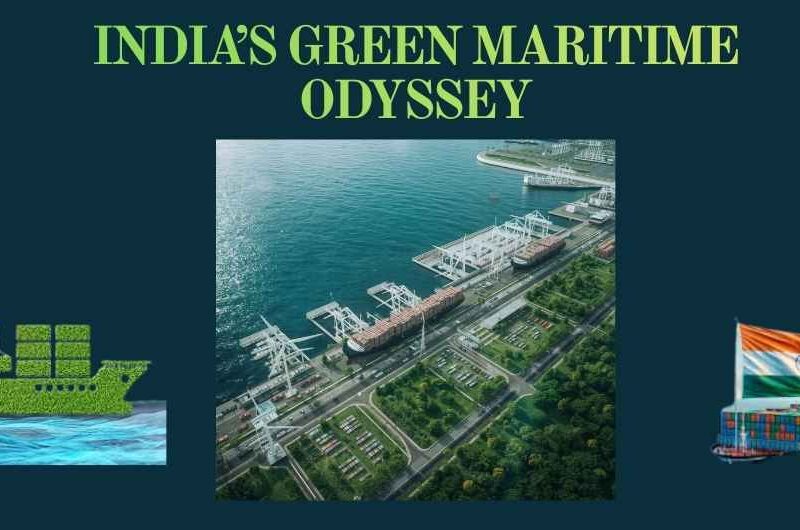
India’s Green Maritime Odyssey
1. Maritime India Vision 2030 identifies more than 150 initiatives with projected investment of ₹3–3.5 lakh crore across ports, shipping, shipbuilding, and inland waterways.
2. Maritime Amrit Kaal Vision 2047 sets a longer-term roadmap with planned investment of about ₹80 lakh crore to strengthen India’s maritime and blue economy capabilities.
3. In FY 2024–25, India’s major ports handled around 855 million tonnes of cargo, reflecting continued expansion in maritime trade and port activity.
4. Cargo handling capacity at major ports reached about 1,630 million tonnes per annum by March 2024, roughly doubling from 800.5 million tonnes per annum in 2014.
5. Average turnaround time at major ports has been brought down to about 48 hours, indicating major gains in operational efficiency and global competitiveness.
6. Harit Sagar Green Port Guidelines were issued in May 2023 to guide ports on carbon reduction, clean energy use, ecosystem protection, and sustainable operations.
7. The National Green Hydrogen Mission targets annual production of 5 million metric tonnes of green hydrogen by 2030 with expected investment of about ₹8 lakh crore.
8. The mission is also expected to create around 6 lakh jobs and reduce fossil fuel import dependence through domestic clean-energy production and industrial use.
9. Kandla, Paradip, and Tuticorin have been identified as key green hydrogen port hubs within India’s maritime energy transition strategy.
10. Under Sagarmala, 840 projects worth ₹5.8 lakh crore are planned for implementation by 2035 to improve logistics efficiency, port connectivity, and trade competitiveness.
11. Of these Sagarmala projects, 272 projects worth ₹1.41 lakh crore had been completed and 217 worth ₹1.65 lakh crore were under implementation by October 2025.
12. Major ports are targeting transition of 50 percent of vehicles to CNG, LNG, or electric systems by 2030 to reduce emissions from port-side operations.
13. Shore-to-ship power and electrification of cranes and cargo-handling equipment are being promoted to cut emissions from berthed vessels and diesel-driven machinery.
14. Environmental norms require around 33 percent green cover in port areas, supporting carbon absorption, noise reduction, erosion control, and biodiversity protection.
15. Nine Indian ports have entered the World Bank Container Port Performance Index, showing improvement in efficiency, competitiveness, and international benchmarking.
Must Know Terms :
1. Harit Sagar
Harit Sagar is the Green Port Guidelines framework issued in May 2023 for Indian ports. It focuses on low-carbon operations, clean energy adoption, greener fuels, ecosystem protection, and sustainable maintenance practices. The framework aligns port development with the “Working with Nature” approach and encourages storage, handling, and bunkering readiness for green hydrogen, green ammonia, and related fuels.
2. Sagarmala
Sagarmala is India’s flagship maritime infrastructure and logistics programme focused on port modernization, connectivity, coastal community development, and port-led industrialisation. By October 2025, 840 projects worth ₹5.8 lakh crore were planned up to 2035. Out of these, 272 projects worth ₹1.41 lakh crore had been completed, while 217 projects worth ₹1.65 lakh crore were under implementation.
3. Green Tug Transition Programme
The Green Tug Transition Programme was launched to shift harbour tugs from conventional fossil fuels to cleaner alternatives in a phased manner. It is part of India’s maritime decarbonisation strategy and is intended to reduce emissions from port craft operations. The programme supports cleaner port ecosystems and complements broader plans for electrification, cleaner fuels, and carbon reduction in major ports.
4. Green Hydrogen
Green hydrogen is hydrogen produced using renewable energy rather than fossil fuels. Under the National Green Hydrogen Mission, India targets production of 5 million metric tonnes annually by 2030, with expected investment of about ₹8 lakh crore and creation of around 6 lakh jobs. Kandla, Paradip, and Tuticorin have been identified as major port hubs in this transition framework.
5. Shore-to-Ship Power
Shore-to-ship power allows ships berthed at ports to draw electricity from the shore instead of running onboard fuel-based engines. This reduces local air pollution, fuel use, and greenhouse gas emissions during berthing. In India’s green port transition, shore power is being promoted alongside electrification of cargo-handling systems to make port operations cleaner and more energy-efficient over time.
6. Turnaround Time
Turnaround time is the total time taken by a ship inside a port, from arrival to departure, including unloading, loading, and operational handling. It is a key efficiency indicator in maritime logistics. India’s major ports reduced average turnaround time to about 48 hours, showing significant improvement in port productivity, faster cargo movement, and stronger alignment with international operating benchmarks.
MCQ:
- India’s Green Maritime strategy primarily aims to balance economic growth with which of the following?
(a) Expansion of naval power
(b) Environmental protection and sustainability
(c) Inland industrialisation
(d) Defence logistics only
- Which long-term roadmap outlines nearly ₹80 lakh crore investment for India’s maritime sector?
(a) Sagarmala Programme
(b) Maritime India Vision 2030
(c) Maritime Amrit Kaal Vision 2047
(d) Coastal Regulation Framework
- Maritime India Vision 2030 primarily functions as a catalyst for:
(a) Coastal tourism only
(b) Ship recycling activities
(c) Trade, investment, and employment
(d) Fisheries development
- Which clean fuel is identified as a future cornerstone for zero-emission maritime transport?
(a) Diesel
(b) Furnace oil
(c) Green hydrogen
(d) Naphtha
- Under the green energy strategy, which innovative solar installation method is proposed for ports?
(a) Desert solar farms
(b) Floating solar plants on calm waters
(c) Nuclear-powered solar units
(d) Offshore thermal plants
- Which three ports have been identified as green hydrogen hubs?
(a) Mumbai, Kochi, Chennai
(b) Kandla, Paradip, Tuticorin
(c) Visakhapatnam, Ennore, Haldia
(d) Mormugao, New Mangalore, Kamarajar
- The target year for producing 5 million tonnes of green hydrogen annually is:
(a) 2027
(b) 2028
(c) 2030
(d) 2047
- The Harit Sagar Green Port Guidelines primarily focus on:
(a) Increasing port tariffs
(b) Achieving carbon neutrality with ecosystem protection
(c) Expanding private port ownership
(d) Promoting inland shipping exclusively
- The Green Tug Transition Programme aims to replace:
(a) Cargo ships
(b) Passenger ferries
(c) Harbour tugs using conventional fuels
(d) Fishing vessels
- The first Coastal Green Shipping Corridor is planned between:
(a) Mumbai–Kochi
(b) Chennai–Kolkata
(c) Kandla–Tuticorin
(d) Visakhapatnam–Paradip
- Under Sagarmala Programme, the total number of projects planned by 2035 is:
(a) 500
(b) 620
(c) 740
(d) 840
- Indian ports aim to switch at least what percentage of vehicles to cleaner fuels by 2030?
(a) 30%
(b) 40%
(c) 50%
(d) 75%
- Shore-to-ship power is mainly introduced to reduce:
(a) Noise pollution in cities
(b) Emissions from ships at berth
(c) Inland water salinity
(d) Cargo handling delays
- Environmental regulations mandate approximately what proportion of green cover around ports?
(a) 20%
(b) 25%
(c) 30%
(d) 33%
- The Indian Ports Bill, 2025 primarily seeks to:
(a) Privatise all major ports
(b) Replace outdated legal frameworks with modern global standards
(c) Restrict foreign investment
(d) Reduce coastal shipping activity


0 comment