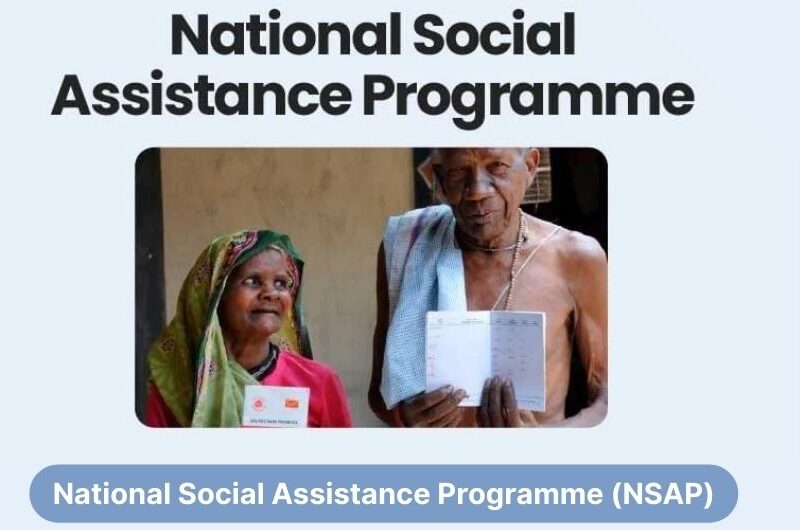
National Social Assistance Programme
1. The National Social Assistance Programme (NSAP) was launched on 15 August 1995 as a nationwide social security initiative for vulnerable persons living below the poverty line.
2. NSAP is implemented by the Ministry of Rural Development and covers both rural and urban areas under a centrally supported social assistance framework.
3. The programme combines income support and food security measures for persons lacking stable livelihoods, regular earnings, or adequate social protection mechanisms.
4. NSAP currently supports more than 3.09 crore beneficiaries across the country through multiple pension, family assistance, and food-security components.
5. The programme operates through five components: Indira Gandhi National Old Age Pension Scheme, Indira Gandhi National Widow Pension Scheme, Indira Gandhi National Disability Pension Scheme, National Family Benefit Scheme, and Annapurna Scheme.
6. Each State and Union Territory is given a scheme-wise ceiling on beneficiaries to support balanced implementation and maintain fiscal discipline within the programme structure.
7. Under the old age pension scheme, persons aged 60–79 years receive ₹200 per month as central assistance, while those aged 80 years and above receive ₹500.
8. Under the widow pension scheme, widows aged 40–79 years receive ₹300 per month, while beneficiaries aged 80 years and above receive ₹500 per month.
9. Under the disability pension scheme, persons with severe or multiple disabilities aged 18–79 years receive ₹300 per month, increasing to ₹500 after 80 years.
10. States and Union Territories may add their own contribution to central assistance, resulting in higher effective pension support in many regions.
11. The National Family Benefit Scheme provides a one-time assistance of ₹20,000 to below-poverty-line families after the death of the primary breadwinner aged 18–59 years.
12. The Annapurna Scheme provides 10 kilograms of food grains per month free of cost to eligible elderly persons not receiving old age pension benefits.
13. Beneficiary identification is carried out at the grassroots level through Gram Panchayats and Municipalities for local verification and inclusion in the programme.
14. Benefits are mainly disbursed through Direct Benefit Transfer into bank or post office accounts, with limited doorstep cash delivery allowed in exceptional cases.
15. For FY 2025–26, NSAP received a budget allocation of ₹9,652 crore, and the programme is linked with Aadhaar, bank accounts, and the Public Financial Management System.
Must Know Terms :
1. NSAP
National Social Assistance Programme (NSAP) is a centrally supported social security programme launched on 15 August 1995 for vulnerable persons living below the poverty line. It is implemented by the Ministry of Rural Development and covers rural as well as urban areas. It currently supports more than 3.09 crore beneficiaries through pension, family assistance, and food-security components under a monitored welfare framework.
2. Annapurna
Annapurna Scheme is a food-security component under the National Social Assistance Programme. It provides 10 kilograms of food grains per month free of cost to elderly persons who are eligible for old age pension but are not receiving pension benefits. The scheme targets vulnerable senior citizens and functions as a supplementary support mechanism where regular pension assistance is not reaching the eligible person.
3. NFBS
National Family Benefit Scheme (NFBS) provides one-time financial assistance of ₹20,000 to below-poverty-line families after the death of the primary breadwinner aged between 18 and 59 years. It is one of the five major components of NSAP. The scheme is designed to reduce immediate economic distress in affected households and provide minimum relief during a sudden income shock.
4. DBT
Direct Benefit Transfer (DBT) is the main disbursement mechanism used under NSAP for transferring benefits directly into beneficiaries’ bank or post office accounts. It reduces leakages, improves transparency, and ensures faster delivery of welfare payments. Under the programme, doorstep cash delivery is allowed only in limited exceptional circumstances, while DBT remains the standard mode of benefit transfer across states.
5. PFMS
Public Financial Management System (PFMS) is the digital platform used to strengthen transparency and payment tracking under NSAP. Beneficiary details are linked with Aadhaar, bank accounts, and PFMS to improve monitoring and reduce leakages in welfare delivery. Its integration helps verify fund flows, streamline disbursement, and support more accountable implementation of pension and assistance schemes under the programme.
6. Digital Life Certification
Digital Life Certification is a mobile-based verification system introduced under NSAP to simplify annual beneficiary authentication. It reduces the need for repeated physical visits and improves access for elderly, widowed, and disabled beneficiaries who may face mobility or administrative difficulties. This digital verification mechanism supports continuity of benefits, easier compliance, and more efficient management of beneficiary records within the programme.
MCQ :
1. The National Social Assistance Programme was introduced in which year?
A) 1989
B) 1991
C) 1995
D) 2000
2. The National Social Assistance Programme is implemented by which Union Ministry?
A) Ministry of Social Justice and Empowerment
B) Ministry of Home Affairs
C) Ministry of Rural Development
D) Ministry of Finance
3. The primary objective of the National Social Assistance Programme is to provide:
A) Employment opportunities
B) Social security to vulnerable citizens
C) Skill development support
D) Housing assistance
4. NSAP is applicable to beneficiaries belonging to which category?
A) Below Poverty Line households
B) All rural households
C) Urban informal workers
D) Scheduled Caste households only
5. Which of the following is NOT a component of NSAP?
A) Indira Gandhi National Old Age Pension Scheme
B) Indira Gandhi National Widow Pension Scheme
C) Pradhan Mantri Jeevan Jyoti Bima Yojana
D) National Family Benefit Scheme
6. Under IGNOAPS, individuals aged 80 years and above receive central assistance of:
A) ₹300 per month
B) ₹400 per month
C) ₹500 per month
D) ₹600 per month
7. Under IGNWPS, widows between 40–79 years receive central assistance of:
A) ₹200 per month
B) ₹250 per month
C) ₹300 per month
D) ₹500 per month
8. Indira Gandhi National Disability Pension Scheme provides assistance to persons with:
A) Any physical disability
B) Temporary disability
C) Severe or multiple disabilities
D) Occupational injuries only
9. The age group eligible under the National Family Benefit Scheme is:
A) 18–59 years
B) 21–60 years
C) 40–79 years
D) 60 years and above
10. The lump-sum assistance provided under NFBS is:
A) ₹10,000
B) ₹15,000
C) ₹20,000
D) ₹25,000
11. Under the Annapurna Scheme, eligible beneficiaries receive food grains per month:
A) 5 kg
B) 8 kg
C) 10 kg
D) 12 kg
12. Identification of beneficiaries under NSAP is primarily done by:
A) District Collector
B) State Secretariat
C) Gram Panchayats and Municipalities
D) Central Government agencies
13. The preferred mode of benefit disbursement under NSAP is:
A) Cash payments
B) Cheque payments
C) Direct Benefit Transfer
D) Smart card system
14. For the year 2025–26, the total budget allocation for NSAP is approximately:
A) ₹6,500 crore
B) ₹8,200 crore
C) ₹9,652 crore
D) ₹11,000 crore
15. Digitisation of NSAP beneficiaries primarily aims to:
A) Increase pension amounts
B) Reduce beneficiary numbers
C) Improve transparency and prevent duplication
D) Replace state governments’ role



0 comment