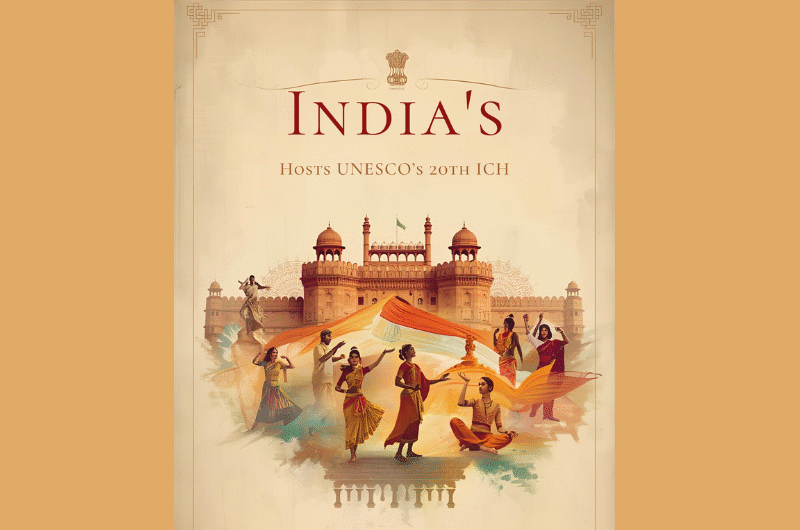
India Hosts UNESCO’s 20th ICH Session
1. India hosted the 20th session of the UNESCO Intergovernmental Committee for Safeguarding of the Intangible Cultural Heritage at Red Fort, New Delhi, from 8 to 13 December 2025.
2. This was the first time India hosted the Intergovernmental Committee session for intangible cultural heritage, marking a major milestone in the country’s international cultural profile.
3. The event coincided with the twentieth anniversary of India’s ratification of the 2003 Convention for the Safeguarding of the Intangible Cultural Heritage.
4. The 2003 Convention was adopted by UNESCO during its 32nd General Conference in Paris to address risks faced by living cultural traditions under globalisation and social change.
5. The Intergovernmental Committee is responsible for implementing the Convention, reviewing safeguarding practices, examining inscription requests, and overseeing use of the Intangible Cultural Heritage Fund.
6. India has already served three terms on the UNESCO Intergovernmental Committee for the Safeguarding of the Intangible Cultural Heritage.
7. The Red Fort, chosen as venue for the session, is a UNESCO World Heritage Site and symbolically linked India’s tangible heritage with its living cultural traditions.
8. India has 15 elements inscribed on UNESCO’s Representative List of the Intangible Cultural Heritage of Humanity, reflecting wide regional and thematic diversity.
9. These Indian inscriptions include Kutiyattam, Vedic chanting, Ramlila, Ramman, Chhau dance, Kalbelia, Buddhist chanting of Ladakh, Sankirtana, Thatheras metalcraft, Yoga, Kumbh Mela, Durga Puja, Garba, and shared inscription of Novruz.
10. India nominated Chhath Mahaparva and Diwali for the current cycle, showing continued effort to secure international recognition for living traditions.
11. The Ministry of Culture runs the Scheme for Safeguarding the Intangible Heritage and Diverse Cultural Traditions of India to support documentation, inventories, training, workshops, and nomination dossiers.
12. The scheme extends support to practitioners, researchers, universities, cultural organisations, and state institutions involved in preserving and transmitting living traditions.
13. Sangeet Natak Akademi plays an important role in awareness-building, training workshops, and promotion of performing arts traditions linked to intangible cultural heritage.
14. Intangible cultural heritage supports social cohesion, intergenerational knowledge transfer, crafts-based livelihoods, performing communities, tourism potential, and cultural identity across regions.
15. By hosting the 20th session, India positioned itself as an active global voice in heritage safeguarding, international cultural cooperation, and protection of community-based living traditions.
Must Know Terms :
1. 2003 Convention
The 2003 Convention for the Safeguarding of the Intangible Cultural Heritage is UNESCO’s main international legal framework for protecting living traditions. It was adopted during UNESCO’s 32nd General Conference in Paris. The Convention focuses on practices, rituals, performing arts, festive events, craftsmanship, oral traditions, and knowledge systems, while recognising communities and practitioners as the central custodians of intangible heritage.
2. Intergovernmental Committee
The Intergovernmental Committee is the main body responsible for implementing the 2003 Convention. It promotes the Convention’s objectives, reviews best practices, recommends safeguarding measures, examines nomination requests for heritage lists, evaluates requests for international assistance, studies periodic reports from States Parties, and oversees the Intangible Cultural Heritage Fund. India hosted its 20th session in New Delhi in December 2025.
3. Representative List
The Representative List of the Intangible Cultural Heritage of Humanity is UNESCO’s global list meant to showcase and increase visibility of living cultural traditions. India currently has 15 elements on this list. These include traditions from theatre, ritual, oral culture, dance, crafts, chanting, festivals, and yoga, demonstrating the wide cultural diversity and continuity of community-based heritage across the country.
4. Intangible Cultural Heritage Fund
The Intangible Cultural Heritage Fund is the financial mechanism associated with the 2003 Convention. It supports safeguarding activities, international assistance, capacity-building, and implementation needs related to living heritage. The Intergovernmental Committee oversees its use and prepares plans for its utilisation. The Fund is important because it links international cultural policy with practical preservation support for communities and States Parties.
5. Sangeet Natak Akademi
Sangeet Natak Akademi is India’s national academy for music, dance, and drama and plays a major role in safeguarding intangible cultural heritage. It contributes through awareness programmes, training workshops, documentation, and promotion of performing arts traditions. In India’s heritage ecosystem, it functions as an institutional bridge between practitioners, cultural transmission, and policy-backed preservation of living artistic and ritual traditions.
6. Nomination Dossier
A nomination dossier is the formal documentation submitted for inscription of an element on UNESCO’s intangible cultural heritage lists. It includes details about the tradition, community involvement, safeguarding measures, and cultural significance. India’s safeguarding scheme supports preparation of such dossiers. For the current cycle, India has prepared nominations for Chhath Mahaparva and Diwali, reflecting continued efforts toward global recognition.
MCQ:
1. The venue selected for hosting the 20th session of the UNESCO Intergovernmental Committee for Safeguarding of Intangible Cultural Heritage is:
A) Humayun’s Tomb, Delhi
B) Red Fort, New Delhi
C) City Palace, Jaipur
D) Golconda Fort, Hyderabad
2. The 2003 Convention for Safeguarding of the Intangible Cultural Heritage was adopted during UNESCO’s General Conference held in:
A) Geneva
B) Paris
C) Rome
D) Vienna
3. The 20th session of the ICH Committee coincides with:
A) India’s independence centenary
B) India’s first ICH inscription anniversary
C) Twentieth anniversary of India’s ratification of the 2003 Convention
D) Fiftieth anniversary of UNESCO’s creation
4. Under the 2003 Convention, safeguarding intangible heritage places primary importance on:
A) National governments alone
B) Private organisations
C) Communities and practitioners
D) Commercial sponsors
5. Which of the following is NOT a function of the Intergovernmental Committee?
A) Monitoring implementation of the Convention
B) Approving World Heritage Sites
C) Drafting operational directives
D) Evaluating nomination requests for ICH Lists
6. India has served on the UNESCO Intergovernmental Committee for Safeguarding ICH for:
A) One term
B) Two terms
C) Three terms
D) Four terms
7. The Scheme for Safeguarding the Intangible Heritage and Diverse Cultural Traditions of India is implemented by:
A) Ministry of External Affairs
B) Ministry of Culture
C) Ministry of Education
D) NITI Aayog
8. The Sangeet Natak Akademi plays a key role primarily in:
A) Archaeological excavation
B) Promoting capacity building and awareness for ICH
C) Trade facilitation measures
D) Managing national archives
9. Which of the following is among India’s nominations for UNESCO’s ICH List for the current cycle?
A) Holi and Onam
B) Chhath Mahaparva and Diwali
C) Bihu and Pongal
D) Rath Yatra and Guruparv
10. Which Indian element is included on UNESCO’s Representative List of Intangible Cultural Heritage?
A) Kathakali murals of Kerala
B) Garba of Gujarat
C) Terracotta temples of Bishnupur
D) Ajanta cave paintings
11. The 2003 Convention addresses threats arising from:
A) Climate treaties
B) Globalisation and rapid social change
C) International trade barriers
D) Radioactive pollution
12. The Intangible Cultural Heritage Fund is primarily used for:
A) Military support
B) Global economic reforms
C) Safeguarding measures and international assistance
D) Infrastructure development
13. The Red Fort was chosen as the session venue because it symbolises:
A) Technological progress
B) Convergence of tangible and intangible heritage
C) India’s maritime strength
D) Expansion of trade routes
14. The Ministry of Culture’s ICH scheme supports:
A) Patent registration for industries
B) Documentation, inventory creation and training for ICH practitioners
C) Agricultural mechanisation
D) Space technology missions
15. Elements such as Kutiyattam, Chhau dance, and Vedic chanting represent:
A) Modern industrial practices
B) Living cultural traditions inscribed under UNESCO’s ICH framework
C) Geological formations of India
D) Intangible assets in financial markets

0 comment