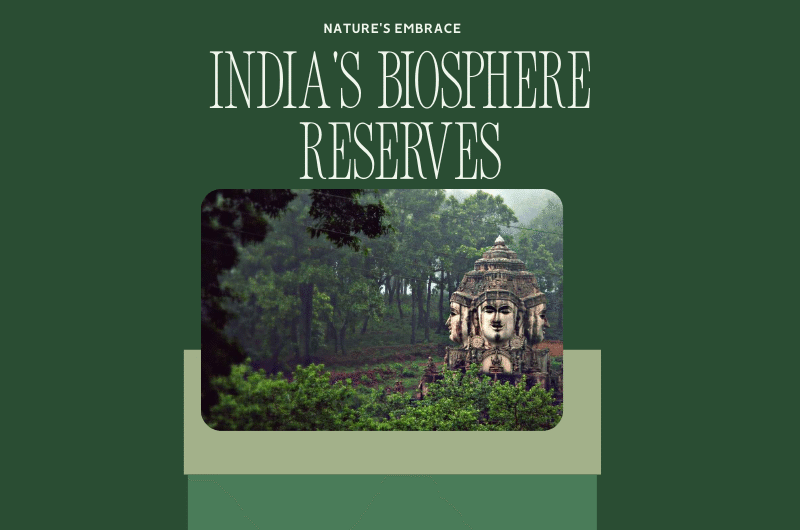
INDIA’S BIOSPHERE RESERVES
INTRODUCTION
On November 3, the International Day for Biosphere Reserves is observed to promote harmony between nature and communities. These reserves act as “living laboratories” for sustainable development, biodiversity protection, and local welfare. India celebrates this day with pride, having a strong network of 18 biosphere reserves covering 91,425 sq. km — 13 of which are recognized by UNESCO under the Man and Biosphere (MAB) Programme.
KEY FACTS
- Centrally Sponsored Scheme (MoEFCC) with 60:40 funding; 90:10 for North-Eastern and Himalayan states.
- India ranks 9th in global forest area and 3rd in annual forest gain (FAO 2025).
- Cold Desert Biosphere Reserve added to UNESCO list in 2025.
- Biodiversity conservation budget increased from ₹5 crore (2024-25) to ₹10 crore (2025-26).
- Emphasizes coexistence of biodiversity conservation and community livelihood.
WHAT ARE BIOSPHERE RESERVES
Biosphere Reserves are areas designated by governments to conserve biological diversity and promote sustainable use of natural resources. They are special regions where people and nature coexist responsibly. Each reserve includes terrestrial, coastal, or marine ecosystems and serves as a testing ground for reconciling conservation with development.
STRUCTURE OF A BIOSPHERE RESERVE
- Core Zone: Strictly protected area, free from human activity.
- Buffer Zone: Limited human use with eco-development projects.
- Transition Zone: Sustainable human settlements and livelihoods.
UNESCO MAN AND BIOSPHERE PROGRAMME
The MAB Programme is a global initiative under UNESCO that recognizes and connects Biosphere Reserves as part of the World Network of Biosphere Reserves (WNBR). It integrates natural and social sciences to improve human livelihoods and environmental sustainability. The MAB Council, comprising 34 Member States, governs this network.
IMPLEMENTATION IN INDIA
The Ministry of Environment, Forest and Climate Change (MoEFCC) manages the scheme under the CNRE programme. States receive financial and technical support to implement conservation projects through their Forest Departments. Focus areas include eco-development, community participation, and reducing dependence on forest resources.
IMPACT AND SIGNIFICANCE
Biosphere Reserves enhance forest cover, protect species, and support climate resilience. They provide sustainable livelihood options to local and tribal populations, linking environmental protection with socio-economic progress. India’s efforts align with global goals such as climate action and biodiversity preservation.
RELATED NATIONAL PROGRAMMES
- Project Tiger (1973): Protection and management of tiger habitats.
- Project Elephant (1992): Conservation and welfare of elephants.
- Integrated Development of Wildlife Habitats (IDWH): Financial and technical aid for wildlife conservation.
- National Biodiversity Action Plan (NBAP): Framework for sustainable use and regulation of biological resources.
- Eco-Sensitive Zones (ESZs): Buffer areas around national parks and sanctuaries.
- Green India Mission (GIM): Expands forest cover and enhances carbon sequestration.
GLOBAL CONTEXT
Over 260 million people live in biosphere reserves worldwide, protecting over 7 million sq. km—equal to Australia’s size. India’s 18 reserves represent its ecological diversity—mountains, forests, coasts, and islands—and showcase the country’s leadership in nature-human coexistence.
CONCLUSION
India’s Biosphere Reserve network demonstrates that conservation and development can move together. By expanding protected areas, empowering local communities, and engaging with UNESCO frameworks, India sets a global example in environmental stewardship and sustainable living.
MCQs
- Consider the following statements regarding Biosphere Reserves in India:
- Every Biosphere Reserve in India must be recognized by UNESCO.
- Biosphere Reserves include terrestrial, marine, and coastal ecosystems.
- They serve as models for balancing conservation and sustainable use.
Which of the statements given above is/are correct?
(a) 1 only
(b) 2 and 3 only
(c) 1 and 2 only
(d) 1, 2 and 3
- With reference to the UNESCO Man and Biosphere (MAB) Programme, consider the following:
- It was launched in the 1970s to integrate ecological and social sciences.
- Only countries from the Global South are eligible to participate.
- It operates through the World Network of Biosphere Reserves (WNBR).
Which of the above statements is/are correct?
(a) 1 and 3 only
(b) 2 only
(c) 1 only
(d) 1, 2 and 3
- The “core zone” of a Biosphere Reserve in India is primarily meant for:
(a) Community-based livelihood promotion
(b) Strict conservation with minimal human interference
(c) Ecotourism and sustainable forestry
(d) Research on agricultural productivity
- Which of the following is correctly matched?
(a) Nilgiri Biosphere Reserve – Himalayas
(b) Gulf of Mannar Biosphere Reserve – Marine ecosystem
(c) Nanda Devi Biosphere Reserve – Coastal region
(d) Great Nicobar Biosphere Reserve – Desert ecosystem
- In India, the Centrally Sponsored Scheme for Biosphere Reserves operates with which of the following cost-sharing ratios?
(a) 70:30 for all States
(b) 60:40 for all States; 90:10 for NE and Himalayan States
(c) 50:50 uniformly
(d) 75:25 for Union Territories and States
- Consider the following pairs:
- Project Tiger – 1973
- Project Elephant – 1992
- Green India Mission – 2005
Which of the pairs given above is/are correctly matched?
(a) 1 only
(b) 1 and 2 only
(c) 2 and 3 only
(d) 1, 2 and 3
- Which of the following organizations prepares the “Global Forest Resources Assessment”?
(a) United Nations Environment Programme
(b) Food and Agriculture Organization
(c) World Wildlife Fund
(d) World Bank
- Which one of the following statements is NOT correct regarding India’s Biosphere Reserves?
(a) They are notified by State Governments only.
(b) They function under the Ministry of Environment, Forest and Climate Change.
(c) They promote sustainable livelihoods for local communities.
(d) They form part of India’s commitment under UNESCO’s MAB Programme.
- Which of the following is the newest addition to UNESCO’s World Network of Biosphere Reserves from India?
(a) Nilgiri
(b) Cold Desert
(c) Nanda Devi
(d) Gulf of Mannar
- In the context of India’s environmental governance, the CNRE Programme refers to:
(a) Conservation of Natural Resources and Ecosystems
(b) Climate Neutral Renewable Energy
(c) Community Natural Resource Enhancement
(d) Conservation of National Renewable Energy
- Consider the following:
- Eco-Sensitive Zones
- Project Elephant
- Integrated Development of Wildlife Habitats
Which of the above are linked directly with India’s Biosphere Reserve framework?
(a) 1 and 3 only
(b) 2 and 3 only
(c) 1, 2 and 3
(d) 1 only
- The MAB International Coordinating Council (MAB-ICC):
(a) Is composed of 34 Member States under UNESCO
(b) Is headquartered in New Delhi
(c) Reports to the United Nations General Assembly
(d) Works under the UN Environment Programme
- Which one of the following is NOT a function of Biosphere Reserves?
(a) Testing sustainable development models
(b) Ensuring complete exclusion of human presence
(c) Monitoring biodiversity and ecosystem changes
(d) Promoting environmental education and research
- According to the PIB 2025 release, which of the following statements is correct?
(a) India ranks first globally in annual forest gain.
(b) India’s biodiversity conservation budget declined in 2025-26.
(c) India ranks 3rd globally in annual forest gain.
(d) Only 10 Biosphere Reserves are recognized by UNESCO.
- Which of the following best describes the transition zone in a Biosphere Reserve?
(a) It is the innermost zone with maximum protection.
(b) It is the area for research and wildlife breeding.
(c) It is the outermost zone allowing sustainable human activities.
(d) It is the strictly protected buffer around the core area.




0 comment