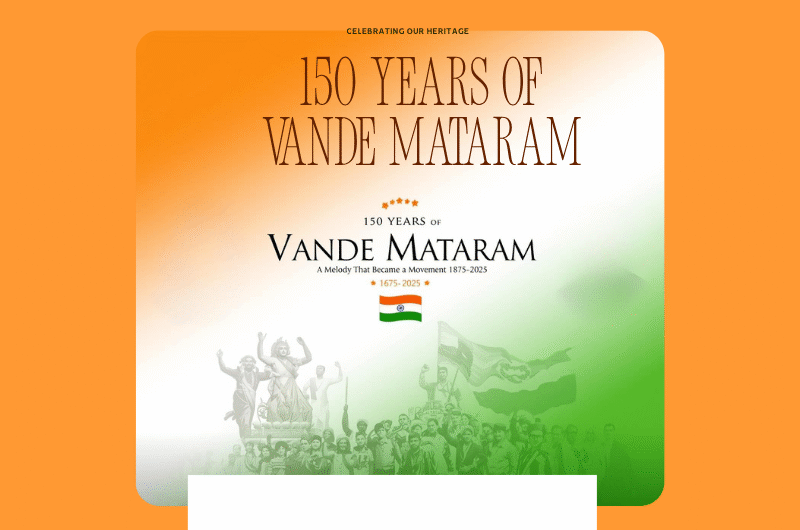
150 YEARS OF VANDE MATARAM
- INTRODUCTION
- 7 November 2025 marks the 150th anniversary of India’s National Song “Vande Mataram,” composed by Bankim Chandra Chatterjee.
- First published in *Bangadarshan* (1875) and later included in *Anandamath* (1882).
- Set to music by Rabindranath Tagore; symbolizes unity, devotion, and nationalism.
- HISTORICAL BACKGROUND
- First sung by Rabindranath Tagore at the 1896 Congress Session, Calcutta.
- Used as a political slogan on 7 August 1905 during the anti-partition movement.
- Inspired by Bengal’s awakening against colonial rule; mentioned by Sri Aurobindo (1907).
- Madam Bhikaji Cama’s 1907 tricolour in Stuttgart bore “Vande Mataram.”
- ANANDAMATH AND THE RELIGION OF PATRIOTISM
- Novel’s monks (Santanas) worshipped the motherland as a goddess in three forms: past glory, present suffering, future resurgence.
- Represented spiritual patriotism — devotion to the motherland as divine duty.
- BANKIM CHANDRA CHATTERJEE (1838–1894)
- Pioneer of modern Bengali prose and nationalism.
- Key works: *Anandamath*, *Durgeshnandini*, *Kapalkundala*, *Devi Chaudhurani*.
- Through “Vande Mataram,” he envisioned the motherland as sacred and invincible.
- SONG OF RESISTANCE
- 1905–08: British bans on singing Vande Mataram in schools and public gatherings.
- Processions (Barisal, Calcutta, Rangpur, Tuticorin, Belgaum) defied prohibitions.
- Bipin Chandra Pal & Aurobindo’s *Bande Mataram* newspaper (1906) spread nationalism.
- Became the anthem of Swadeshi, uniting all communities under one cause.
- GLOBAL IMPACT
- 1907: Tricolour with “Vande Mataram” raised abroad by Bhikaji Cama.
- 1909: Madan Lal Dhingra’s last words — “Bande Mataram.”
- Indian patriots in Europe published *Bande Mataram* (Geneva).
- NATIONAL STATUS
- Constituent Assembly (24 Jan 1950): Dr. Rajendra Prasad declared “Vande Mataram” to be honoured equally with “Jana Gana Mana.”
- Both symbolize India’s cultural and political unity.
- 150-YEAR COMMEMORATION (2025)
- National inaugural event in Delhi (Indira Gandhi Stadium).
- Release of commemorative stamp & coin.
- Cultural programs, exhibitions, global music festival, and “Vande Mataram – Salute to Mother Earth” plantation drive.
- Campaigns linked with “Har Ghar Tiranga.”
- CONCLUSION
- “Vande Mataram” remains a timeless emblem of India’s freedom struggle and cultural pride.
- It represents the synthesis of spirituality and nationalism — the soul of India’s collective identity.
MCQ
Q1. Consider the following statements regarding *Vande Mataram*:
- It was first published in the 1882 edition of *Anandamath*.
- Its earliest musical composition was by Rabindranath Tagore.
- It was first publicly sung at the Calcutta Congress Session of 1896.
How many of the above statements are correct?
(a) Only one
(b) Only two
(c) All three
(d) None
Q2. The term “Religion of Patriotism,” associated with *Vande Mataram*, refers to:
(a) The blending of devotional worship with political awakening.
(b) The replacement of religious rituals by national service.
(c) The rejection of foreign faiths in favour of Vedic traditions.
(d) A sect founded by Bankim Chandra to revive Hinduism.
Q3. Which of the following correctly matches the year with the related event of *Vande Mataram*?
- 1905 – Used as slogan during the Swadeshi Movement.
- 1906 – Launch of the newspaper *Bande Mataram*.
- 1907 – Tricolour flag with “Vande Mataram” raised in Stuttgart.
Select the correct code:
(a) 1 and 2 only
(b) 2 and 3 only
(c) 1 and 3 only
(d) 1, 2 and 3
Q4. In the context of *Anandamath*, the three representations of the Mother Goddess signify:
(a) Past, Present, and Future of Indian civilisation.
(b) Knowledge, Power, and Wealth.
(c) Dharma, Artha, and Karma.
(d) Freedom, Faith, and Federation.
Q5. Which of the following best explains why “Vande Mataram” was controversial during colonial rule?
(a) It called for violent revolution.
(b) It was seen as invoking a religious image in nationalist politics.
(c) It was banned for being written in Bengali script.
(d) It criticised the British Crown by name.
Q6. With reference to the *Bande Mataram* daily (1906), consider the following:
- It was published from Lahore.
- Bipin Chandra Pal was its first editor.
- It later had Sri Aurobindo as co-editor.
Which of the statements given above is/are correct?
(a) 1 and 2 only
(b) 2 and 3 only
(c) 3 only
(d) 1 and 3 only
Q7. The earliest known ban on singing “Vande Mataram” in educational institutions was imposed by:
(a) Bengal Presidency Government
(b) Madras Presidency Government
(c) Government of Eastern Bengal and Assam
(d) Central Legislative Council
Q8. “The Mother of his vision held trenchant steel in her twice seventy million hands” — this quotation reflects:
(a) Sri Aurobindo’s interpretation of Vande Mataram as militant patriotism.
(b) Bankim’s description of divine motherhood in Durgeshnandini.
(c) Tagore’s critique of religious nationalism.
(d) Tilak’s call for Swaraj through Karma Yoga.
Q9. Which one of the following events did **not** feature the chanting of “Vande Mataram”?
(a) Tuticorin labour strike (1908)
(b) Tilak’s trial in Bombay (1908)
(c) Lahore protest against Rawalpindi arrests (1907)
(d) Quit India Movement rally in 1942
Q10. In 1950, while conferring national status to “Vande Mataram,” Dr. Rajendra Prasad’s statement implied that:
(a) It would be sung as an alternate National Anthem on official occasions.
(b) It holds equal honour but is distinct from the National Anthem.
(c) Its use would be restricted to cultural events only.
(d) It would replace Jana Gana Mana after independence celebrations.
Q11. With reference to *Vande Mataram* in India’s national identity, consider the following:
- It appears in the Constitution’s Eighth Schedule.
- It was adopted by the Constituent Assembly without debate.
- It was set to tune originally by Rabindranath Tagore.
How many of the statements given above are correct?
(a) One only
(b) Two only
(c) All three
(d) None
Q12. During the 150-year commemoration (2025), which of the following initiatives directly link cultural revival with environmental awareness?
(a) “Vande Mataram: Salute to Mother Earth” plantation drive
(b) Global Music Festival on Indian soil
(c) Release of commemorative coin and stamp
(d) Murals on national highways
Q13. The phrase “Mother, I bow to thee” in *Vande Mataram* symbolically denotes:
(a) Territorial nationalism rooted in devotion to land.
(b) Ethnic unity among linguistic groups.
(c) Political allegiance to the Indian National Congress.
(d) Resistance to Western education.
Q14. The first publication of *Vande Mataram* (1875) is corroborated by a 1907 article by:
(a) Bipin Chandra Pal
(b) Sri Aurobindo
(c) Rabindranath Tagore
(d) Bal Gangadhar Tilak
Q15. Which of the following accurately captures the essence of *Vande Mataram* ?
(a) A song of devotion that transcended its literary origin to become a political manifesto.
(b) A purely religious hymn confined to Bengal’s cultural renaissance.
(c) A literary satire on British administrative corruption.
(d) A classical poem symbolising divine femininity only.




0 comment