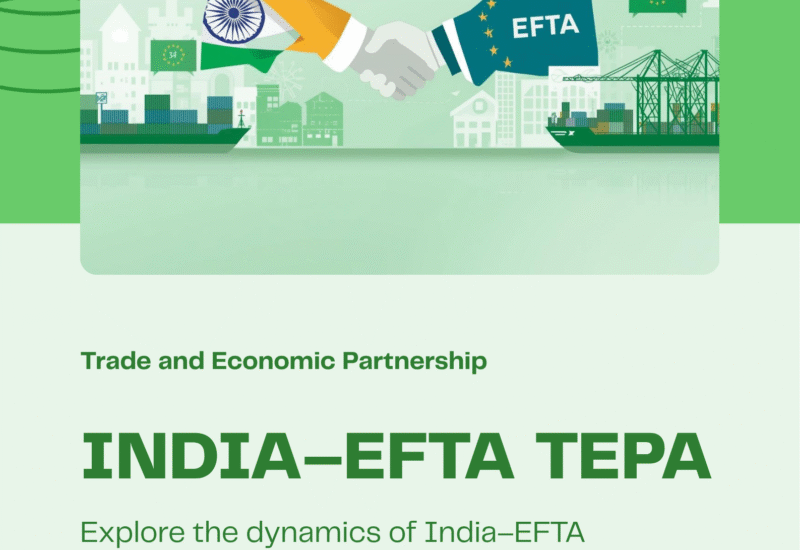
INDIA–EFTA TRADE AND ECONOMIC PARTNERSHIP AGREEMENT (TEPA)
- INTRODUCTION
– The India–EFTA TEPA came into effect on 1 October 2025, signed on 10 March 2024 in New Delhi.
– It is India’s first Free Trade Agreement with four developed European nations — Switzerland, Norway, Iceland, and Liechtenstein.
– First FTA to include binding commitments on investment and job creation: USD 100 billion investment and 1 million direct jobs over 15 years.
– Aligns India’s Atmanirbhar Bharat vision with EFTA’s pursuit of diversified, resilient partnerships.
- ABOUT EFTA
– European Free Trade Association (EFTA) established in 1960.
– Members: Iceland, Liechtenstein, Norway, Switzerland.
– Promotes free trade and economic integration among non-EU European economies.
- KEY FEATURES OF TEPA
(a) Investment and Employment
– USD 50 billion FDI in the first 10 years + USD 50 billion in next 5 years (Article 7.1).
– One million direct jobs expected.
– Focus areas: manufacturing, innovation, renewable energy, life sciences, digital transformation.
– India–EFTA Investment Desk operational since February 2025.
(b) Market Access
– EFTA: 92.2% of tariff lines (99.6% of India’s exports).
– India: 82.7% of tariff lines (95.3% of EFTA exports).
– Sensitive sectors excluded: dairy, soya, coal, pharma, medical devices.
– Gold imports (80% of total from EFTA) – no duty change.
– Tariff reduction phased for Make in India and PLI sectors (5–10 years).
(c) Services and Mobility
– India made commitments in 105 sub-sectors; EFTA in 110–128.
– Covers IT, business, cultural, education, and professional services.
– Includes MRAs in nursing, chartered accountancy, and architecture.
– Market access modes:
Mode 1 – Digital delivery of services
Mode 3 – Commercial presence
Mode 4 – Temporary movement of professionals
(d) Intellectual Property Rights (IPR)
– Based on TRIPS principles with flexibility for generics and public health.
– Protects innovation while preventing patent evergreening.
– Enhances mutual trust between India and innovation hubs like Switzerland.
(e) Sustainable Development
– Promotes inclusive growth, transparency, simplification, and environmental protection.
– Contains a separate chapter on Trade and Sustainable Development (TSD).
- SECTORAL AND COUNTRY-WISE GAINS
(a) Agriculture and Allied Goods
– Exports: guar gum, basmati rice, pulses, fruits, grapes.
– Tariff benefits mainly in Switzerland and Norway (covering 99% of India’s agri-trade with EFTA).
Switzerland – Tariff removal on food, grapes, nuts, vegetables.
Norway – Duty-free access for rice, condiments, beverages.
Iceland – MFN tariffs on processed foods and confectionery cut to zero.
(b) Marine Products
– Norway: Up to 13.16% duty removed on fish and shrimp feed.
– Iceland: Up to 10% tariff eliminated on frozen seafood.
– Switzerland: Zero duty on fish oils.
(c) Industrial and Manufacturing
– Engineering exports: USD 315 million in FY 2024–25 (18% growth).
– Gains for electric machinery, energy systems, and precision engineering.
– Textiles, leather, sports goods, and toys gain from zero-duty access.
– Gems and jewellery receive stable duty-free access.
(d) Electronics and Software
– Focus: medical electronics, smart sensors, fintech, EV components, energy monitoring systems.
– Expands scope for MSMEs and OEMs to integrate with European markets.
(e) Chemicals, Plastics and Allied Products
– Zero or reduced tariffs on 95% of exports.
– Export growth expected from USD 49 million to USD 65–70 million.
– Enables diversification into high-value European markets.
- STRATEGIC AND POLICY SIGNIFICANCE
– First FTA with a developed European bloc.
– Strengthens India’s credibility in global trade negotiations.
– Balances domestic protection with export competitiveness.
– Advances Make in India, PLI, and Atmanirbhar Bharat objectives.
– Encourages technology transfer, innovation partnerships, and green trade.
- QUANTITATIVE SNAPSHOT
| Parameter | Value / Commitment |
| Signed On | 10 March 2024 |
| Came into Force | 1 October 2025 |
| Investment Commitment | $100 billion (15 years) |
| Job Creation Target | 1 million direct jobs |
| EFTA Tariff Coverage | 92.2% of lines (99.6% of India’s exports) |
| India Tariff Coverage | 82.7% of lines (95.3% of EFTA exports) |
| Sensitive Sectors | Dairy, coal, soya, select agri goods |
| Key Provisions | IPR, MRAs, Sustainable Development, Services Access |
- SIGNIFICANCE
TEPA marks a shift in India’s trade strategy from tariff liberalization to comprehensive economic partnerships driven by investment, employment, and sustainability. It establishes India as a trusted partner in rule-based trade, integrating domestic priorities with global economic opportunities.
MCQ
Q1. With reference to the India–EFTA Trade and Economic Partnership Agreement (TEPA), consider the following statements:
- It is India’s first Free Trade Agreement with four developed European countries.
- It includes legally binding investment commitments for the first time in any Indian FTA.
- The agreement came into force in March 2024.
Which of the statements given above is/are correct?
(a) 1 and 2 only
(b) 2 and 3 only
(c) 1 and 3 only
(d) 1, 2 and 3
Q2. The European Free Trade Association (EFTA) comprises which of the following countries?
- Iceland
- Norway
- Finland
- Switzerland
- Liechtenstein
Select the correct answer using the code given below:
(a) 1, 2, 4 and 5 only
(b) 1, 3, 4 and 5 only
(c) 2, 3 and 4 only
(d) 1, 2, 3, 4 and 5
Q3. Under the TEPA, India has committed to cover approximately what percentage of tariff lines for EFTA exports?
(a) 72%
(b) 82.7%
(c) 89.4%
(d) 92.2%
Q4. Which of the following sectors were kept under the ‘sensitive’ category and excluded from tariff liberalisation under TEPA?
(a) Dairy and coal
(b) Automobiles and petroleum
(c) Electronics and software
(d) Renewable energy and mining
Q5. Consider the following pairs:
Mode of Service Delivery — Description
- Mode 1 — Commercial presence in foreign country
- Mode 3 — Digital delivery of services
- Mode 4 — Temporary movement of professionals
Which of the pairs given above is/are correctly matched?
(a) 1 and 3 only
(b) 2 and 3 only
(c) 3 only
(d) None
Q6. The TEPA’s Intellectual Property Rights (IPR) chapter is notable because it:
(a) Compels India to adopt European patent laws entirely.
(b) Protects innovation while allowing flexibility for generics and public health.
(c) Eliminates India’s pharmaceutical patent exemptions.
(d) Introduces data exclusivity for 25 years.
Q7. In the context of TEPA, the “Trade and Sustainable Development” (TSD) chapter focuses primarily on:
(a) Expanding military and defence trade.
(b) Promoting inclusive growth, transparency, and environmental protection.
(c) Ensuring free movement of capital only.
(d) Removing all labour laws to attract FDI.
Q8. Which of the following statements best describes the investment commitment under TEPA?
(a) $100 billion investment over 10 years with no job targets.
(b) $100 billion investment over 15 years creating one million direct jobs.
(c) $50 billion investment in five years with 500,000 jobs.
(d) Unlimited investment with no time frame.
Q9. The India–EFTA Investment Desk, established to facilitate implementation of TEPA, became operational in:
(a) March 2024
(b) October 2024
(c) February 2025
(d) October 2025
Q10. Under the TEPA, the majority of India’s exports to EFTA already enjoy tariff elimination up to:
(a) 72%
(b) 85%
(c) 95.3%
(d) 99.6%
Q11. Which of the following agricultural products are expected to gain the most under TEPA?
- Guar gum
- Basmati rice
- Pulses and fruits
- Soybean and wheat
Select the correct answer using the code below:
(a) 1, 2 and 3 only
(b) 2 and 4 only
(c) 1 and 4 only
(d) 1, 2, 3 and 4
Q12. Which EFTA member is a major importer of Indian rice, condiments, and beverages as per TEPA gains?
(a) Switzerland
(b) Iceland
(c) Norway
(d) Liechtenstein
Q13. Consider the following statements regarding TEPA’s industrial benefits:
- Engineering exports from India grew by over 15% in FY 2024–25.
- Gems and jewellery receive stable duty-free access.
- Textiles and leather are excluded from tariff benefits.
Which of the statements given above is/are correct?
(a) 1 and 2 only
(b) 2 and 3 only
(c) 1 and 3 only
(d) 1, 2 and 3
Q14. Which of the following sectors is explicitly identified under TEPA for cooperation in innovation and high-technology manufacturing?
(a) Life sciences and renewable energy
(b) Arms and ammunition
(c) Mining and steel
(d) Telecom spectrum trade
Q15. TEPA represents a strategic evolution in India’s FTA approach because it:
(a) Prioritizes only tariff reduction and trade surplus.
(b) Shifts focus toward investment, employment, and sustainability.
(c) Limits technology transfer to domestic PSUs.
(d) Excludes any provisions on services or IPR.




0 comment