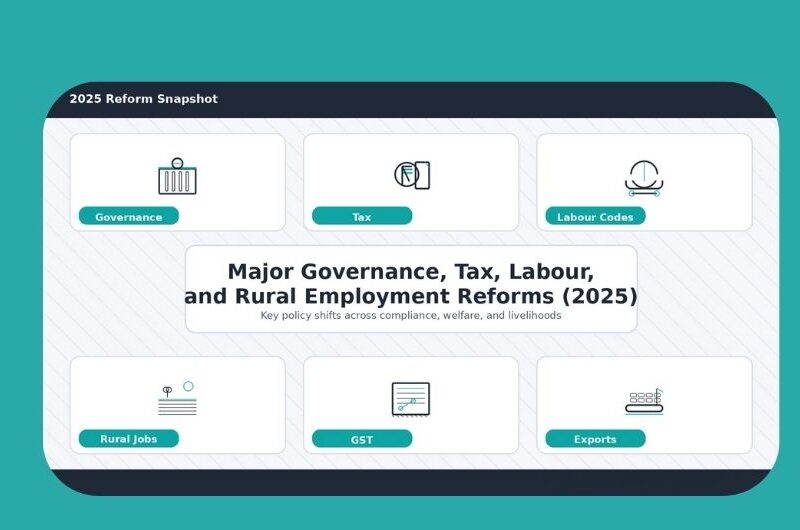
Major Governance, Tax, Labour, and Rural Employment Reforms (2025)
Key Takeaways
2025 Economic reforms focused on outcome-driven governance, simplifying systems, and boosting growth, inclusivity, and ease of doing business.
Labour reforms unified 29 laws under four Labour Codes, extending social security and workplace safety.
Next-Gen GST simplified taxation, expanded the taxpayer base to 1.5 crore.
The Export Promotion Mission (₹25,060 crore) strengthens MSME and first-time exporter support with finance, compliance, and market access.
Rural employment reforms provide 125 days of guaranteed paid work.
1. 2025 reforms shifted governance from expanding regulations to measurable outcomes, simplifying systems, lowering compliance burdens, and improving predictability for citizens and businesses nationwide overall.
2.Union Budget 2025–26 exempted annual income up to ₹12 lakh under the new regime; salaried taxpayers effectively reach ₹12.75 lakh after standard deduction benefit.
3.Income Tax Act, 2025 overhauled the 1961 law, simplifying language, removing obsolete provisions, and restructuring sections, while keeping tax rates unchanged, to cut litigation.
4.A unified Tax Year, the financial year beginning 1 April, replaced Assessment Year and Previous Year concepts, improving clarity and reducing compliance disputes materially.
5.Twenty-nine labour laws were consolidated into four codes covering wages, industrial relations, social security, and occupational safety, health, and working conditions into one framework.
6.The codes expand wage security, social protection, and workplace safety for women, migrant, unorganized, gig, and platform workers, supporting inclusive formalisation for broader coverage.
7.Nearly ten million gig and platform workers receive annual social security support, alongside improved leave provisions, maternity benefits, and strengthened workplace safety each year.
8.Viksit Bharat Guarantee for Rozgar and Ajeevika Mission (Gramin) Act, 2025 replaced MGNREGA, integrating employment with community development and livelihoods with stronger statutory accountability.
9.Rural households receive up to 125 days of guaranteed wage employment yearly, balancing labour availability for peak agricultural seasons with worker security and resilience.
10.Wages must be paid weekly or within fifteen days of completing work, reducing delays and reinforcing income stability for rural workers under legal timelines.
11.All works flow from Viksit Gram Panchayat Plans approved by Gram Sabha, digitally linked with PM Gati Shakti for cross-ministry convergence and district-level coordination.
12.Administrative expenditure ceiling increased from 6% to 9%, strengthening staffing, training, technical capacity, and field support to improve implementation outcomes at the field level.
13.Quality Control Orders were phased with MSME relaxations: extra time for micro and small units, exemptions for certain imports, and legacy stock clearance safely.
14.Next-generation GST aimed for a two-slab structure, expanded the taxpayer base beyond 1.5 crore, and achieved ₹22.08 lakh crore collections in FY2024–25 for stability.
15.Export Promotion Mission, outlay ₹25,060 crore for FY2025–26 to FY2030–31, unifies support with trade finance, compliance, logistics, branding, and market access for MSMEs nationwide.
MCQ:
1. With reference to the Union Budget 2025–26 provisions mentioned, which one is correct regarding the new regime exemption threshold?
A. ₹10 lakh, with no standard deduction relevance
B. ₹12 lakh, with salaried effective threshold ₹12.75 lakh after standard deduction
C. ₹12.75 lakh for all taxpayers regardless of salary status
D. ₹15 lakh, with standard deduction removed
2. Consider the following statements about the Income Tax Act, 2025:
I. It replaced the 1961 law with simplified language and a restructured layout.
II. It changed tax rates to align with the new regime exemption threshold.
III. It aimed to reduce litigation by removing obsolete provisions.
Which of the statements given above are correct?
A. I and II only
B. II and III only
C. I and III only
D. I, II and III
3. The “Tax Year” introduced refers to:
A. A calendar year beginning 1 January
B. A financial year beginning 1 April, replacing Assessment Year and Previous Year concepts
C. A half-yearly tax period for all taxpayers
D. A quarterly filing period for GST-linked income tax assessment
4. Twenty-nine labour laws were consolidated into four codes covering:
A. Wages; industrial relations; social security; occupational safety, health and working conditions
B. Wages; taxation; consumer protection; environmental standards
C. Industrial relations; competition law; social security; corporate governance
D. Social security; wages; agriculture marketing; workplace harassment
5. Which of the following worker groups are explicitly indicated as beneficiaries of expanded coverage under the labour codes?
A. Only government employees and retirees
B. Women, migrant, unorganized, gig, and platform workers
C. Only organized sector industrial workers
D. Only small traders and MSME owners
6. Consider the following statements about annual social security support mentioned:
I. It covers nearly ten million gig and platform workers annually.
II. It is coupled with improved leave provisions and maternity benefits.
Which of the statements given above are correct?
A. I only
B. II only
C. Both I and II
D. Neither I nor II
7. The Viksit Bharat Guarantee for Rozgar and Ajeevika Mission (Gramin) Act, 2025 is described as:
A. A minor amendment within MGNREGA retaining its original statutory framework
B. A replacement of MGNREGA integrating employment with community development and livelihoods
C. A scheme limited to urban employment and apprenticeships
D. A purely cash-transfer programme without work creation
8. Under the rural wage employment guarantee described, a rural household is entitled to:
A. Up to 100 days of guaranteed wage employment yearly
B. Up to 125 days of guaranteed wage employment yearly
C. Up to 150 days of guaranteed wage employment yearly
D. Up to 200 days of guaranteed wage employment yearly
9. Consider the following statements about wage payment timelines under the described rural employment framework:
I. Wages must be paid weekly, or within fifteen days of completing work.
II. Wages can be deferred up to thirty days if administrative expenditure exceeds the ceiling.
Which of the statements given above are correct?
A. I only
B. II only
C. Both I and II
D. Neither I nor II
10. All works under the described rural employment framework are to be derived from:
A. State secretariat directives only, without local approvals
B. Viksit Gram Panchayat Plans approved by Gram Sabha
C. District collector’s discretionary list of works
D. Private contractor proposals approved by line departments
11. The digital linkage for convergence mentioned connects local plans with:
A. National Monetisation Pipeline
B. PM Gati Shakti
C. Direct Benefit Transfer platform only
D. National Food Security portal
12. The administrative expenditure ceiling for the rural programme was revised from:
A. 4% to 6%
B. 6% to 9%
C. 9% to 12%
D. 10% to 15%
13. With reference to the Quality Control Orders (QCOs) approach described, which one is correct?
A. Immediate blanket enforcement without any MSME-specific provisions
B. Phased implementation with MSME relaxations including extra time and specified exemptions
C. Permanent exemption for all imports irrespective of category
D. Total withdrawal of product standards to ease compliance
14. Consider the following statements about next-generation GST as described:
I. It aimed for a two-slab structure.
II. It sought to expand the taxpayer base beyond 1.5 crore.
III. It recorded ₹22.08 lakh crore collections in FY2024–25.
Which of the statements given above are correct?
A. I and II only
B. II and III only
C. I and III only
D. I, II and III
15. The Export Promotion Mission described is associated with:
A. Outlay ₹25,060 crore for FY2025–26 to FY2030–31, unifying support including trade finance, compliance, logistics, branding, and market access for MSMEs
B. Outlay ₹2,506 crore for FY2024–25 only, limited to tariff refunds
C. Outlay ₹50,260 crore for FY2025–26 only, limited to port infrastructure
D. Outlay ₹25,060 crore for FY2026–27 to FY2028–29, limited to marketing campaigns



0 comment